HUB 04 · Immersion Blenders
How to Choose an Immersion Blender
Six checks, in the order they matter. Shaft length against the pot you actually own comes first, wattage comes last, and the gap between a good stick blender and a bad one is almost never the motor.
We earn a commission if you buy through our links. It does not change the price you pay, and it does not decide our picks — our selection criteria are published in full. How this works.
Measure the deepest pot you own before you shop. That single check disqualifies more stick blenders than every other criterion put together, and it is the one nobody does. After that: does the bell vent, does the shaft detach, is the speed genuinely variable, what does the warranty document actually say, and only then how many watts.
1. Shaft length, against the pot you actually own
A stick blender works submerged. If the shaft is too short for your stockpot, you either blend in batches in a smaller vessel — which defeats the point of owning one — or you tilt the pot and put your knuckles where the steam is. That second option is how people get burned, and it is entirely a purchasing mistake rather than a technique one.
Take a tape measure to the pot you make soup in, from the base to the rim. You want the blending head fully covered with the motor housing still comfortably clear of the rim. Manufacturers are inconsistent about publishing shaft length, so where it is not stated, treat that as a reason to prefer a model where it is.
2. Whether the bell vents
The bell is the guard around the blade. Push a flat-rimmed bell against the base of a pan and it forms a seal: the blade spins, nothing circulates, and the machine tries to lift the pan. This is the single most irritating failure mode in the category and it is a design problem, not a power one.
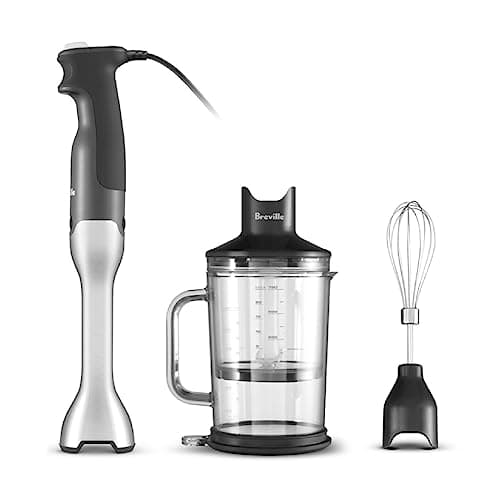
Some makers engineer it out. Breville’s Control Grip has a vented bell designed specifically to stop suction lock, and it is the clearest example of a manufacturer fixing the thing owners actually complain about. Where a maker does not mention it, look at the bell shape in the product photography: relief cut into the rim is what you want.
3. Whether the shaft detaches, and what it is made of
The motor housing must never go in water. If the blending shaft detaches, you can rinse or dishwasher the part that touched food and keep the electrical part dry, which is both safer and faster. A one-piece stick means wiping around a live component over a sink, forever.
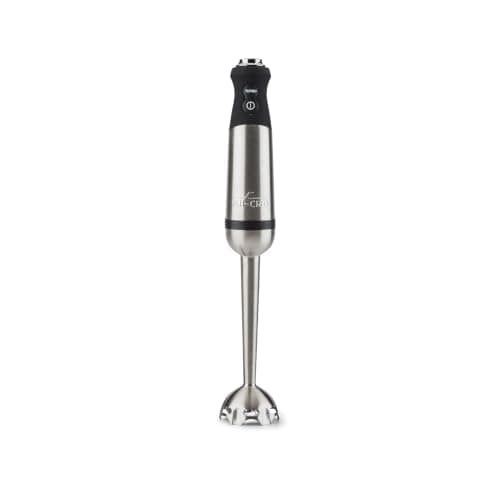
Metal shafts tolerate heat and staining better than plastic. Turmeric, tomato and curry will mark a plastic shaft permanently; stainless steel will not. All-Clad’s all-metal construction is the argument in its favor, and it is a real one for anyone who cooks with color.
4. Variable speed, and where the control sits
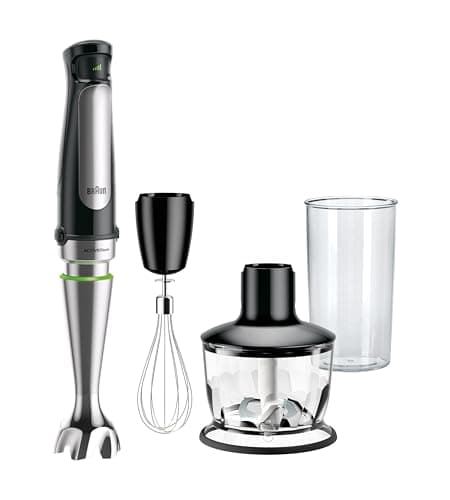
A stick blender is held over a hot pan with one hand. The speed control should therefore fall under the hand already holding it — not on the far side of the body, not requiring a second hand. Braun’s MultiQuick 7 responds to grip pressure, so you modulate mid-blend without reaching for anything. Breville puts a trigger and a dial under the same hand.
Genuinely variable beats a set of steps, for the same reason it does on a countertop machine: you want to start slow so hot liquid does not climb the pan, then bring it up. A turbo button is useful as an override, not as a substitute.
5. What the warranty document says — not the product page
This is where the biggest differences hide, and they are much larger than the differences in performance. Across the three machines we track, cover ranges from one year to three for broadly comparable tools at broadly comparable prices.
Two traps worth knowing. Braun’s printed manual guarantee is marked “For UK Only” at two years while the US term is three, which is confusing on the box — the US figure comes from Braun’s own knowledge base. And All-Clad’s warranty applies only to purchases from authorized sellers, so a marketplace bargain may be an uncovered machine. We tabulate the whole category in blender warranties compared.
| Machine | Published motor | In the box | Warranty | Cost / year |
|---|---|---|---|---|
| Braun MultiQuick 7 MQ7035X | 500 W input power | 500 ml chopper, whisk | 3 years (US) | $1.67 |
| Breville Control Grip BSB510XL | 280 W, no qualifier | 42 oz jug, 25 oz chopper | 1 year limited | $0.94 |
| All-Clad stainless steel immersion blender | 600 W, no qualifier | Listed piece count is one | 2 years, parts and labor | $2.01 |
6. Wattage, last
The three machines above span 280 to 600 published watts, and every one of them purées soup without complaint, because cooked vegetables in stock are an easy load. Wattage starts to matter only at the dense end — a pan of root vegetables with little liquid, where 600 W does show an advantage over 280.
What wattage will never buy you is capability a stick blender does not have. No hand blender crushes ice, makes nut butter, or blends a frozen load, whatever number is on the box. If that is what you need, you are shopping in the countertop hub, not this one. Note also that brands publish this figure inconsistently: Braun states input power, which is what the motor actually draws, while others give a bare number with no qualifier. The full explanation is in blender wattage explained.
The two-minute version.Measure your deepest pot. Prefer a vented bell and a detachable metal shaft. Put the speed control under your gripping hand. Read the warranty document rather than the product page. Then, and only then, compare watts — and expect the difference to be small.
What the attachments are actually for
The chopper bowl is a small food processor and the most useful thing in the box: onions, herbs, nuts, breadcrumbs. It is wide and low, which is the geometry chopping needs and the geometry a blender jar cannot have. Fuller explanation in immersion blender attachments explained.
The whisk handles cream, egg whites and lump-free sauces. It is the attachment most people never fit and then discover they wanted.
The beakeris a tall, narrow vessel that keeps splatter in and forces ingredients back onto the blade. For mayonnaise and vinaigrette it is not optional — the emulsion depends on the narrow column.
Where to go next
If soup is the main job, the soup ranking applies these checks directly. If you also want chopping, see immersion blenders with a chopper. And if you are not yet sure a stick blender is the right form factor at all, blender vs immersion blender settles it in a table.
The hardware
The hardware this guide is about
The products this guide refers to, with prices pulled live from Amazon and dated on every card. Full rankings live in the roundups linked above.
Soup, most weeks
Braun MultiQuick 7 MQ7035X
Three years of US warranty on a hand blender — triple what most rivals offer — and Braun publishes an input-power figure rather than a peak number.
Not fighting the pan
Breville Control Grip BSB510XL
The bell has a vent designed to stop it suction-locking to the pan — the single most common complaint about stick blenders, engineered out. One year of warranty, though.
Power in a stick
All-Clad stainless steel immersion blender
600 watts and a two-year warranty covering parts and labor, in a body built like the pans. Priced like a premium tool and specified like one.
#ad · As an Amazon Associate we earn from qualifying purchases.
Questions
Frequently asked
How do I choose an immersion blender?
Start with shaft length against the deepest pot you own — the head must be fully submerged with the motor clear of the rim. Then check that the bell vents rather than suction-locking, that the shaft detaches for washing, and that the speed control sits under your gripping hand. Compare wattage last.
How many watts should an immersion blender have?
Anything from about 280 W upward purées soup perfectly well. Higher figures — 500 to 600 W — help on dense, low-liquid loads like a pan of root vegetables. No wattage makes a stick blender able to crush ice or make nut butter.
Is a metal or plastic shaft better?
Metal, for heat tolerance and staining. Turmeric, tomato and curry mark a plastic shaft permanently and stainless steel shrugs them off. Plastic is lighter and cheaper, which is a fair trade if you mostly make pale soups.
Do I need the chopper and whisk attachments?
The chopper is the most useful thing in the box — a small food processor with the right wide, low bowl shape for onions, herbs and nuts. The whisk is the one people never fit and then find they wanted. Neither is essential, but a set costs little more than a bare stick.
Keep reading
Related
- Immersion and hand blendersThe hub, with every stick blender we cover.
- Best immersion blenders for soupThese checks applied to the job most people buy one for.
- Immersion blender attachments explainedWhat the chopper, whisk and beaker are each genuinely for.
- Blender vs immersion blenderWhether this is the right form factor for you at all.
- Best blenders for baby foodSmall-batch pureeing, where a stick blender is often the right tool.
Receipts
Sources
- Braun Household — MultiQuick 7 MQ7035X product page
- Braun Household US — warranty length by product type (article 25832)
- Breville — Control Grip BSB510XL product page and specification fields
- All-Clad — stainless steel immersion blender product page
- All-Clad — small electric appliance warranty (PDF)
- US EIA, Electric Power Monthly — average residential price, US total
We do not run a testing lab and we do not pretend to. Specifications come from the manufacturer's own published documents and from published standards; prices come from the live Amazon API. Where a figure is not published, the page says “not published” rather than guessing. Read the full method.