HUB 04 · Immersion Blenders
Immersion blender vs hand mixer
They look like the same shape of tool and they do opposite things. The short version: blades break structure down, beaters build it up, and neither substitutes for the other.
We earn a commission if you buy through our links. It does not change the price you pay, and it does not decide our picks — our selection criteria are published in full. How this works.
They are not substitutes. An immersion blender spins a small blade at high speed to shear solids apart and force fat and water into an emulsion. A hand mixer turns two beaters slowly to fold air into a mixture. One breaks structure down, the other builds it up. If you make soup you need the blender; if you make cake you need the mixer; owning the wrong one for the job is not something technique can fix.
The mechanism, which is the whole answer
A stick blender’s blade sits inside a guard, close to the bottom of the pan, turning fast. It works by shear: it cuts particles progressively smaller and drags them past each other hard enough that droplets of oil break up and stay suspended in water. That second effect is emulsification, and it is why the same tool that purees soup also makes mayo in about thirty seconds while a whisk takes ten patient minutes.
A hand mixer’s beaters are open wire loops turning much more slowly through a much larger volume. They work by aeration: every pass drags air into the mixture and traps it in a protein or fat structure that then holds. Whipped cream, meringue and creamed butter are all the same trick — a network built around bubbles. Shear is the enemy of that structure, which is precisely why you cannot use the blender.
So the question is never “which is more powerful”. It is: does the job need something broken apart, or something filled with air?
Which tool for which job
| Job | Immersion blender | Hand mixer |
|---|---|---|
| Pureeing soup in the pan | Yes — this is the job it exists for | No. Beaters cannot break down cooked vegetables; they stir them |
| Mayo and vinaigrette | Yes — shear is what makes the emulsion hold | Slowly, and less reliably |
| Smoothies in a beaker | Yes, with soft or thawed fruit | No |
| Whipped cream, meringue | Only with a whisk attachment fitted, not with the blade | Yes — this is the job it exists for |
| Creaming butter and sugar | No — the blade cannot move a stiff mixture | Yes |
| Cake batter, cookie dough | No | Yes |
| Mashed potato | No — the blade turns it to glue | Cautiously, on low, for a few seconds |
| Ice, frozen fruit, nut butter | No | No |
The potato problem, explained properly
This is the single most common way people ruin dinner with an immersion blender, and it is worth understanding rather than just being told. Potato cells are packed with starch granules. Cooking swells them; gentle mashing ruptures some cells and releases some starch, which is what makes mash creamy. A high-speed blade ruptures nearly all of them at once and then keeps working the freed starch, which hydrates into a continuous elastic gel.
The result is not a texture you can rescue by adding butter — it is closer to wallpaper paste, and the transformation takes seconds. A ricer, a food mill or an ordinary masher is the right tool. A hand mixer on a low speed for a few seconds is survivable. A stick blender is not, and this is the one job where the more capable-sounding tool is categorically the wrong one.
Several manufacturers sell a dedicated masher attachment for exactly this reason — a perforated plate driven up and down rather than a spinning blade. None of the three machines covered on this site publishes one in the box, and the attachments guide goes through what each kit actually includes.
Why a mixer cannot puree
The reverse mistake is rarer but people try it: beating a pan of cooked vegetable soup with a hand mixer in the hope of smoothness. It does not work, and the reason is geometry rather than power. Wire beaters have no cutting edge and pass through liquid with very little shear; they will break up the softest lumps and leave everything else recognizable. What you get is aerated, slightly frothy soup with the texture unchanged, plus liquid flung around the kitchen — beaters were designed to work in a bowl of something thick, not a pan of something thin.
There is also a safety difference worth naming. An immersion blender is the safe way to blend hot liquid because there is no sealed vessel and therefore no steam pressure to build under a lid — the hazard that makes pouring boiling soup into a countertop jar a genuinely bad idea. A hand mixer over a hot pan gives you the splash risk with none of the benefit. The specifics are in the hot-liquid safety guide.
Why you cannot compare them on wattage
Both tools are sold with a watt figure on the box, and the two figures describe different mechanical problems. A stick blender’s motor spins one small blade very fast against the low resistance of liquid — a high-speed, low-torque job. A hand mixer’s motor turns two large beaters slowly through something stiff — a low-speed, higher-torque job. Neither rating predicts performance on the other’s work, and a bigger number on a blender tells you nothing at all about whipping cream.
The published figures for the two machines on this page make the point about scale. Braun publishes 500 watts of input power for the MultiQuick 7; Breville publishes 280 watts for the Control Grip. Both are ample for soup, because soup is already cooked soft. Neither number is a statement about aeration, and treating watts as a general measure of capability is the mistake that leads people to buy the wrong tool. The wattage explainer goes through why these ratings are not interchangeable even between two blenders, let alone between two different kinds of appliance.
Cleaning and storage, which decides which one you keep using
A stick blender detaches into a shaft you rinse under a tap, or drop into a jug of soapy water and pulse for a few seconds. The motor body never goes near water. A hand mixer has two beaters that come off and usually go in the dishwasher, and a body that also must not be immersed. On cleaning they are close to equal, and both are dramatically easier than a countertop blender’s jar, lid, gasket and blade assembly.
Storage is where they differ. A stick blender is a single column that fits a deep drawer; the attachments are what create the storage problem, not the machine. A mixer is bulkier but flatter. Neither claims counter space, and that is a genuine argument for owning both rather than compromising with one — over a year, the tool that is easy to reach for is the tool that gets used.
Where they genuinely overlap
One place: the whisk attachment. Most stick blenders, including the Braun MultiQuick 7, ship with a single wire whisk that clips on in place of the blade shaft. It will whip cream and egg whites for a small quantity — a couple of servings — and for many households that is enough to make a separate hand mixer unnecessary.
It is not equivalent, and it is worth being clear why. One whisk turning at a stick blender’s speed in a beaker is a smaller, faster, narrower action than two beaters moving through a mixing bowl. For four egg whites it is fine. For a batch of meringue, a double quantity of cream or anything stiff, the mixer wins on volume and on not stalling. If you bake regularly, the whisk attachment will not replace a mixer. If you bake twice a year, it probably will. And once the baking is regular enough that a hand mixer stalls too, the tool is a stand mixer — a category we do not cover, so stand mixer guides are the better place to work out which one.
Which one to buy first
If you cook savory food more than you bake, buy the immersion blender first. It has the wider range — soup, sauces, emulsions, baby food, smoothies from soft fruit — it is the safe tool for anything hot, and its whisk attachment covers the occasional bowl of cream. The two on this page are the ones worth looking at: Braun publishes 500 W of input power with a three-year US warranty, and Breville publishes 280 W with a bell vented against suction lock and one year of cover. Both are ranked properly in the soup roundup.
If you bake more than you cook, buy the hand mixer first and accept that soup will be chunky until you own both. And if you were hoping one purchase would cover ice, frozen fruit or nut butter, neither of these is that tool — a countertop blender is, and the buying guide works out from what you actually cook rather than from a price ladder.
The hardware
The hardware this guide is about
The products this guide refers to, with prices pulled live from Amazon. Prices last checked October 19, 2026. Where we have no verified live price we show none rather than a stale number. Full rankings live in the roundups linked above.
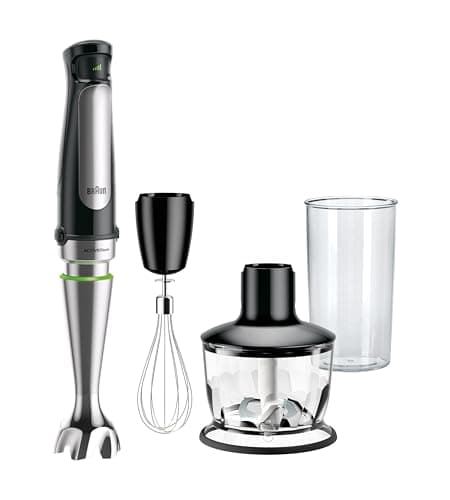
Soup, most weeks
Braun MultiQuick 7 MQ7035X
Three years of US warranty on a hand blender — triple what most rivals offer — and Braun publishes an input-power figure rather than a peak number.
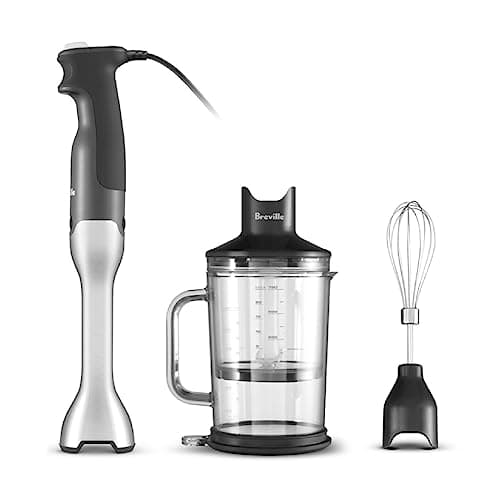
Not fighting the pan
Breville Control Grip BSB510XL
The bell has a vent designed to stop it suction-locking to the pan — the single most common complaint about stick blenders, engineered out. One year of warranty, though.
#ad · As an Amazon Associate we earn from qualifying purchases.
Questions
Frequently asked
Can I use a hand mixer instead of an immersion blender for soup?
Can an immersion blender whip cream?
Why does my immersion blender ruin mashed potato?
If I can only buy one, which should it be?
Keep reading
Related
- Best immersion blenders for soupThree stick blenders ranked on published warranty terms, motor figures and included vessels.
- Immersion blender attachments explainedWhat the whisk, chopper and masher are really worth, and what each kit actually publishes.
- Blender vs food processorThe other pair of tools people expect to substitute for each other, and why they do not.
- Best blenders for mashed potatoesThe load that separates these two tools most sharply.
Receipts
Sources
- Braun Household — MultiQuick 7 MQ7035X product page
- Braun Household US — warranty length by product type (article 25832)
- Breville — Control Grip BSB510XL product page and specification fields
We do not run a testing lab and we do not pretend to. Specifications come from the manufacturer's own published documents and from published standards; prices come from the live Amazon API. Where a figure is not published, the page says “not published” rather than guessing. Read the full method.