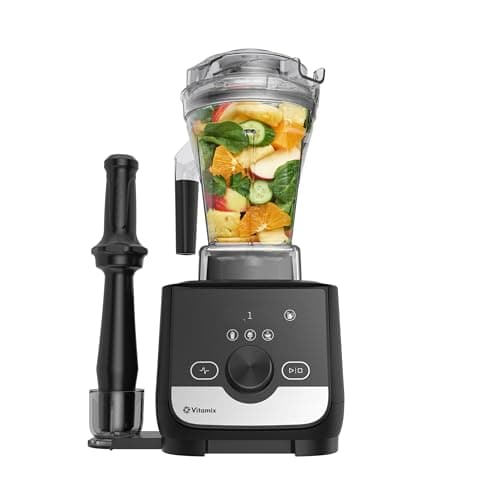
The case for the Vitamix Ascent X3 is three published facts: a ten-year full warranty that is transferable to a new owner, a tamper in the box, and a height of 17 incheswith the container on — which makes it the only full-size machine in this catalog that clears the standard 18-inch gap between a US worktop and the cabinet above it. The case against it is one number: the container is 48 ounces, a third smaller than the 64 oz jar on the 5200 and the VX1, and it costs more than either.
We have not blended anything in this machine.This review is assembled from Vitamix’s own Ascent X3 specification list, its in-box contents, and the 10-Year Full Warranty document the product page links to. Where Vitamix publishes nothing — a decibel figure, for instance — this page says so instead of estimating. That standard is set out on how we pick.
What Vitamix actually publishes
Every value from Vitamix’s Ascent X3 product page specification list and its 10-Year Full Warranty document, with the 5200 and VX1 columns from their own pages for context. | Ascent X3 | Vitamix VX1 | Vitamix 5200 |
|---|
| Published motor | 2.2 HP; 120V, 1500W | 2.2 HP; 1,440 W | 2 HP; 11.5 A, no watt figure |
|---|
| Container | 48 oz | 64 oz Classic | 64 oz Classic |
|---|
| Tamper in the box | Yes — S2 low-profile, plus a holder | Yes | Yes |
|---|
| Height with container | 17 in | 19.6 in | 20.5 in |
|---|
| Footprint | 9.75 in L × 7.75 in W; 13.6 lbs | Not published in this form | Not published in this form |
|---|
| Programs | 3 — Smoothies, Frozen Desserts, Soups — plus self-clean | None; self-clean on the dial | None |
|---|
| Controls | Variable speed, pulse, touch buttons, digital timer | Dial 1–10, pulse switch, count-up timer | Variable-speed dial, High/Variable switch |
|---|
| Container recognition | SELF-DETECT wireless — adjusts the program to the container fitted | No | No |
|---|
| Cord | 3.5 ft | 3.5 ft | 6 ft |
|---|
| Warranty | 10 years, full — transferable | 5 years, limited — original owner only | 7 years, full — transferable |
|---|
| Est. cost to run / year | $5.02 | $4.82 | $4.62 |
|---|
| Noise | Not published | Not published | Not published |
|---|
The running-cost column uses the site’s standard method — the published watt figure where there is one, 3 minutes a day, 365 days a year, at the EIA average residential rate retrieved September 2026. The spread across all three machines is under forty cents a year. Whatever decides this purchase, it is not electricity; the arithmetic is shown in full on how much a blender costs to run.
The ten-year warranty, read off the document
This is the headline, and it holds up when you read the terms rather than the number. Vitamix’s 10-Year Full Warranty document says that if the blender fails within ten years of purchase or delivery “due to a defect in material or workmanship or as a result of normal wear and tear from ordinary household use,” Vitamix will repair the failed blender or component part free of charge — and if repair is not possible, replace it or refund the purchase price. Vitamix pays standard shipping both ways. The cover extends to the motor base, the containers, the lids and the tampers bought together with it.
Two details are worth more than the extra three years over a 5200. The first is the phrase normal wear and tear, which is broader than a defects-only term and is the difference between “full” and “limited” in Vitamix’s own vocabulary — the distinction the VX1’s five-year limited term gives up. The second is transferability: ownership can be moved to a new owner by updating the registration on Vitamix’s site, so the balance of the term survives a resale. That is a real part of what the machine is worth in year six, and it is the same mechanism that makes the 5200 a good second-hand buy and the VX1 a poor one.
The term is household-use only — not commercial, not rental. And one footnote for the careful reader: on the day we checked, the X3 product page’s own specification list labels the cover “10 Year Standard Warranty,” while the document it links to is titled 10-Year Full Warranty and reads as a full warranty throughout. The document is what you would be claiming under and it is what we cite. The same inconsistency appears on the 5200’s page, which suggests a template rather than a trap. Every brand’s terms side by side are on blender warranties compared, and what a term implies about service life is on how long blenders last.
Seventeen inches: the spec that decides it for some kitchens
Standard US clearance between a worktop and the cabinet above it is 18 inches. Vitamix publishes 20.5 inches for the 5200 and 19.6 for the VX1, so neither lives under a cabinet with its jar on — you either store the container off the base or you give the machine an open stretch of counter. The X3 is published at 17 inches tall in a 9.75 × 7.75-inch footprint, which clears that gap with the container fitted.
If you have been putting off a full-size Vitamix because of where it would have to live, this is the specification that changes the answer, and it is the main practical reason to choose the X3 over a cheaper, larger-jarred Vitamix. Measure your own gap first — 18 inches is a convention, not a law, and plenty of kitchens run less. The broader version of this problem, across form factors and price brackets, is on best blenders for small kitchens.
The 48 oz container is the real trade
Height has a price, and this is it. Forty-eight ounces is 1.5 quarts of total capacity before you account for the headroom any blender needs, and it is the smallest jar on any full-size machine in this catalog. For one or two people it is the right size — a narrower jar actually blends a small batch better than a 64 oz one, because a tall wide jar needs a minimum volume before the vortex forms at all. For a family batch it means two passes.
That is the honest dividing line. If your normal load is two big smoothies, the X3’s jar is an advantage disguised as a limitation. If you make four at a time, or a pitcher of soup for a household, the 64 oz 5200 does it in one pass for less money, and the ranked answer for that job is on best blenders for family smoothies. Working out which capacity you actually need before you shop is on what size blender do I need.
The base accepts other Vitamix SELF-DETECT containers, so the capacity question is not permanently closed — but a second container is a real additional cost, and buying a machine on the assumption you will buy a bigger jar for it later is how people end up having paid premium-Vitamix money twice.
The tamper, and what it is actually for
The in-box list for the X3 is the motor base, the 48 oz container, an S2 low-profile tamper and a tamper holder. The tamper is the single feature that separates this class of machine from a Ninja or a NutriBullet, and it has nothing to do with power. A thick, low-liquid mixture — nut butter, a frozen dessert with no added liquid, a dense smoothie bowl — cavitates: the blade spins an air pocket and the food above it never moves. More watts do not fix that. A tool that pushes the mass down through the lid does.
So the X3 can do the loads the 1,200-watt Ninja BN701 cannot, and the 1500-watt figure on the spec list is not why. What the tamper unlocks is laid out on best blenders for nut butter and best blenders for smoothie bowls. The “low-profile” part matters too: it is cut for a 48 oz jar, so it reaches the blade without over-travel.
Programs, the timer and SELF-DETECT
Three programs — Smoothies, Frozen Desserts, Soups — plus variable speed, a pulse, touch buttons, a digital timer and a self-cleaning program. The programs ramp, hold and stop on their own, which is worth exactly as much as walking away from the counter is worth to you; the variable dial underneath them is what you will use for anything the three presets do not cover.
SELF-DETECT is the Ascent-line feature: the base reads wirelessly which container or attachment is fitted and adjusts program settings and blend speed for it. On a machine sold with one container this does nothing on day one. It earns its place later, if you add a second container — the machine does not need to be told, and a program written for a 64 oz jar does not run unchanged on a small one. Treat it as insurance on a future purchase rather than a feature you buy today.
The self-cleaning program is standard across the Ascent X series: warm water, a drop of dish soap, run it. Vitamix does not publish a dishwasher statement either way for the X3’s container on the product page — unlike the VX1, whose manual states twice that its container is not dishwasher-safe. We are not going to infer the X3’s answer from a different machine’s manual. If the dishwasher is a condition of purchase, check the manual in Vitamix’s manuals library for your exact model before buying, and read how to clean a blender for the method that works regardless.
What it is bad at
- Big batches. 48 oz is the smallest full-size jar here. Two passes for a family of four.
- Price. It is the most expensive machine in this catalog, above both other Vitamix machines, and the live number sits beside the pick above rather than in this sentence because it moves.
- Noise. Vitamix publishes no decibel figure for it. This class of machine is loud, and nothing on the spec sheet suggests this one is an exception. If quiet is the requirement, start at best quiet blenders.
- The cord.3.5 feet, same as the VX1 and shorter than the 5200’s 6 feet. It decides where on the counter the machine can live.
- Program count. Three is the fewest in the Ascent X line. The X4 and X5 add more on what appears to be the same panel hardware, so if presets are what you are buying, the X3 is the wrong rung.
Who should buy something else
Buy the 5200 instead if you want 64 ounces and the longest-standing Vitamix warranty for less money, and your counter has the headroom for a 20.5-inch machine. Seven years full and transferable is not ten, but it is a long way past every non-Vitamix term in the category; see the 5200 review.
Buy the VX1 insteadif you want the 64 oz jar and the tamper for the least Vitamix money and five years is a long enough horizon — accepting that the term is limited rather than full and does not survive a resale. The two are compared directly on VX1 vs 5200.
Buy a Ninja insteadif your honest use is drinkable smoothies with liquid added. A 1,200-watt machine with a 72 oz pitcher makes that smoothie indistinguishably well for a fraction of the money, and the thing it cannot do — thick, low-liquid work without a tamper — may be something you never ask of it. That argument in full is on Ninja vs Vitamix, and the brand-level version is on is a Vitamix worth it.
How to read any Ascent X specification list
Four lines on the page do the work, and three of the four are not the watt figure.
1. The warranty document, not the warranty number
“10 years” is not a term; it is a headline. Open the linked document and look for two things: whether it says full or limited, and whether normal wear and tear is covered or only defects in material and workmanship. The X3’s says full and covers wear. That is the difference between a warranty that replaces a motor that has simply worn out and one that argues about whether it was defective.
2. Height with the container on
Spec lists sometimes give base height, which is useless. You need the figure with the jar fitted, and you need your own worktop-to-cabinet gap measured rather than assumed. 17 inches against a measured 18 is a machine that lives where you use it; 20.5 inches is a machine you lift out.
3. Container size against your actual batch
Jar capacity is printed as total volume, and no blender fills to the brim. A 48 oz jar is two generous smoothies. A 64 oz jar is four. Decide which number you are before you decide which machine you want, because this is the one specification you cannot change later without buying hardware.
4. Whether a tamper is in the box
Not whether one exists for the model — whether it ships with it, and whether it is cut for the jar the machine comes with. The X3 ships an S2 low-profile tamper and a holder with a 48 oz container. A tamper is the capability; watts are the marketing.
The watt figure is last for a reason, and it is worth saying plainly: Vitamix publishes 1500 W for the X3 and nothing at all for the 5200, which does not mean the 5200 is weaker. Why these numbers are not comparable, even within one brand, is on blender wattage explained, and what the whole spread of prices in this category actually buys is on how much a blender costs.