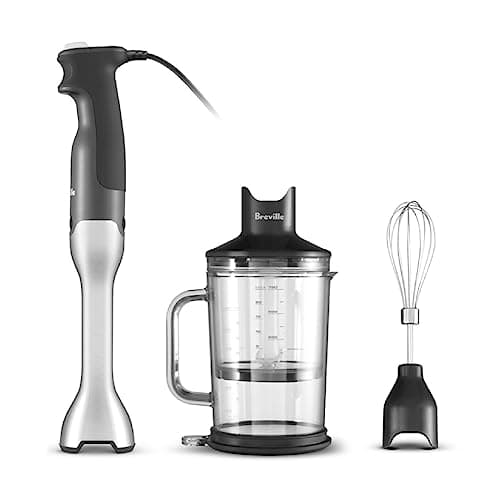
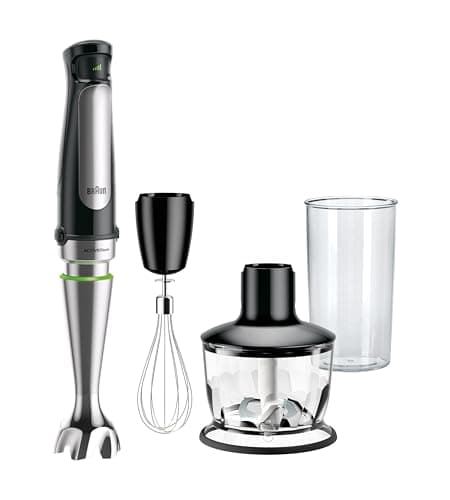
Buy the Braun MultiQuick 7if you make dressings, mayonnaise or pan sauces. A stick blender in a tall narrow container is the right shape for an emulsion in a way no pitcher is — the walls sit close to the blade, the whole batch is inside the working zone, and you can raise the stick slowly to pull oil down into it. Braun also backs it for three years, against one year on most machines costing more. If you want the same thing with a trigger and a vented bell that does not suction-lock to the pan, buy the Breville Control Grip. Buy a full-size jar machine for this job only if your sauces are large batches.
That ranking will look upside down against the rest of this site, where high-power pitcher machines win. The reason is simple: a vinaigrette is about a cup of liquid, and a cup of liquid in a 64 oz jar does not emulsify. It sits in a ring around the blade and spins.
Why an emulsion is a geometry problem
A dressing is oil and water forced into a mixture that does not want to exist. Making it work means breaking the oil into droplets small enough to stay suspended, and that only happens where the blade is — in a layer a few millimetres thick. Everything outside that layer is waiting its turn, and it only gets a turn if the vessel keeps pushing it back in.
A narrow vessel does that constantly. A wide one barely does it at all: oil, being lighter, floats to the top and stays there while the blade works the vinegar underneath it. This is why an immersion blender in a beaker outperforms a 1,500 W pitcher machine on a cup of mayonnaise, and why the pitcher machine wins the instant you scale to a quart. Power is not the variable. Clearance is.
The same logic appears elsewhere on this site in reverse. In hummus and salsa the load is thick and barely flows, so a tamper and a tall narrow jar win. In soup the volume is large and hot, so blending in the pan wins. Dressings are the small, thin, cold corner of the same map.
Two neighbouring small-batch jobs sit in that same corner, and are worth knowing about if either describes you. A smooth puree for a baby is about texture standards rather than emulsions, and is ranked at best blenders for baby food. A single protein shake is the easiest small-batch load there is, and best immersion blenders for protein shakes opens by saying a stick blender is the wrong buy if shakes are the only job.
Who each pick is for
- Braun MultiQuick 7 —for the person making dressings and pan sauces most weeks who wants three years of warranty and a 500 ml chopper and whisk in the box.
- Breville Control Grip — for the person who makes mayonnaise and hollandaise-style sauces by feel and wants a trigger they can feather rather than a speed button.
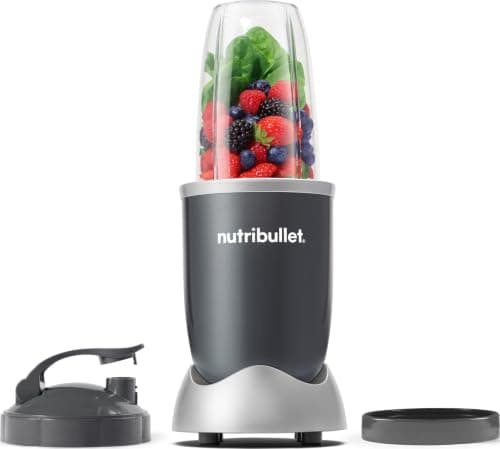
- NutriBullet 600 — for the person making a cup of pesto or a jar of dressing in a sealed cup, as cheaply as possible, with no stick to wash.
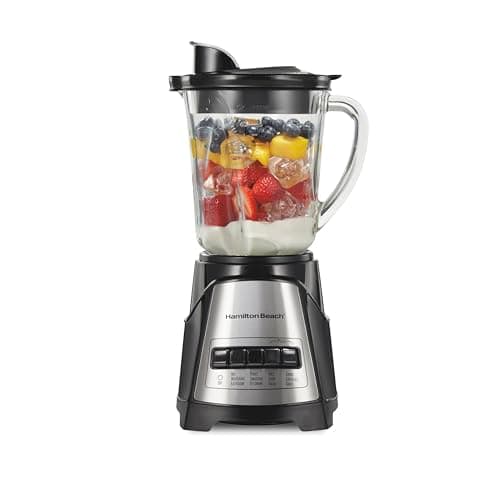
- Hamilton Beach Power Elite —for the person who wants a full-size jar but a glass one — because garlic, onion and chilli do not haunt glass the way they haunt plastic.
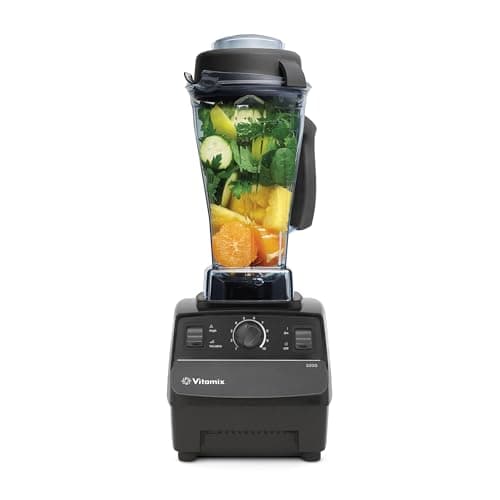
- Vitamix 5200 — for the person making sauces in quantity, or wanting a genuinely silky puree-style sauce, who has a fully variable dial to drizzle oil into.
The five, side by side
Manufacturer figures only, from the pages and manuals listed at the foot of this page. “Smallest workable batch” is our judgment from vessel geometry, not a manufacturer claim — it is reasoning we are showing you, not a measurement. | Published motor | Vessel | Smallest workable batch | Warranty |
|---|
| Braun MultiQuick 7 MQ7035X | 500 W | Stick; 500 ml chopper and whisk included; works in any narrow container you own | A few tablespoons | 3 years |
|---|
| Breville Control Grip BSB510XL | 280 W | Stick; 42 oz jug and 25 oz chopper; trigger plus speed dial | A few tablespoons | 1 year |
|---|
| NutriBullet 600 | 600 W | Sealed single-serve cup | About half a cup | 1 year |
|---|
| Hamilton Beach Power Elite Wave Action | 700 W peak; rating plate 3.7 A at 120 V (about 444 W) | 40 oz glass jar | About two cups | 3 years US; 5 years Canada |
|---|
| Vitamix 5200 | 2 HP; 11.5 A at 120 V. No watt figure published | 64 oz, tall and narrow | About three cups | 7 years, full |
|---|
The one thing nobody warns you about: odour
Sauces are where a blender jar earns its smell. Garlic, raw onion, chilli, anchovy, fish sauce, mustard — these are the ingredients that stay in a plastic container after it has been washed, and then turn up uninvited in a strawberry smoothie three days later. Glass does not do this. Neither does a stick blender you rinse under a tap in eight seconds.
It is the strongest practical argument for the Hamilton Beach on this list, which carries a 40 oz glass jar at the lowest price here, and it is a real reason to own a separate small vessel if your main machine is plastic. The full trade-off, including the ways glass is worse, is on glass vs plastic blender jars, and if a jar has already picked up a smell, how to clean a blender has the fix.
Technique, which matters more here than hardware
Mayonnaise, the immersion-blender way.Put the egg, the acid, the mustard and all the oil into a beaker barely wider than the blender’s bell. Lower the stick to the very bottom, start it, and leave it there until the base turns pale and thick. Then raise it slowly, a centimetre at a time, and the oil above gets drawn down into the emulsion as you go. A pitcher machine cannot do this because you cannot move its blade.
Vinaigrette.Blend everything except the oil first, then add the oil in a thin stream with the machine running. In a bullet cup you cannot do that at all — the cup is sealed — so put the oil in with everything else and run it longer; the mixture will hold for a meal but separate in the fridge, which is normal and not a fault.
Pesto and other pastes. These are not emulsions and they want the opposite handling: short pulses, scraping down, and no long run, because heat from the blade turns basil army-green and makes garlic bitter. Pulse is more useful than wattage.
Pan sauces.If the sauce is in a hot pan, take the pan off the heat and use a stick blender in it. Pouring a near-boiling sauce into a sealed bullet cup is the one genuinely risky thing on this page — a sealed container with hot liquid in it can force its lid off. See blending hot liquids safely.
What we do not claim
We have not made mayonnaise in any of these machines, and we publish no emulsion-stability figure, hold-time, or taste result for any of them, because no manufacturer publishes those and we have no test kitchen. This ranking is built from published motor ratings, vessel geometry, control type and warranty documents, plus plainly stated reasoning about how an emulsion forms. Where a cell in the table above is our judgment rather than a manufacturer figure, the caption says so. The whole method is published.
Buying for sauces: four checks
1. How narrow is the vessel at the blade?
The only measurement that matters for an emulsion. A beaker that is barely wider than the blade keeps the whole batch in the working zone; a 64 oz jar does not. If the machine you are considering has one large jar and nothing smaller, it will be poor at one-cup sauces no matter what its motor says.
2. Can you move the blade, or only the food?
This is the real advantage of a stick blender and it is rarely stated. Being able to raise and lower the blade through the mixture is what lets you build an emulsion from the bottom up. A pitcher machine can only wait for the food to come to the blade. For mayonnaise and mayonnaise-like sauces, that difference decides it.
3. Is the control continuous or stepped?
Drizzling oil into a running machine needs a speed you can hold steady and low. A trigger or a variable dial is better for this than two fixed buttons. It is also the difference between pesto and basil soup. Which machines have what is set out on the immersion blender buying guide.
4. Will the vessel hold the smell?
Covered above, and worth repeating because it is the thing people regret. If this machine will do garlic and onion work as well as breakfast, either buy glass or buy a stick blender you can rinse immediately.
The honest alternatives
A jar and a whisk make a vinaigrette in thirty seconds and need no electricity. A food processor handles chunky salsas and pastes better than any blender here, for reasons set out on blender vs food processor and hand blender vs food processor. Buy a blender for sauces when you want emulsions, purees and smooth textures — not when you want things chopped.