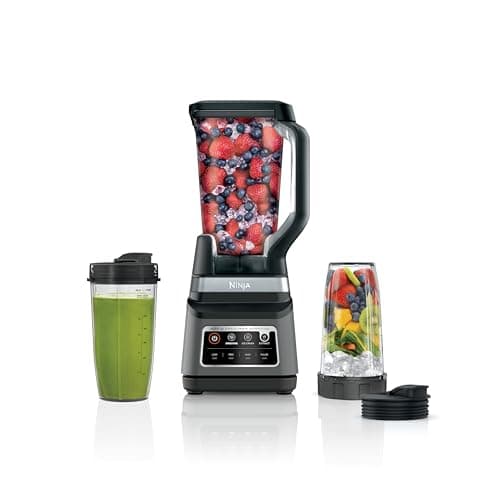
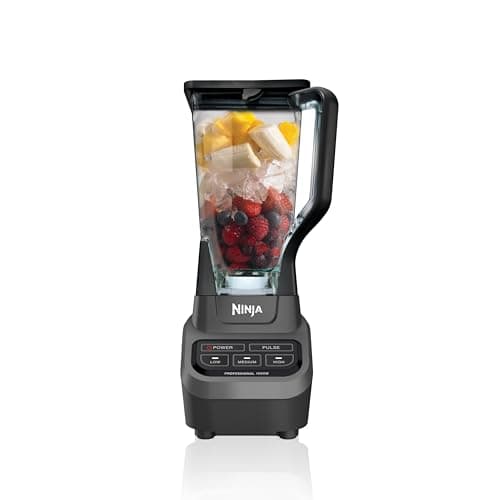
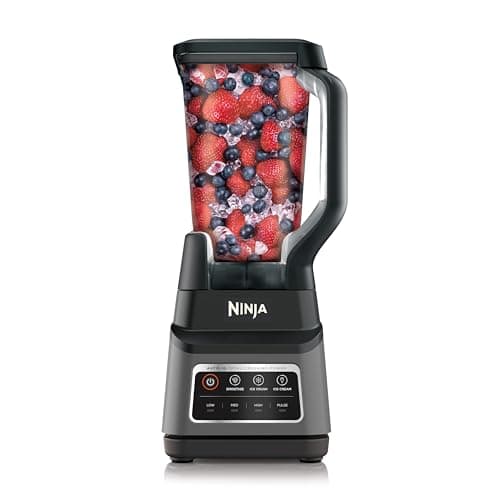
Buy the Ninja Professional Plus BN701. It is the right answer for most people asking this question, because SharkNinja publishes the same motor figures, the same pitcher capacity and the same warranty termfor both machines — 1,200 watts continuous, 1,400 watts peak, a 72 oz pitcher holding 64 oz of liquid, one year limited. The BN751 DUO is worth the difference only if you will genuinely blend into a single-serve cup and walk out of the house with it several times a week, rather than twice in the first fortnight. If you want to spend as little as possible and can live with a machine whose manufacturer has withdrawn its spec page, the older BL610 is on this page too, ranked last for the reason that sentence implies.
The part of this comparison that is genuinely settled
Most head-to-heads on this site come down to a number one brand publishes and another does not. This one does not, because both machines are SharkNinja’s and both specification tables say the same things. The motor is published as 1,200 watts continuous and 1,400 watts peak on each. The pitcher is published as 72 oz total with a 64 oz maximum liquid fill on each. The warranty is one year limited on each. Auto-iQ preset programs appear on each.
That matters because it removes a whole category of argument. You are not choosing between more power and a longer warranty, or between a bigger jar and a smaller footprint. On the full-pitcher job — the job a pitcher blender is bought for — these two machines are documented as the same machine. Whatever the BN751 costs over the BN701 is the price of vessels.
So the only question is whether you will use the cups
A single-serve cup is not a smaller pitcher. It is a different way of using a blender: you fill the cup, invert it onto the base, blend, screw a drinking lid on and leave. Nothing is decanted, so nothing is washed except the cup you drank from and the blade. That is the entire appeal of a bullet blender, and the DUO puts it on the same base as a family pitcher.
It is also the feature most likely to go unused. The honest test is not “would that be convenient?” — it would — but “do I already carry a drink out of the house in the morning?” If the answer is no, a cup on a base will not create the habit, and you will have bought a BN701 with accessories. If the answer is yes, and the alternative is buying a separate bullet blender later, the DUO is the cheaper and smaller-footprint route to both jobs.
There is a second honest check: you may already own the thing the cups replace. If a working bullet blender is already on your worktop, the DUO’s premium buys you a second set of cups you do not need, and the whole case for it collapses at that point.
The three, side by side
Manufacturer figures only. Every cell traces to the source list at the foot of this page; where SharkNinja publishes nothing for a model, the cell says so rather than carrying a number from elsewhere. | Published motor | Pitcher | Single-serve cups | Warranty |
|---|
| Ninja Professional Plus BN701 | 1,200 W continuous; 1,400 W peak | 72 oz total, 64 oz max liquid | None | 1 year limited |
|---|
| Ninja Professional Plus DUO BN751 | 1,200 W continuous; 1,400 W peak — the same figures | 72 oz total, 64 oz max liquid — the same pitcher | Yes, with a drinking lid | 1 year limited — the same term |
|---|
| Ninja Professional Blender BL610 | 1,000 W, from the replacement motor base listing | 72 oz, from the replacement pitcher listing | None | Not published for this model |
|---|
What a year of either one costs to run
At 18.34¢ per kWh (US EIA, Electric Power Monthly — average residential price, US total, retrieved September 2026) and 3 minutes a day, 365 days a year, a 1,200 W continuous motor costs about $4.02 a yearto run. That figure is identical for both machines, because the motor figure is identical. The BL610’s 1,000 W works out at about $3.35— a difference of pennies over a year, which is the point: electricity is never the reason to choose between blenders. The arithmetic is shown in full on how much a blender costs to run.
Where the BL610 fits, and why it is last
The BL610 was the default budget recommendation in this category for most of a decade, and it still blends frozen fruit for less money than either current model. The reason it ranks last here is documentation: SharkNinja no longer publishes a product page for it, so the 1,000 W figure above comes from the company’s own listing for the model’s replacement motor base, and no warranty term is published for it at all. Ninja states one year on every current blender page; nothing is stated for this one.
On a site whose entire claim is that the numbers trace back to a manufacturer document, that is a real mark against a machine rather than a technicality. It is still a legitimate purchase if price is the constraint — the full case is on Ninja BL610 vs BN701.
What neither machine gives you
Neither has a tamper, which is the limitation that matters most and the one Ninja’s marketing never raises. A tamper is the tool that pushes a thick, low-liquid mixture back into the blade while the motor is running, and without one a nut butter or a thick smoothie bowl becomes a sequence of stopping, unplugging, scraping and restarting. If that is your main use, the comparison you want is not this one — what a blender tamper is used for explains why, and the best blenders for nut butter ranks the machines that have one.
Neither publishes a decibel figure either. Ninja states none for any of these models, so nobody can tell you how loud one is relative to the other in a way you can check. That absence is the subject of why blenders are so loud.
What we have not done
We have not blended anything in either machine. There is no texture score, no seconds-to-smooth figure and no side-by-side test on this page, because this site has no test kitchen and says so. What it has instead is both specification tables read in full, the one difference between them identified, and the warranty term checked against Ninja’s own published statement rather than repeated from another review. Our method is published in full.
Four checks before you choose between them
1. Count the mornings you leave with a drink
Not the mornings you would like to. The DUO’s premium is the price of a habit you either have or do not. Three or more mornings a week and the cups earn their money; one or none and they are a stored accessory.
2. Check what is already on your worktop
If you own a working bullet blender, buy the BN701 and keep the two machines. If your old bullet blender is on its way out, the DUO replaces two appliances with one footprint, which is a genuine argument in a small kitchen — see best blenders for small kitchens.
3. Do not pay a premium for power you already have
Both machines publish the same motor. Any review that tells you the DUO blends better is not reading SharkNinja’s own tables. If you want more capability than either, the step up is a machine with a tamper and a longer warranty, not a different Ninja — Ninja vs Vitamix is that comparison.
4. Read the warranty, because one year is one year
Both carry a single year. That is the shortest term of any brand in our catalog except the models that publish nothing at all, and it is the clearest statement of what the price difference between a Ninja and a Vitamix actually buys. The whole category is laid out on blender warranties compared.