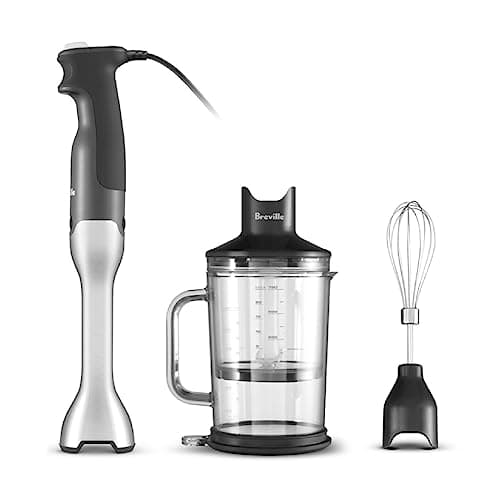
The case for the Breville Control Grip is a single genuinely clever piece of engineering: the bell around the blade is vented, which stops it suction-locking to the bottom of the pan — the thing that makes cheap stick blenders infuriating. It also ships a properly sized jug and chopper. The case against it is a one-year warranty where Braun offers three on a similar tool at similar money, and a modest 280-watt motor.
What this review is.Specification- and documentation-based, not hands-on. Nobody at Basket & Blade has used a Breville Control Grip. Every figure below comes from Breville’s product page or US manual, and where Breville publishes nothing this page says so. The method is on how we pick.
The vented bell is the reason to buy it
Suction lock is the defining frustration of a stick blender: press the bell flat against the bottom of a pan and it seals, the blade cavitates, and the whole thing sticks and stutters. Breville’s bell is designed with a vent that breaks that seal, so the blade keeps drawing food through instead of gluing itself to the pan. It is a small piece of engineering that addresses the single most common complaint about the entire category, and it is the honest reason this machine exists.
Controls that fall under the hand already holding it
The trigger and the speed dial sit under the hand that is already gripping the blender, so you adjust speed without reaching for a separate control over a hot pan. On a tool you use one-handed over a simmering pot, that ergonomic detail matters more than it sounds — it is the difference between modulating the blend and stopping to fiddle with a dial.
The attachments are properly sized, not token
Breville includes a 42 oz blending jug and a 25 oz chopper bowl, and both are genuinely useful sizes rather than the token vessels some kits ship. The jug is tall enough to blend a real quantity without splashing, and the chopper handles onions, herbs and small batches. For a buyer who wants one tool that covers blending and chopping, the included kit is a real part of the value.
The motor, and the honest limitation
Breville publishes 280 wattswith no peak, continuous or max qualifier — a plain, unqualified figure, which is the honest way to state it. But 280 watts is modest: it is enough for soup, sauces and the everyday stick-blender jobs, and emphatically not enough for anything thick or dense. If you routinely blend stiff mixtures, the 600-watt All-Clad is the more powerful tool. For the soup-and-sauce work a stick blender is actually bought for, 280 watts is sufficient.
The warranty is the clear weak point
One year, limited. That is the single clearest reason not to buy this one: Braun offers three years in the US on the same kind of tool for similar money, and one year is hard to justify against that. Breville compounds it by stating no term on its warranty page and deferring to the product page, which is a poor way to publish a warranty. Every immersion term is compared on the warranty comparison, and the head-to-head is on blender vs immersion blender for the format question.
Who should not buy this
Anyone who chooses on warranty length — Braun’s three years is the better deal on that measure alone. Anyone who needs to blend thick or dense mixtures, where 280 watts runs out of headroom. Anyone who wants a single machine for everything: a stick blender will not crush ice, will not make nut butter, and will not blend a frozen load, whatever its wattage.
The decision rule
Buy the Control Grip if fighting the pan is your recurring stick-blender frustration and the vented bell is worth more to you than two extra years of warranty. If warranty length is how you choose, buy the Braun instead — the reviews sit side by side on the immersion hub, and the soup roundup ranks both against the field.
How we picked
Blenders we claim to have tested: 0
Every site in this category tells you they blended twenty smoothies. We have not blended any, and we say so. Here is what we do instead: read the manufacturer's manual and spec sheet, record the published motor rating, jar capacity and warranty term, verify the warranty against the manufacturer's own warranty document, work out what the machine costs to run for a year and show the arithmetic, and cite all of it so you can check the work. Prices come live from Amazon's API and disappear rather than go stale.
The scores above are judgments from that documented research — not test results. The full rubric, including what disqualifies a product, is published in full.