Buy the All-Clad stainless steel immersion blenderif — and this condition is the whole page — you buy it from an All-Clad authorized seller. It publishes 600 W against Breville’s 280, it is built from metal rather than plastic, and its warranty runs two years covering labor as well as parts, which is a distinction most brands skip past. Buy the Breville Control Grip BSB510XLif you are buying from a marketplace listing you cannot verify, or if you want a 42 oz jug and a 25 oz chopper in the box, or if you have ever fought a stick blender that suction-locked itself to the bottom of a pan. And if what you actually want is the longest warranty for the least thought, neither of these is the answer — it is the Braun MultiQuick 7, at three years.
This comparison looks one-sided until you read the warranty document, and then it is genuinely close. Here is the whole of it.
The clause that decides it
All-Clad’s small-appliance warranty is, on its face, the better one in this matchup: two years rather than one, and it explicitly covers labor as well as parts. Brands routinely cover parts and leave you to pay for the work, so saying labor out loud is meaningful.
The condition is that it applies to the original purchaser and to machines bought through All-Clad authorized sellers. If you buy this blender from a third-party marketplace seller — which is how a great many kitchen tools are actually bought — you may have no warranty at all, and you will find that out at the point you need it rather than at the point you pay. We flag it in the product’s own skip line in exactly those terms: an unauthorized bargain is an uncovered machine.
So the honest framing is not “All-Clad has the better warranty”. It is that All-Clad has the better warranty conditionally, and Breville has a worse one unconditionally. A two-year term you might not have is not obviously better than a one-year term you definitely do. Which of those you prefer depends entirely on whether you can confirm the seller, and that is a question about your shopping cart rather than about either blender.
Breville’s side of this is not spotless either. The term is one year limited, which is short for a tool at this price, and Breville’s own warranty page states no term at all, deferring to the product page instead. We list that as a drawback on the machine, because a brand that will not put the number in its warranty document is making the buyer work for something that should be the easiest fact to find. The full taxonomy of how these terms differ is on blender warranties compared.
600 W against 280 W — and why the gap matters less than it reads
All-Clad publishes 600 W; Breville publishes 280 W. Both do so without a peak or continuous qualifier, which makes them unusually comparable for this category — on Breville’s page and in its US manual the words peak, continuous and max appear nowhere, and All-Clad’s figure carries no qualifier either. Taken at face value, All-Clad has more than twice the motor, and it tells on a dense pan of root vegetables.
But a stick blender’s job is mostly thin and hot: soup in the pan, a sauce, a vinaigrette, baby food, a puree. Two hundred and eighty watts is comfortably enough for all of that, and we score Breville 9.0 on hot liquids against All-Clad’s 9.0 — level, because the limiting factor for soup is not power. Where the gap shows up is dense, low-liquid work: a thick root mash, a stiff pumpkin puree, larger batches.
There is also one load where All-Clad’s advantage inverts into a liability. Mashed potato punishes power, because blending ruptures starch granules and makes paste, so the 600 W machine with a turbo button is the easiest one here to ruin dinner with. We worked that out properly on best blenders for mashed potatoes, where Breville’s lower power is treated as a feature.
Neither will make nut butter, crush ice or blend a frozen load, whatever the wattage suggests. That is a form-factor limit rather than a motor limit, and it applies to every stick blender — blender vs immersion blender sets out what you give up by not owning a pitcher.
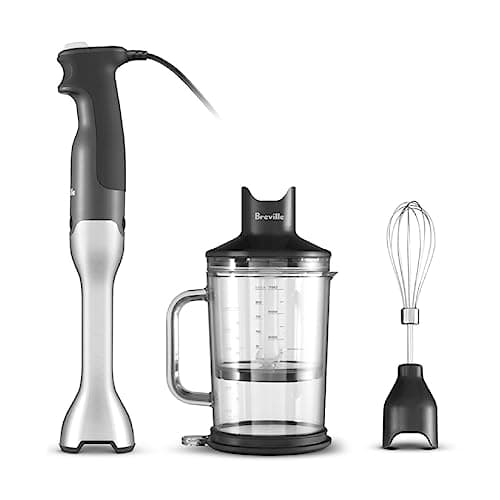
The vented bell, which is the best piece of engineering on this page
Breville’s bell — the shroud around the blade — is vented, and it is vented specifically to stop the thing suction-locking itself to the bottom of the pan. Anyone who has used a cheap stick blender knows this failure: the bell seals against the base, the mixture stops moving, and you are left wrestling a running appliance out of hot soup while one spot turns to puree and the rest stays lumpy.
Breville engineered that out, and it is the single most useful feature in this comparison for day-to-day cooking. It is also why the same machine places second on our mashed-potato ranking, where a dense load makes suction lock most likely. All-Clad publishes no equivalent feature.
The controls go the same way. Breville puts the trigger and the speed dial under the hand that is already holding the tool, so you are not reaching across a hot pan to change speed. All-Clad gives you a variable dial plus a turbo function — the dial is good, and the turbo is the button not to press on anything starchy.
What is in the box, which is a real cost difference
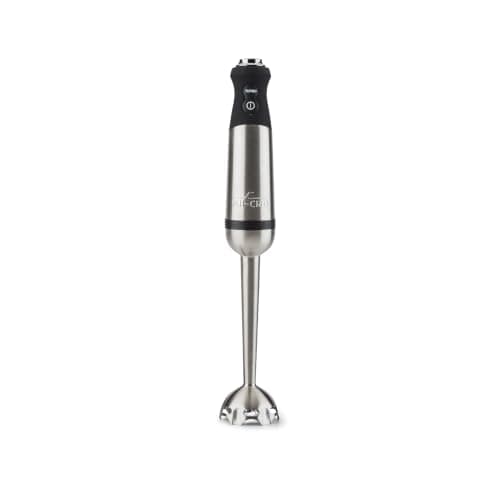
Breville includes a 42 oz blending jug and a 25 oz chopper bowl, and both are properly sized rather than token. All-Clad publishes a piece count of one: no beaker, no chopper, no whisk.
That matters more than it sounds. A chopper bowl is what turns a stick blender from a one-trick soup tool into the thing that also does onions, herbs, nuts and breadcrumbs, and buying one separately costs real money. If you want the attachments, Breville is cheaper than its price tag suggests and All-Clad is dearer than its own — and the Braun arrives with a chopper and a whisk as well. Which attachments are worth having is on immersion blender attachments explained.
Side by side
Manufacturer figures only. Every cell traces to the source list at the foot of this page; where a maker publishes nothing, the cell says so rather than carrying an estimate. Annual cost assumes 3 minutes a day, 365 days a year at 18.34¢ per kWh. | All-Clad stainless steel immersion blender | Breville Control Grip BSB510XL | Braun MultiQuick 7 MQ7035X |
|---|
| Published motor | 600 W, no qualifier | 280 W, no qualifier | 500 W input power |
|---|
| Warranty term | 2 years, parts and labor | 1 year limited | 3 years (US) |
|---|
| Warranty conditions | Original purchaser, authorized sellers only | Breville’s warranty page states no term, deferring to the product page | Printed manual guarantee is marked “For UK Only” at two years |
|---|
| Anti-suction bell | Not published | Yes — vented by design | Not published |
|---|
| In the box | One piece — no beaker or chopper published | 42 oz jug, 25 oz chopper bowl | Chopper and whisk |
|---|
| Speed control | Variable dial plus turbo | Trigger plus dial under the same hand | Variable by grip pressure |
|---|
| Cost per year to run | $2.01 | $0.94 | $1.67 |
|---|
| Noise | Not published | Not published | Not published for the US market |
|---|
The third option, because it wins on the thing this site cares most about
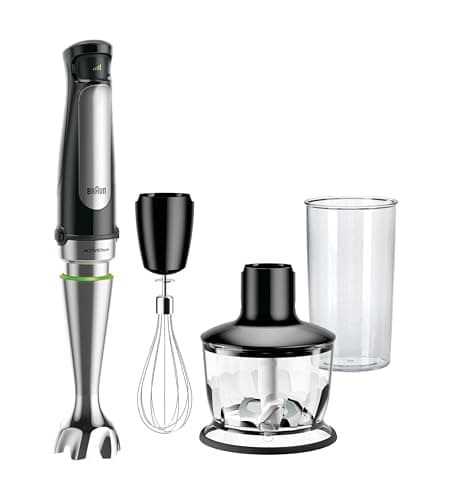
We would be hiding something if we argued these two in isolation. The Braun MultiQuick 7 MQ7035X publishes three years of US warrantyon the same kind of tool at broadly similar money — longer than All-Clad’s two and triple Breville’s one — and it does so without an authorized-seller condition attached. It also publishes an input powerfigure of 500 W rather than a peak marketing number, which is the honest way round, and it arrives with a chopper and a whisk.
Its own documentation has one wrinkle we record rather than gloss: the printed manual guarantee is marked “For UK Only” at two years, while the US term of three years comes from Braun’s own knowledge base. The box is confusing; the published US term is three years.
So the clean way to read all three: Braun for warranty and attachments, Breville for the bell and the jug, All-Cladfor power and a metal body you will not melt or stain — bought from a seller you can verify. The Braun-against-Breville version of this argument, which turns on term versus engineering rather than on power, is on Braun vs Breville.
Where each one is genuinely bad
All-Clad.Two years against Braun’s three at a higher price; the warranty is void outside authorized sellers, which turns a marketplace bargain into an uncovered machine; and it ships with nothing but the blender, so the attachments are a second purchase. It is also the easiest of the three to over-blend something starchy with.
Breville.One year of warranty against Braun’s three at similar money is the clearest reason not to buy it, and we say so in its skip line. 280 W is modest — fine for soup and emphatically not enough for anything thick. And its warranty page publishing no term at all is poor practice for a premium brand.
Braun.The “For UK Only” two-year line on the printed guarantee contradicts the three-year US term on the website, which is a confusing thing to find in the box. No decibel figure for the US market, and the beaker capacity is not published anywhere we could find.
What we are not going to tell you
We have not used any of these three. We publish no blend-time comparison, no noise figure — none of the three brands publishes a decibel number — no durability ranking and no claim about build quality beyond what each maker states its machine is made of. What this comparison is built from is each brand’s published motor figure, each warranty document read in full including its conditions, the features each maker describes, and the published in-box contents. The authorized-seller clause is the single most useful thing on this page and it comes from All-Clad’s own warranty PDF, linked below. Our method is published in full.
How to decide between them
Buy the All-Clad if
You can confirm the seller is All-Clad authorized, you blend dense or large batches where 600 W earns its keep, and you want an all-metal tool that tolerates heat and staining better than plastic over years of going into hot pans. Check the seller before you check the price.
Buy the Breville if
You are buying from a listing you cannot verify, you want the 42 oz jug and the 25 oz chopper included, or you cook things dense enough that suction lock is a real annoyance. Accept that one year is short and that it is the least powerful of the three.
Buy the Braun instead if
Warranty length is how you choose. Three US years with no authorized-seller condition, an honest input-power figure, grip-pressure speed control and a chopper and whisk in the box is the most defensible purchase of the three on this site’s own criteria — which is why it also wins best immersion blenders for soup.
Buy none of them if
You want one machine for everything. No stick blender will crush ice, make nut butter or blend a frozen load — All-Clad’s own skip line says so for the whole category. That is a pitcher job, and best blenders for daily use is where to start.
The check worth doing yourself
Open the brand’s warranty document — not the product page, the actual warranty — and read for two things: the term, and the conditions. On this page the term favours one machine and the conditions favour the other, and you would never learn that from the marketing. It takes two minutes and it is the highest-value two minutes in a small-appliance purchase.