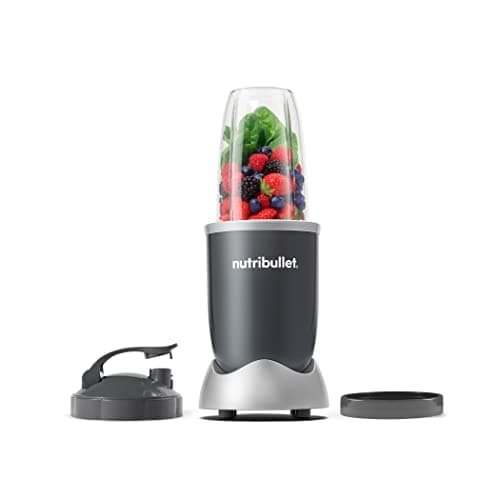
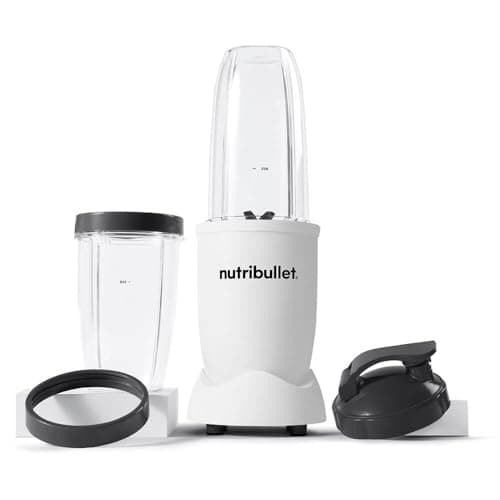
Buy the NutriBullet Pro if you regularly load the cup with frozen fruit and want the extra 300 watts of margin. Buy the NutriBullet 600 if your shake is mostly soft fruit, powder and yogurt, or if you actually want a small single serving — the 600 ships an 18 oz short cup, and it is the only genuinely modest vessel in the NutriBullet range.
Both are inverted-cup bullet blenders from the same maker, share the same accessory ecosystem, and carry the same one-year warranty. The only things that separate them are power and cup sizes — but for the right buyer those two are exactly the deciding factors.
The two machines, side by side
Manufacturer figures. NutriBullet publishes both wattages with no peak/continuous qualifier. Running cost is computed, not measured. | NutriBullet Pro (900 W) | NutriBullet 600 |
|---|
| Published motor | 900 W | 600 W |
|---|
| Cups | Two 32 oz cups | 24 oz tall cup, 18 oz short cup |
|---|
| Warranty | 1 year (excludes cups) | 1 year |
|---|
| Est. cost to run / year | $3.01 | $2.01 |
|---|
Where they genuinely differ
The cup size is the underrated part
Everyone frames this as a power comparison, but the cup is the more interesting difference. The 600 is the only machine in NutriBullet’s line-up with a properly single-serving 18 oz vessel; the Pro starts at 32 oz and offers nothing smaller. If you make one modest shake at a time, the Pro blends it in a cup nearly twice the size it needs, which means more to wash and a vessel that does not fit a cup holder. For a genuine single serving, the smaller machine is the better-designed one.
300 watts, and when it shows
The Pro’s 900 watts against the 600’s 600 is a real margin on one specific job: a cup packed with frozen fruit and little liquid. At 600 watts that load can stall, and pulsing a stalled motor repeatedly is how a bullet blender gets cooked. For soft fruit, protein powder, yogurt and a few berries, both machines do the job and the difference is academic.
What each one is bad at
The Pro has no small cup and, like all NutriBullets, excludes the cups from its one-year warranty — the parts that actually fail. The 600 is the least powerful machine in the line and it shows on a frozen load; it also runs at a single speed, controlled only by how long you press.
The decision rule.If “frozen fruit, not much liquid” describes your usual shake, pay for the Pro’s 900 watts. If it does not — soft fruit, powder, a small portion — the 600 is the better fit, not merely the cheaper one, because its 18 oz cup is the only right-sized vessel NutriBullet makes.
Thinking one rung higher? The next step up in the same family is Pro vs Ultra, where the real upgrade is a five-year blade warranty. For the whole class, see the personal-blender hub.
How we picked
Blenders we claim to have tested: 0
Every site in this category tells you they blended twenty smoothies. We have not blended any, and we say so. Here is what we do instead: read the manufacturer's manual and spec sheet, record the published motor rating, jar capacity and warranty term, verify the warranty against the manufacturer's own warranty document, work out what the machine costs to run for a year and show the arithmetic, and cite all of it so you can check the work. Prices come live from Amazon's API and disappear rather than go stale.
The scores above are judgments from that documented research — not test results. The full rubric, including what disqualifies a product, is published in full.