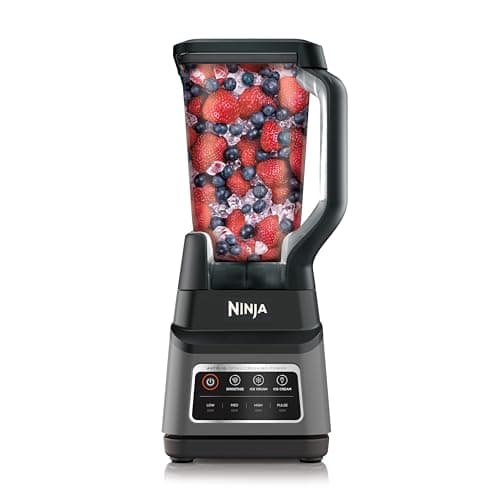
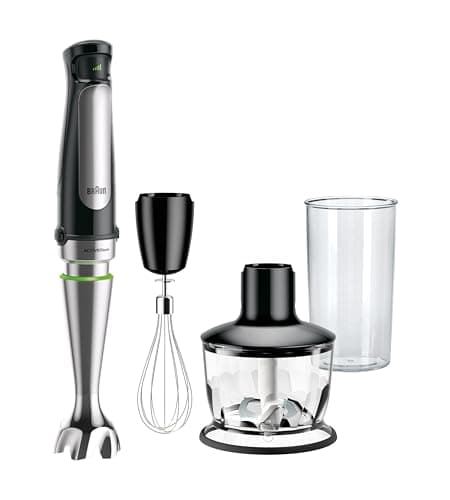
Most pages comparing these two treat them as a budget question. They are not. The decisive difference is hot liquid, and it is a matter of physics rather than preference: a countertop blender full of hot soup is a sealed pressure vessel, and a stick blender is not a sealed anything. Everything else — cleaning, batch size, what each one simply cannot do — follows from that and from the fact that one machine goes to the food while the other makes the food come to it.
The published specifications, side by side
| Published spec | Braun MultiQuick 7 MQ7035X | Ninja Professional Plus BN701 |
|---|
| Motor rating, in the manufacturer’s own words | 500 watts input power | 1,200 watts continuous; 1,400 watts peak |
|---|
| Vessel | None — you blend in the pan. 500 ml chopper included | 72 oz total, 64 oz max liquid |
|---|
| Warranty | 3 years (US) | 1 year limited |
|---|
| Sealed lid under pressure? | No sealed vessel at all | Yes — the reason hot blending needs care |
|---|
| Published noise figure | Not published for the US market | Not published |
|---|
| Price | Live from Amazon with the date checked, in the panel above; the number disappears rather than going stale |
|---|
Two things in that table are worth pausing on. Braun publishes input power— the honest way round, since it describes what the motor draws rather than a flattering peak. And Braun’s US warranty runs three years against Ninja’s one, which is unusual in a category where the cheaper tool normally carries the shorter term.
Hot liquid is a pressure problem, not a heat problem
This is the part that decides the comparison. Put hot soup in a blender jar and clamp the lid on, and the steam coming off it expands. It has nowhere to go. Pressure builds under the lid, and at some point the lid leaves — along with the contents, upward, at speed. This has genuinely injured people. It is not a heat problem, in the sense that the temperature itself is not what fails; it is a containment problem, and the container is the thing you added.
Every countertop blender manual addresses this, and the good ones are specific about maximum fill levels and vented lids. The rules are real and they work: fill low, vent the lid, start slow, hold the lid down with a folded towel, and let the soup cool a little first. The full set, with a manufacturer document cited for each, is in the hot-liquid safety guide, which is worth reading before rather than after.
An immersion blender sidesteps the entire failure mode, because there is no sealed vessel to pressurize. You blend in the open pan the soup is already in. The remaining hazards are splashing and burns from the pan itself — real, but manageable by keeping the head below the surface before you start it and releasing the trigger before you lift it out.
If a meaningful share of what you blend is hot and already in a pot, this one factor should outweigh every spec on the table above. It is also why the immersion category exists at all: it is not a cheap blender, it is a different answer to a different problem.
Cleaning, and why it decides which machine you actually use
A countertop blender has a jar, a lid, a gasket and a blade assembly to wash, and on the BN701 that blade is a stacked tower with more surfaces than a single fixed blade. A stick blender has a shaft you run under a tap, or dip in a jug of soapy water and pulse for five seconds.
That sounds like a minor convenience and over a year of weekly soup it is not. It is the difference between a machine that stays on the counter and one that stays in the cupboard, and cupboard machines get used a fraction as often. Weighting cleaning effort more heavily than a spec sheet suggests is one of the few pieces of blender advice that reliably changes outcomes.
The tradeoff is that a stick blender has to be held. Your arm is the stand, so a large volume of thick mixture tires you out before it troubles the motor. For a pan of soup that is thirty seconds of work. For anything longer, the countertop machine wins by simply holding itself.
Batch size runs in both directions
The Ninja publishes 72 oz of total capacity and 64 oz of maximum liquid, and that is a genuine family batch in one go. The Braun publishes no jar at all, because it does not have one — its working capacity is whatever pot you own, which is both bigger than any blender jar and constrained by how much you can comfortably hold a motor over.
For a large pan of soup the immersion blender is unambiguously better: no ladling hot liquid into a jar in batches, no second container, no decanting back. For four servings of smoothie the countertop machine is unambiguously better: one load, one lid, done. The smallest batch is where the stick blender is worst — blending 8 oz of anything with a hand blender means finding a vessel narrow enough to submerge the head in, and the 500 ml chopper Braun includes exists partly to solve that.
What a stick blender genuinely cannot do
This is where the honest limits are, and they are not marginal:
- Ice.Not crushed ice, not cubes in a drink. Braun’s 500 watts of input power is not the constraint so much as the geometry — there is no jar to circulate a frozen mass in and no vortex to pull it onto the blade.
- Frozen fruit straight from the freezer. Same reason. A stick blender is built to work in liquid that is already soft, and frozen fruit is neither.
- Nut butter. The load is too thick for the blade to move and the motor is not designed to sit near stall for several minutes.
- Dry grinding. Coffee, spices, oats into flour. There is no dry vessel and no mechanism for it.
- Large volumes of thick mixture. Not because the machine fails, but because you are holding it.
Braun’s own limitation is stated in exactly those terms: a stick blender will not crush ice, will not make nut butter and will not blend a frozen load, whatever the wattage suggests. Comparing its 500 W against the Ninja’s 1,200 W continuous is not really a power comparison at all — the two motors are solving different problems, and the smaller one is sized for liquid that is already soft and already hot.
What a countertop blender is bad at
It is bad at hot food, for the reason at the top of this page, and the mitigations are procedures you have to remember every time. It is bad at small quantities: a 72 oz jar asked to blend one cup of dressing mostly smears it around the walls. It is bad at cleaning effort, with four components to wash against one shaft. And on this particular machine, the warranty is one year against Braun’s three — a genuinely awkward comparison, since the more expensive machine here is also the less covered one.
The stick blender’s weaknesses are the mirror image: no ice, no frozen loads, no nut butter, no dry work, and your arm as the stand. Neither of these lists is a defect. They are the shapes of two tools that were designed for different jobs, and the mistake is expecting either to cover both.
The decision rule
If more than half of what you blend is hot and already in a pot — soups, sauces, purees, slow-cooked dishes — buy the immersion blender, because the sealed-jar pressure problem is the one difference here that no technique fully removes and no amount of extra power compensates for. If more than half of what you blend is frozen, icy or thick — smoothies with frozen fruit, frozen drinks, smoothie bowls, nut butter — buy the countertop blender, because a stick blender does not do those jobs badly, it does not do them at all. If it is genuinely half and half, buy the immersion blender first: it is the cheaper of the two, it covers the job that is dangerous to improvise, and a hot soup in a sealed jar is a worse mistake than a mediocre smoothie.
The condition that flips the answer is the temperature of what you blend most. Not budget, not counter space, not wattage. And unlike most buying decisions, this one has a safety component rather than only a satisfaction one, which is why the tiebreaker leans the way it does.
If the rule pointed at a stick blender, the soup-specific version of the shortlist is over here. If it pointed at a countertop machine, the ranked list is the place to start, and the under-$200 roundup is where most people who blend a few times a week should be looking.
What this comparison is not
It is not a head-to-head test. No soup was blended for this page. The pressure argument is a mechanical description backed by the manufacturer manuals cited in the hot-liquid guide, and every specification above comes from the manufacturer pages listed below. Where a figure is not published — noise, on both machines, and Braun’s beaker capacity — the page says so instead of estimating.