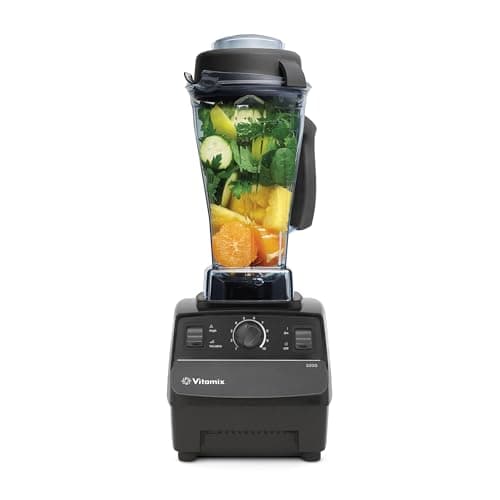
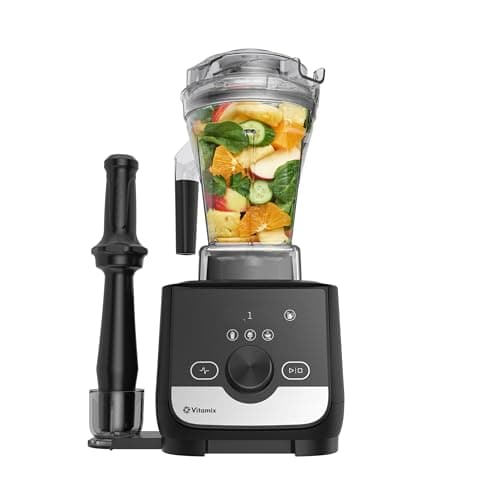
Buy the Vitamix Ascent X3if you have a cabinet above your worktop or you want the longest warranty Vitamix writes — at 17 inches tall it is the only full-size machine in our catalogue that clears a standard 18-inch gap with its container on, and its ten-year term is full rather than limited. Buy the Vitamix 5200if you blend for three or more people, because its 64 oz container is a third larger than the X3’s 48 oz jar, it costs less, and it is the machine Vitamix’s published dry-grains compatibility list actually covers.
Nothing here turns on power. Vitamix publishes no watt figure at all for the 5200 — only 2 HP and an 11.5 amp nameplate draw — and publishes 2.2 HP and 1,500 W for the X3. Those are nameplate ratings, not a measured performance gap, and both machines have a fully variable dial and a tamper, which is the combination that actually decides what a blender can do. Treat this as a decision about a jar, a kitchen and a warranty document.
The three differences that decide it
1. Height, which is a kitchen measurement, not a spec
Vitamix publishes 17 inches for the Ascent X3 with the container on. The 5200 is 20.5 inches. A standard worktop-to-cabinet gap is 18 inches. That means the X3 lives on the counter under a cabinet and the 5200 does not — you lift it out, or you store it with the jar off, or you give it a stretch of open worktop. For a lot of kitchens this ends the comparison before anything else is read, which is why it is first here.
2. Jar size, in the opposite direction
The X3 ships with 48 oz. The 5200 ships with 64 oz. That is a third more capacity on the older, cheaper machine, and it is the X3’s real cost — a family-sized batch becomes two passes. Vitamix sells larger Ascent containers separately, but a container you have not bought is not capacity you have. If you are weighing batch size properly, start with what size blender do I need.
3. Warranty: ten years full against seven years full
Both are fullwarranties, which in Vitamix’s own documents means normal wear and tear from ordinary household use, not defects alone — and both documents allow ownership to be transferred. The X3 gets three more years. That is a genuine difference and it is worth paying something for, though less than the price gap implies once you divide each machine’s live price by its years. One footnote worth knowing: the X3 product page’s own specification list calls the cover “10 Year Standard Warranty” while the document it links to is titled Full and reads as one. We cite the document, and we flag the discrepancy rather than smoothing it over. The brand-by-brand version of this exercise is on blender warranties compared.
The two machines, side by side
Vitamix’s own published figures, from the two product pages and the two warranty documents. Where Vitamix publishes nothing — noise, for both machines — the cell says so. | Vitamix Ascent X3 | Vitamix 5200 |
|---|
| Published motor | 2.2 HP; 120 V, 1,500 W | 2 HP; 120 V, 11.5 A. No watt figure published |
|---|
| Container | 48 oz, BPA-free | 64 oz |
|---|
| Height with container | 17 in | 20.5 in |
|---|
| Cord | 3.5 ft | 6 ft |
|---|
| Tamper in the box | Yes — S2 low-profile tamper plus holder | Yes |
|---|
| Controls | Variable dial, pulse, 3 programs, self-clean, digital timer | Fully variable speed dial. No programs, timer or self-clean |
|---|
| Warranty | 10 years, full; transferable | 7 years, full; transferable |
|---|
| Dry grains container published as compatible | No — Ascent is not on the list | Yes — Legacy Series |
|---|
| Noise | Not published | Not published |
|---|
| Electricity, 3 minutes a day, 365 days a year | about $5.02 a year | about $4.62 a year |
|---|
The running-cost row is there to be dismissed: the gap between these two is a few cents a year at the EIA average residential rate retrieved September 2026. We publish it because we publish it everywhere, not because it should move your decision. The arithmetic is on how much a blender costs to run.
The container list, and why it matters more than it sounds
Vitamix sells a 32 oz Dry Grains Container for milling flour, and publishes which machines it fits: the Legacy Series and the Explorian Series. The 5200 is a Legacy-series machine — Vitamix’s own 5200 page files it under C-Series: Classic, and the container page cross-references the 5200 directly. The Ascent series is not on that list.
If you will never mill grain, ignore this entirely. If you might, it is the one capability the older machine has and the newer one does not, and we rank it accordingly on best blenders for grinding grains and spices.
What the X3 adds that the 5200 genuinely lacks
Three programs, a self-clean cycle and a digital timer on the panel, plus SELF-DETECT, which reads which container is fitted and adjusts the program for it. The 5200 has none of that: it is a dial, a switch and a motor, and Vitamix has never pretended otherwise. Whether that matters is a question about you rather than about the machines. A programme that stops on its own is worth real money to someone making the same smoothie every morning and nothing at all to someone who watches the jar.
What the X3 does notadd is the ability to blend something the 5200 cannot. Both have the dial and the tamper. On nut butter, frozen desserts and thick bowls, the two machines belong in the same bracket — see best blenders for nut butter.
Who each one is for
- Vitamix Ascent X3 — for the buyer with a cabinet over the worktop who wants the longest term Vitamix writes and blends for one or two people.
- Vitamix 5200 — for the buyer who blends for a family, wants the bigger jar and the longer cord, and would rather spend less for seven years of the same kind of cover.
And if neither sounds like you, the honest third answer is that the entry-level Vitamix may be enough: Vitamix VX1 vs 5200 settles that, and is a Vitamix worth it asks whether the whole bracket is the right purchase in the first place. For cross-brand buyers, Blendtec vs Vitamix vs Ninja puts all three in one table.