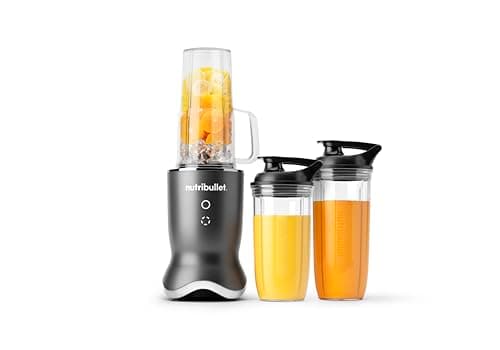
The case for the NutriBullet Ultra is 1,200 watts — the most power in this catalog’s personal-blender class — two cup sizes in the box, and a genuinely unusual five-year warranty on the blade assembly, which is a common failure point. The case against it is that it is marketed as NutriBullet’s quietest single-serve blender with no decibel figure published anywhere, and it costs roughly double the NutriBullet Pro for power most single servings will not use.
What this review is.Specification- and documentation-based, not hands-on. Nobody at Basket & Blade has used a NutriBullet Ultra. Every figure below comes from NutriBullet’s product page and warranty terms, and where NutriBullet makes a claim it does not back with a number — the quietness claim — this page says so. The method is on how we pick.
The power, and whether you will use it
NutriBullet publishes 1,200 wattswith no peak or continuous qualifier, which is the most power of any single-serve machine here — a third more than the 900-watt Pro. For a single serving of frozen fruit that is more than enough, and honestly more than most single servings need; the Pro’s 900 watts already handles a cup of frozen fruit through its inverted-cup design. The extra power is real, but it is not the reason to buy this over the Pro unless you routinely push a cup near its limit.
The five-year blade warranty is the genuinely useful part
Here is where the Ultra earns its place. NutriBullet publishes one year on the machine and five yearson the Ultra Rapid Extractor blade — an unusual split, and a genuinely useful one, because the blade assembly (specifically its gasket) is the single most common thing to fail on a bullet blender. Covering the blade for five years targets exactly the part that breaks. Note the standard NutriBullet caveat still applies: the general warranty terms exclude cups and accessories, so it is the blade specifically, not the cups, that carries the long term.
The quietness claim with nothing behind it
NutriBullet markets the Ultra as its quietest single-serve blender, and publishes no decibel figure at allto support it — not for the Ultra, and not for the machines it is quieter than. That makes the claim unverifiable: there is nothing to compare it against, and paying a premium for an unverifiable quietness claim is precisely the thing this site exists to talk you out of. A 1,200-watt motor in a small vessel is not a quiet appliance by any reasonable expectation, and “quieter than our other models” is a relative claim with no absolute number attached.
Two documented cup sizes
The Ultra ships a 24 oz and a 32 oz cup, and NutriBullet’s page is consistent about it — which is worth noting because the Pro’s page contradicts itself about its own cup contents. Both cups take the standard NutriBullet accessory ecosystem, so replacement cups, lids and blades are easy to find.
Who should not buy this
Anyone buying it for the quietness — there is no published number to justify the premium. Anyone who makes single servings a 900-watt Pro already handles, since the extra power will not show up in the cup. Anyone who makes anything thick: like every bullet, the narrow cup gives a stiff mixture nowhere to move, and 1,200 watts does not change that.
The decision rule
Buy the Ultra if the five-year blade warranty is what sells you — it is the honest reason to choose it, targeting the part that actually fails — and you have decided the quietness claim is not part of the calculation. If you just want a capable bullet blender at a lower price, the Pro does the same everyday job; the two are laid out against the field on the personal-blender roundup, and the ice question is covered on can personal blenders handle ice.
How we picked
Blenders we claim to have tested: 0
Every site in this category tells you they blended twenty smoothies. We have not blended any, and we say so. Here is what we do instead: read the manufacturer's manual and spec sheet, record the published motor rating, jar capacity and warranty term, verify the warranty against the manufacturer's own warranty document, work out what the machine costs to run for a year and show the arithmetic, and cite all of it so you can check the work. Prices come live from Amazon's API and disappear rather than go stale.
The scores above are judgments from that documented research — not test results. The full rubric, including what disqualifies a product, is published in full.