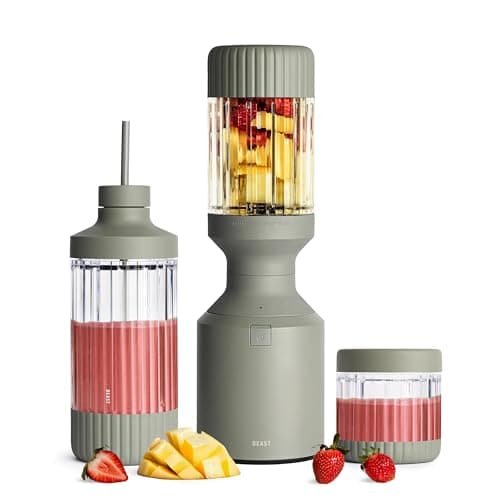
The Beast Mega 1200 earns its premium in two concrete ways: a two-year warranty in a class where one is standard, and a manufacturer honest enough to publish blending capacity separately from total vessel volume. At 1,200 W it has the power to move a frozen load a 600 W machine will not. It is a single generous serving, not a batch, and it costs meaningfully more than the mainstream bullets.
What this review is.Specification-based, not hands-on — this site owns no blenders. Every figure is from Beast Health’s own product page and warranty terms, and the running cost is computed and shown. Here is how we pick.
The two things Beast does differently
First, warranty: two years, USA and Canada, household use, against the single year that NutriBullet, Ninja and Magic Bullet all offer in this class. Warranty length is the number this site weights most heavily, because it is a manufacturer’s own written estimate of how long the motor will last — and doubling it is the clearest advantage Beast holds.
Second, honesty about capacity. Beast is the only brand in this catalog that publishes the amount you can actually blend — a distinct figure from the total vessel volume — because you cannot fill a blender to the brim and expect it to work. Its 1,000 mL (33 oz) vessel is stated with that distinction intact, which is a small signal of a larger attitude to specification.
Power, and running cost
Beast publishes a 1,200 W motor and separately states a ~1.6 horsepower equivalent, rather than quoting a peak figure. It is the top of the personal-blender range here and enough for frozen loads that stall a 600 W machine. The ribbed vessel is designed to disrupt the vortex — the mechanism that otherwise lets a smooth spin do nothing. Running cost is, predictably, a non-issue:
Beast Mega 1200 — 1200 W ÷ 1,000 = 1.200 kW
1.200 kW × 18.25 hours a year = 21.90 kWh
21.90 kWh × 18.34¢ per kWh = $4.02 a year
Where the premium bites
It is substantially more expensive than the bullets it competes with; 33 oz is one generous serving, not a family batch, so it does not replace a full-size jar; and no decibel figure is published — a 1,200 W motor in a small vessel is not quiet. Its replacement parts exist but are neither as cheap nor as ubiquitous as NutriBullet’s, which is the practical counter-argument covered in Beast vs NutriBullet.
Who it is for
Buy it if a two-year warranty and honest capacity figures are worth a real premium to you, you make single servings, and you will leave it out on the counter as the designed object it is. Skip it if you need to feed more than one person — 33 oz refilled three times is worse than owning a pitcher — or if cheap, widely available spare parts are your priority. For batches, see the high-power roundup.
What the two-year warranty is really telling you
A warranty is a manufacturer’s own bet on how long its motor lasts, so Beast doubling the class-standard term is a small but real signal of confidence. The practical value is simple: two years of cover on a single-serving machine you use daily is a genuine hedge against the one failure a bullet blender is prone to. Pair that with Beast’s habit of publishing usable blending capacity rather than total volume and you have the two most honest numbers in the class.
Who should buy it, and what to weigh it against
The Beast makes sense for one person who blends daily, wants the object out on the counter, and reads the two-year warranty and honest specs as worth a premium. The obvious alternative is the NutriBullet Pro — far cheaper, one-year warranty, and the biggest parts ecosystem in the category, which is the pragmatic pick if price and cheap spares beat a second year of cover. That trade is the whole of Beast vs NutriBullet.
What the Beast is notis a batch machine. 33 oz is one generous serving, and refilling it three times to feed a family is worse than owning a pitcher — so if a household is the use case, a full-size jar from the high-power roundup is the right buy, not this.
How we picked
Blenders we claim to have tested: 0
Every site in this category tells you they blended twenty smoothies. We have not blended any, and we say so. Here is what we do instead: read the manufacturer's manual and spec sheet, record the published motor rating, jar capacity and warranty term, verify the warranty against the manufacturer's own warranty document, work out what the machine costs to run for a year and show the arithmetic, and cite all of it so you can check the work. Prices come live from Amazon's API and disappear rather than go stale.
The scores above are judgments from that documented research — not test results. The full rubric, including what disqualifies a product, is published in full.