The two machines look similar, cost similar money, sit in the same aisle, and are almost never the answer to the same question. Here is the whole comparison in one line: a blender moves food through liquid; a food processor cuts food in air. Everything else on this page is a consequence of that sentence, including why no number of attachments turns either one into the other.
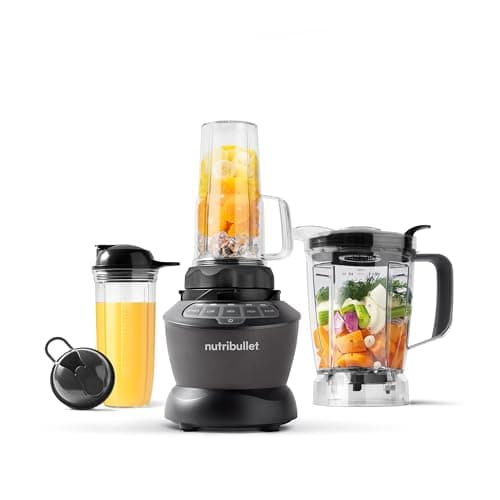
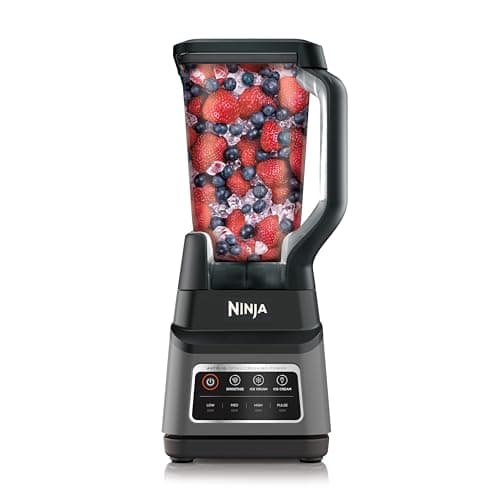
The two blenders in this comparison
These are the machines on this page, with their published figures. We are not printing specifications for a food processor, because we have not sourced one from a manufacturer document, and a made-up number is worse than an absent one:
| Published spec | Ninja Professional Plus BN701 | NutriBullet 1200 W Blender Combo |
|---|
| Motor rating, in the manufacturer’s own words | 1,200 watts continuous; 1,400 watts peak | 1200 W, with no peak or continuous qualifier published |
|---|
| Vessels | 72 oz total, 64 oz max liquid | 64 oz pitcher, 32 oz cup, 24 oz handled cup |
|---|
| Warranty | 1 year limited | 1 year |
|---|
| Warranty exclusions worth knowing | Limited terms as published on the product page | NutriBullet’s terms exclude cups and accessories |
|---|
| Tamper in the box | No | No |
|---|
| Published noise figure | Not published | Not published |
|---|
| Price | Live from Amazon with the date checked, in the panel above; the figure disappears rather than going stale |
|---|
Note the first row, because it demonstrates the problem with spec-sheet shopping in miniature. Both machines show 1,200 watts. Only one of them says what kind of 1,200 watts it is. Ninja publishes a continuous rating and a peak rating separately; NutriBullet publishes a plain unqualified figure. Identical numbers, different claims.
The mechanism, which explains everything else
A blender jar is tall and narrow and its blades sit at the bottom. Spinning them creates a vortex that drags the contents down, past the blade, and back up the sides. That circulation is the machine. It requires a fluid to happen in — liquid, or something soft enough to behave like one — and when there is not enough of it, the blades carve out a pocket of air and spin inside it while the food sits above, untouched. That is cavitation, and it is why a powerful blender can roar for a minute and produce nothing. The output of a blender is therefore always a suspension: smooth, wet, homogeneous.
A food processor bowl is wide and shallow and its blade sweeps close to the walls. Nothing circulates. Food is thrown outward, meets the blade on the way past, gets cut, and drops back. There is no vortex and no requirement for liquid — in fact adding liquid is what stops a food processor working properly, because wet food slides rather than being cut. The output of a food processor is therefore always pieces: chopped, sliced, shredded, or a coarse paste that is really just very small pieces.
Those are two different physical operations. One suspends, one divides. This is why the answer to “can I make hummus in a blender” is a hesitant yes-with-more-liquid, and the answer to “can I shred a cabbage in a blender” is no, and never will be, at any wattage. The machines that do manage a smooth hummus are ranked in best blenders for hummus and salsa.
Job by job, which machine actually does it
| The job | Right tool | Why |
|---|
| Smoothies and shakes | Blender | Wet, wants to be homogeneous, needs circulation. A processor makes it lumpy |
|---|
| Crushed ice and frozen drinks | Blender | Needs the frozen mass pulled back onto the blade repeatedly |
|---|
| Pureed soup | Blender (or a stick blender) | Plenty of liquid, wants to be smooth. A processor leaks and leaves texture |
|---|
| Nut butter | Either, with reservations | A processor is more forgiving because the load never has to circulate; a blender needs a tamper, which neither machine above has |
|---|
| Chopping onions | Food processor | Dry cutting. A blender turns them to watery mush or nothing at all |
|---|
| Shredding cheese or cabbage | Food processor | Needs a disc and a feed tube. A blender has no mechanism for this |
|---|
| Slicing potatoes evenly | Food processor | Same reason. Nothing in a blender jar can slice |
|---|
| Pastry and dough | Food processor | Cutting fat into flour is dry division, the processor’s core competence |
|---|
| Hummus and thick dips | Food processor, usually | Low liquid. A blender will do it with extra liquid and a lot of scraping, and the result is thinner |
|---|
| Salsa | Food processor for chunky, blender for smooth | This one genuinely depends on the salsa you want, not on the machine |
|---|
| Protein shakes in a to-go cup | Blender | Only one of these machines lets you drink from the vessel you blended in |
|---|
| Baby food | Blender | Smooth and wet, in small batches |
|---|
Count the rows that describe your cooking. That count is the answer, and it is a more reliable guide than any amount of reading about motors, because it is a fact about your kitchen rather than a claim about a machine.
The attachment trap
Both categories sell combination machines: blenders with chopping bowls, processors with blending jars. They are not lies, but they are compromises, and the compromise always runs the same way. A chopping bowl on a blender base is a small food processor with a blender motor speed profile — usable for herbs, nuts and small quantities, out of its depth on a cabbage. A blending jar on a processor base is a blender with the wrong jar geometry, which is to say the vortex is weaker and thick mixtures stall sooner.
The NutriBullet Combo on this page is a good illustration of what a multi-vessel machine honestly is: one 1200 W base, a 64 oz pitcher and two single-serve cups. Every one of those vessels is a blending vessel. The machine covers two blending jobs — family batch and single serving — on one motor and one footprint. What it does not do, and does not claim to do, is become a food processor. That distinction is the one worth carrying into a store.
The one honest exception is small-quantity dry chopping, where a chopper attachment is genuinely enough for most households. If your food-processor ambitions amount to chopping an onion without crying, a chopper bowl on something you already own will do it.
What each one is bad at
A blender is bad at everything dry. No slicing, no shredding, no grating, no pastry. It is bad at chunky textures, because its entire mechanism is designed to eliminate them. It is bad at low-liquid mixtures without a tamper, and neither machine on this page ships one — Ninja lists exactly that limitation for the BN701, and the NutriBullet Combo has the same gap, which means a thick mixture in either becomes a stop-scrape-restart cycle. It is bad at hot liquid in a sealed jar, which is a pressure problem covered in the hot-liquid safety guide. And both of these carry one-year warranties, with NutriBullet’s terms explicitly excluding the cups and accessories.
A food processor is bad at everything wet and smooth. It will not make a drinkable smoothie: the bowl leaks above a fill line, the blade does not circulate the contents, and the result is textured rather than homogeneous. It will not crush ice into anything you would put in a glass. It has more parts to wash than any blender, most of them sharp. It takes up more cupboard space. And it does not produce a vessel you can drink from, which for a lot of households is the entire reason a blender is on the counter.
You may be asking the wrong question
A meaningful share of people searching this comparison do not need to choose. They need one of the two and have been talked into a false dilemma by a store layout. If your list of jobs is smoothies, shakes, soup and frozen fruit, a food processor will never be used and buying one is money spent on cupboard space. If your list is chopping, shredding, slicing and dough, a blender will disappoint you at every one and no wattage fixes it.
The other version of the wrong question is buying the expensive machine in the wrong category. A premium blender is still a bad slicer. Spending more inside the wrong category does not move you toward the right one, and that is the mistake this page exists to prevent.
The decision rule
Write down the last ten things you actually made from raw ingredients. If more than three of them were wet and wanted to be smooth — smoothies, soups, shakes, sauces, baby food — buy the blender and stop shopping. If more than three of them were dry and wanted to be in pieces — chopped, sliced, shredded, rubbed into flour — buy the food processor and stop shopping. If the list splits evenly, buy the blender first, because it is the cheaper machine to buy well, and add a chopper bowl for the dry jobs before you consider a second full-size appliance.
The condition that flips the answer is wet versus dry, because that is the condition the mechanism itself turns on. It is not budget, it is not counter space and it is not motor power. A reader who follows this rule and ends up buying nothing at all — because the chopper attachment on the machine already in the cupboard covers it — has had the best possible outcome from this page.
If the rule points at a blender, the next question is which one, and the two on this page are a reasonable place to start: the full ranked list puts them against the rest of the field, and the buying guide is written to talk you out of overbuying rather than into it.
What this comparison is not
It is not a test. Nothing has been chopped or blended for this page. The mechanical description above is a statement about how the two machine types work, and the specification figures are quoted from the manufacturer pages listed below. No food-processor specifications appear anywhere on this page, because none have been sourced to a manufacturer document, and this site does not print numbers it cannot point at.