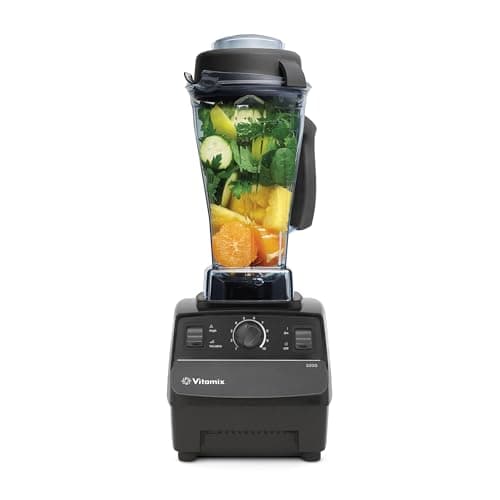
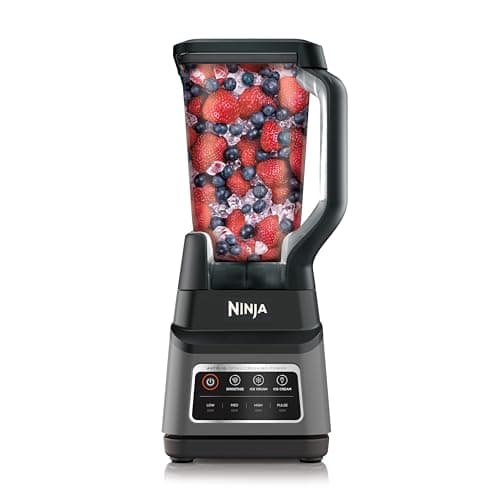
This is the most common comparison in the whole category, and it is usually answered with a shrug. It should not be. The two machines publish their specifications very differently, they disagree about what a motor rating even is, and the warranty documents differ by six years. Every difference below comes out of a manufacturer document, because we have not blended anything in either machine and are not going to imply that we have.
The published specifications, side by side
| Published spec | Ninja Professional Plus BN701 | Vitamix 5200 |
|---|
| Motor rating, in the manufacturer’s own words | 1,200 watts continuous; 1,400 watts peak | 2 HP; 120 V, 50/60 Hz, 11.5 amps. Vitamix publishes no watt figure |
|---|
| Container | 72 oz total, 64 oz max liquid | 64 oz |
|---|
| Warranty | 1 year limited | 7 years, full |
|---|
| What the warranty covers | Limited terms, as published on the product page | Parts, labor and shipping both ways |
|---|
| Tamper in the box | No | Yes |
|---|
| Speed control | Preset programs plus manual speeds | Fully variable dial; no presets, no timer |
|---|
| Published noise figure | Not published | Not published |
|---|
| Price | Live from Amazon, with the date it was checked, in the panel above. It disappears rather than going stale, so there is no remembered number printed here |
|---|
Read that first row again, because it is the whole problem with this comparison as it is normally written. The two brands are not filling in the same field. One of them publishes watts. The other one does not publish watts at all.
Neither motor rating tells you what you think it does
Ninja is unusually candid here, and it deserves saying plainly: the BN701 specification table publishes 1,200 watts continuous and 1,400 watts peak as two separate numbers. Almost nobody else in this category does that. Most brands publish the peak figure alone, because it is bigger, and leave you to assume it is the number that does the work. It is not. Peak wattage is measured at the instant of maximum draw under conditions the manufacturer chooses; continuous wattage is roughly what the motor pulls while it is actually blending your breakfast.
Vitamix takes the opposite approach and publishes no watt figure for the 5200 whatsoever. The specification table gives 2 HP and a nameplate rating of 120 V, 50/60 Hz, 11.5 amps, and stops. That is not evasion so much as a different tradition — but it does mean that every side-by-side table you have ever seen putting a Vitamix wattage next to a Ninja wattage contains a number Vitamix never published. If you want a comparable figure you have to derive it yourself from the nameplate, and you should be told when a number has been derived rather than quoted:
Vitamix 5200 nameplate: 11.5 A × 120 V = 1,380 W
Ninja BN701 published: 1,200 W continuous / 1,400 W peak
Difference at the wall, continuous vs derived nameplate: about 180 W
That 1,380 W is our arithmetic on Vitamix’s own published numbers, shown so you can redo it. It is not a Vitamix specification and we will not present it as one. And what it suggests is that the power gap between these two machines is far narrower than the price gap — a nameplate maximum against a published continuous rating is not even a like-for-like comparison, and the honest summary is that both machines have more than enough motor for a jar of frozen fruit and a banana.
If power is what you came here to compare, the uncomfortable conclusion is that it should not be the thing that decides this purchase. There is a longer treatment of why in the guide to what blender wattage actually means, including why jar geometry and a tamper move a frozen load that another two hundred watts will not.
The warranty is the actual product
Here is where the two machines stop being similar. Ninja publishes a one-year limited warranty on the BN701. Vitamix publishes a seven-year full warranty on the 5200, covering parts, labor and shipping in both directions. Those are not marketing claims, they are the terms each company has written into a document it can be held to, and the gap between them is the single most decisive published fact in this comparison.
Vitamix 5200 warranty: 7 years, full
Ninja BN701 warranty: 1 year, limited
Covered ownership, side by side: 7× as long
A warranty term is a company’s own actuarial judgment about its own motor, published at its own legal risk. When one brand writes seven years and the other writes twelve months, they are telling you something about expected service life that no smoothie test can tell you. This is why the warranty column exists on every table on this site and why it is tabulated across the whole category in the warranty comparison.
But a long warranty is only worth its price if you intend to be there for it. Seven years of coverage is enormous value to somebody who blends daily, makes nut butter, and expects to still own the machine in a decade. It is close to worthless to somebody who makes four smoothies a week and will move house twice in that period. If reading the last two paragraphs has quietly settled it for you — if you have just decided that six extra years of coverage is not what you want to spend the difference on — then the useful next page is not this one. It is the under-$200 roundup, where the BN701 sits among the machines that compete with it directly, and where the comparison you actually need is between them rather than against a machine you have already ruled out.
Where else they genuinely differ
The tamper, and what it is for.The 5200 ships with a tamper; the BN701 does not. This sounds like an accessory and is not. When a mixture is thick or short of liquid, the blades carve a pocket of air and spin inside it while the food sits above, untouched — cavitation, and the reason a powerful blender can sit there roaring while nothing happens. A tamper lets you push the load back down onto the blades while the machine runs. Without one, the same job means stopping, opening, scraping, restarting, and repeating. For a drinkable smoothie this never comes up. For nut butter, thick smoothie bowls or anything low-liquid, it comes up constantly. Ninja’s own listed limitation for the BN701 is exactly this.
Variable dial against preset programs. The 5200 has a fully variable speed dial and no presets, no timer and no self-clean cycle. The BN701 has Auto-iQ programs that run and stop on their own. These are opposite design philosophies and both are defensible. A variable dial is what makes a thick mixture workable, because you can hold the motor at the speed the load will actually accept. A program that stops by itself is worth more than it sounds when you are doing something else in the kitchen. Which of those you value is a fact about how you cook, not about which machine is better.
Capacity, and the height that comes with it.Ninja publishes 72 oz total and 64 oz of maximum liquid; Vitamix publishes a 64 oz container. On usable volume they are effectively the same machine. The 5200’s jar is tall and narrow, which is the shape that generates a proper vortex — and also the shape that will not fit under a wall cabinet in some kitchens. Standard US worktop-to-cabinet clearance is 18 inches. Measure yours with a tape before you spend anything, on either machine, because a blender stored in a cupboard gets used about half as often as one left out.
Repairability. Vitamix publishes and sells replacement parts for the 5200, which means a failure in year eight is a repair rather than a write-off. That is a real difference in what ownership looks like at the far end, and it is not visible anywhere on a spec sheet.
What the price difference does not buy
It is worth being explicit about the things that do not change when you spend several times as much here, because a comparison that only lists advantages is not a comparison. Capacity does not change: 64 oz of usable liquid against 64 oz of container. Noise does not measurably change, in the sense that neither company publishes a decibel figure, so there is no basis on which anyone can claim one is quieter — and both are high-power countertop machines, which is a category that is loud by construction.
Everyday smoothie quality does not change in any way that survives contact with a real kitchen. A jar of frozen berries, a banana, yogurt and liquid is a job both of these machines have far more motor than they need for, and the variable that decides the result is loading order rather than hardware: liquid first, soft ingredients next, powders after that, frozen items last on top. That order is in most manufacturer manuals and it does more for a smoothie than several hundred watts.
Running cost does not change enough to notice either. A blender that draws more power for the same few minutes a day still lands in low single-digit dollars a year, and the full arithmetic — with the electricity rate named and the substitution shown so you can redo it with your own tariff — is set out in the running-cost guide. What the difference buys is the tamper, the variable dial, the availability of spare parts and six extra years of coverage. That is the honest list, and if none of those four items is worth the money to you, that is a complete answer rather than a failure to decide.
What each one is bad at
The Vitamix 5200 is bad at being a modern appliance. No presets, no timer, no self-clean cycle, and a price that mostly buys you a motor and a warranty rather than features. It publishes no decibel figure, and this class of machine is genuinely loud — neither brand publishes noise data, so nobody can honestly tell you which is louder. The tall jar is a real fit problem in kitchens with low cabinets. And if your honest use is four smoothies a week, most of what you are paying for is a seven-year term you will not need.
The Ninja BN701 is bad at thick, low-liquid work. No tamper means a smoothie bowl or a batch of nut butter turns into a stop-scrape-restart session, and a one-year warranty is thin comfort if you intend to put the motor under that kind of load regularly. The stacked blade tower is more surfaces to wash than a single fixed blade. And one year is one year: after month thirteen, a motor failure is your problem.
The decision rule
If you will make nut butter, thick smoothie bowls or hot soup more than a few times a year, or you genuinely intend to own one blender for the next decade, buy the Vitamix 5200 — the tamper and the seven-year warranty are the two things the extra money buys and they both bite on exactly those jobs. If your blending is smoothies, shakes, frozen fruit, salsa and the occasional batch of soup that you will let cool first, buy the Ninja BN701, because on those jobs the published difference between these machines will not show up in your kitchen and you should keep the money.
The condition that flips the answer is thick, low-liquid, sustained work, and it flips it because that is where both differentiators land at once: the tamper is what makes the job possible, and the warranty is what covers the motor for having done it. Nothing about smoothie texture flips it. Nothing about wattage flips it. If you are unsure which side of the line you fall on, the tiebreaker is frequency — a job you do twice a year is not worth several hundred dollars of insurance against.
What this comparison is not
It is not a head-to-head test. We did not put both machines on a bench and run the same smoothie through each. Every figure above is quoted from a manufacturer specification table or warranty document, listed at the bottom of this page, except the derived 1,380 W nameplate arithmetic, which is labeled as ours and shown in full so you can check it. Where a brand publishes nothing — noise, in both cases — the cell says so rather than guessing. You are welcome to disagree with the conclusion while accepting all of the facts; that is a perfectly reasonable outcome and the sourcing is there precisely so you can.