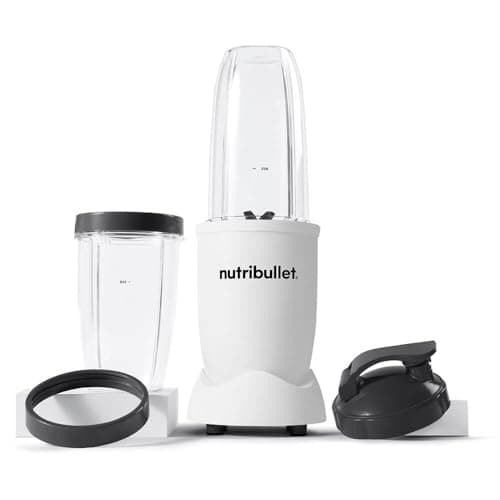
This assessment is specification- and documentation-based, not hands-on. We do not own a NutriBullet Pro, nobody here has blended anything in one, and no sentence below describes how it performed for us — because it has not performed for us at all. What follows is what NutriBullet publishes on its own product page and warranty page, read carefully, put next to the rest of the category, and sourced so you can check every line. That is a narrower claim than most reviews make, and it is the only one we can make honestly.
What NutriBullet actually publishes
Four figures, and one of them is an absence. The motor is listed as 900 watts. The box is listed as containing two 32 oz cups. The warranty is one year, with cups and accessories excluded. And no decibel figure is published anywhere, which is normal for this category and worth stating rather than skipping.
One thing to flag before it confuses you: NutriBullet’s own product page for the Pro is not internally consistent about which cups ship in the box. The specification field we cite reads two 32 oz cups, and that is the figure carried through this page, but if you buy expecting a specific pair of cup sizes, check the listing on the day rather than trusting a review — including this one.
900 watts, with no qualifier attached
NutriBullet publishes “900 watts of power” and lists a 900 W motor base in the box contents. It does not say whether that is a continuous rating, a peak rating measured at the instant of maximum draw, or a nameplate figure. That single omission is more consequential than it looks, because other brands in this category do say.
Ninja publishes a continuous wattage and a peak wattage as two separate numbers on its full-size machines. Hamilton Beach publishes a peak figure, defines what it means in its own manual, and prints the true nameplate amperage next to it. Vitamix publishes no watt figure at all and gives you horsepower and a nameplate amperage instead. Against that spread, an unqualified “900 watts” is not comparable to anything outside NutriBullet’s own line — where it does sit cleanly between the 600 W model and the 1,200 W Ultra, all three quoted the same way.
The practical answer is that 900 W is real power for a single serving, and that for the job this machine is bought for — a shake, a smoothie, a cup with some frozen fruit in it — the number is sufficient rather than decisive. What wattage does and does not tell you is a longer argument, and it applies here more than almost anywhere.
Where the Pro sits in NutriBullet’s own line
This is the one comparison that is genuinely clean, because all three models are quoted the same way by the same company:
| Model | Published motor | Cups in the box | Warranty |
|---|
| NutriBullet 600 | 600 W | 24 oz tall, 18 oz short | 1 year |
|---|
| NutriBullet Pro | 900 W | Two 32 oz cups | 1 year; excludes cups and accessories |
|---|
| NutriBullet Ultra | 1,200 W | 24 oz and 32 oz | 1 year machine; 5 years on the blade |
|---|
Read down the middle column and the Pro is the sensible midpoint on power. Read down the right-hand two and it is the weakest of the three: the 600 ships the only genuinely small cup NutriBullet makes, and the Ultra is the only model in the line with a long term on the part that actually breaks. The Pro’s case is not that it wins any column. It is that it costs a fraction of the Ultra, has more motor than the 600, and is the model whose parts are stocked everywhere.
The warranty is the strongest reason to think twice
NutriBullet’s warranty terms cover the machine for one year and explicitly exclude cups and accessories. Read that against how a bullet blender dies.
The motor base is a sealed unit doing an intermittent, low-duty job. It rarely fails first. What fails first, with striking consistency, is the rubber gasket seated in the blade assembly: it goes through the dishwasher, dries out, hardens, loses compression, and then the cup leaks down the outside of the base every time you run it. At that point the machine works perfectly and is unusable, and the part responsible is an accessory. So is the cup, if you crack one. So is the lid, if you strip the thread.
The uncomfortable summary. NutriBullet covers the component least likely to fail for one year, and excludes the components most likely to fail entirely. That is not a defect in the product; it is a fact about the document, and it should change what you check before you buy — namely whether replacement gaskets, cups and blade assemblies are easy to buy for the model you are choosing.
For the Pro, they are. NutriBullet parts are among the most widely sold in the category, which is the reason this machine still earns a recommendation despite the terms above. A consumable part you can reorder cheaply is, in practice, a better outcome than a warranty claim you are not entitled to make. It is also worth knowing that NutriBullet does write a longer term when it wants to: the NutriBullet Ultra carries five years on its Ultra Rapid Extractor blade against one year on the machine, which is the same company covering the failure point on a different model.
The cups
Two 32 oz cups, and nothing smaller. This is the Pro’s clearest ergonomic weakness and it is rarely mentioned. A 32 oz cup is a large vessel for a 10 to 14 oz shake: the mixture sits low and shallow, the blades have a thin layer rather than a column to move, and you are carrying a container roughly twice the size of what is in it. NutriBullet’s own 600-series ships an 18 oz short cup alongside its 24 oz one, and the Ultra ships 24 oz and 32 oz, so a smaller vessel is plainly something the company builds — just not into this box.
The counter-argument is real: 32 oz of headroom means you can under-fill without ever hitting a fill limit, and the drinking lid means the vessel you blended in is the vessel you leave with, which is the entire reason to own one of these rather than a jug. If you make one large smoothie rather than one modest shake, the cup size is a feature.
What it costs to run
Three minutes of blending a day, every day for a year, at the US average residential rate of 18.34¢ per kWh:
900 W ÷ 1,000 × 18.25 h × 18.34¢ = $3.01 a year
That is the whole electricity story. It is not a differentiator, it should not influence the purchase, and it is published here because knowing a number is small is as useful as knowing it is large. The full method, including how to substitute your own rate, is on the running-cost guide.
What we cannot tell you
How loud it is, in numbers. NutriBullet publishes no decibel figure for the Pro, so there is nothing to quote and nothing to compare. How long it lasts in a real kitchen — we have no failure data and neither does anyone else publishing in this category. And how it compares on power to a machine from another brand, for the reason set out above: an unqualified watt figure cannot be lined up against a qualified one without assuming something nobody stated.
Who should buy it, and who should not
Buy it if your use is a daily shake or smoothie in a cup you take with you, you want the largest parts ecosystem in the category behind it, and you accept a one-year term on the base. That describes most people who search for a bullet blender, which is why this is the default recommendation rather than a contrarian one.
Do not buy it for anything thick. Nut butter, low-liquid smoothie bowls, dough: the narrow cup gives a thick mixture nowhere to move and the motor nowhere to cool, and there is no tamper because you cannot put one in a sealed inverted cup. Do not buy it for hot liquid — the manual prohibits it and the physics agrees. And if a longer warranty is what you are shopping for, the protein-shake roundup has a two-year machine in it.