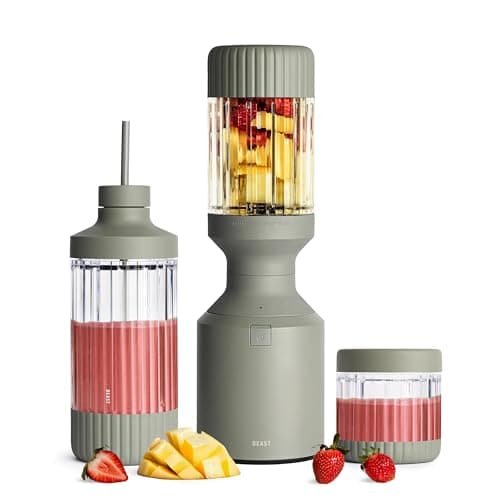
The Beast Mega 1200 takes this one, on two years of warranty where one is the class norm and a manufacturer that states capacity honestly. The NutriBullet Pro is the cheaper answer and the one most people should actually buy. Every machine here has enough motor to mix whey powder into milk, so the ranking is not built on watts — it is built on the cup, the cleaning and the warranty document, which are what decide whether the machine is still on your worktop in two years. Nobody here has blended a shake in any of them; every figure below is quoted from the manufacturer page or warranty page listed at the bottom.
Why wattage is close to the wrong question here
A protein shake is liquid, powder, and usually something soft or frozen. The published motor ratings across this list run from 250 W on the Magic Bullet to 1,200 W on the Beast Mega 1200 and the NutriBullet Ultra — nearly a five-fold spread — and for a scoop of powder in a cup of milk that spread barely expresses itself. Where it does start to matter is the moment you add frozen fruit, and even then the deciding factor is how much frozen fruit relative to liquid, not the number on the base.
There is a second problem with using wattage to choose between these five. NutriBullet publishes 600 W, 900 W and 1,200 W for the three models here with no peak or continuous qualifier attached to any of them; Beast publishes 1200 W and separately states a horsepower equivalent; Magic Bullet publishes a 250 W motor base. Within the NutriBullet line those numbers are at least comparable to each other. Across brands they are not necessarily measuring the same thing, and no manufacturer here says which convention it used. A comparison table that stacks them in one column is quietly asking you to assume something nobody published.
Load the cup in this order: liquid, powder, frozen
This is free, it costs nothing to adopt, and it fixes the single most common complaint about protein shakes in a bullet blender — the gritty, half-dissolved lump at the bottom. The mechanism is mechanical rather than chemical. A bullet blender is loaded upside down: you fill the cup, screw the blade assembly on, and invert the whole thing onto the base, so whatever went into the cup first ends up sitting directly on the blades.
Put dry powder in first and you have packed it into the narrowest part of the vessel, against the blades, with nothing fluid around it. The blades then spin inside a dense paste that has nowhere to go, the mixture above never enters the vortex, and you get exactly the result people blame on the motor. Put liquid in first and the powder lands into it, disperses on the way down, and the blades have something that moves.
The order. Liquid first — the full amount, not a splash. Powder second. Soft ingredients like banana or yogurt third. Frozen fruit and ice last, on top, so they are furthest from the blades when the cup is inverted and get pulled down into a mixture that is already circulating. Then stop at the fill limit for your cup rather than filling to the rim: a blender needs headroom to create a vortex at all.
The ranking
1. Beast Mega 1200 — the best-specified machine here. Two years of warranty in a class where one year is the norm, 1200 W, and a 1000 mL (33 oz) vessel. Beast is also the only brand in this catalog that publishes blending capacity separately from total vessel volume, which is the honest way to state a number nobody can actually use to the brim. The ribbed vessel wall is designed to disrupt the vortex rather than let the mixture spin smoothly past the blades — the failure mode that makes a smooth-walled cup look underpowered. What it costs you is money: it is substantially more expensive than the mainstream bullets, and 33 oz is one generous serving rather than a batch. Those same ribs are also more contour to get a brush around than a straight-sided cup.
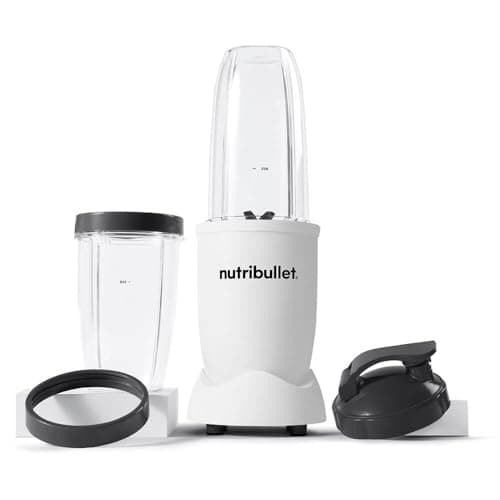
2. NutriBullet Pro (900 W) — the one most people should actually buy.Two 32 oz cups, 900 watts, and the largest replacement-parts ecosystem in the category. That last point is doing more work than it appears to. The part that kills a bullet blender is almost never the motor; it is the rubber gasket in the blade assembly, and NutriBullet cups, lids and blade assemblies are sold everywhere. A machine whose consumable parts are a cheap, easy reorder is a machine you keep. Against that: NutriBullet’s warranty runs one year and explicitly excludes cups and accessories, and the two cups it ships are both 32 oz, which is a large vessel for a 12 oz shake. It sits second here on the warranty and the cup sizes, not on the motor — and it is the pick we would hand to most people asking. The full review is here.
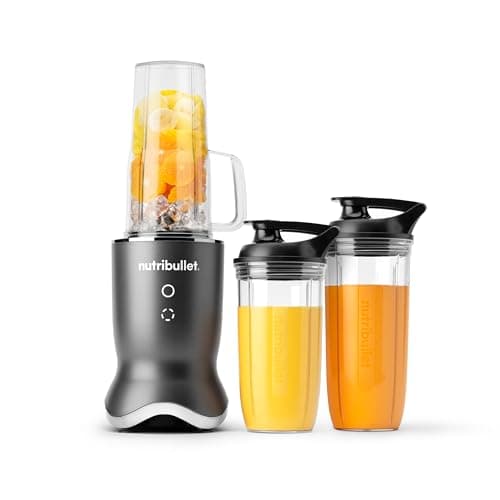
3. NutriBullet Ultra (1200 W) — buy it for the blade warranty, not the noise claim.Two cup sizes in the box, 24 oz and 32 oz, which is a better spread than the Pro’s. The genuinely interesting term is the split warranty: one year on the machine, five years on the Ultra Rapid Extractor blade. Since the blade assembly is where these machines fail, a five-year term on that specific part is worth more than the headline suggests. What it should not be bought for is quietness. NutriBullet markets it as their quietest single-serve blender and publishes no decibel figure at all, from any test, so there is nothing to verify and nothing to compare it against.
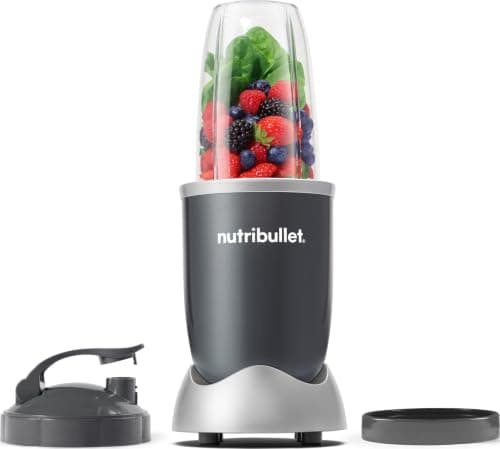
4. NutriBullet 600 — the only genuinely single-serving cup in the list. It ships a 24 oz tall cup and an 18 oz short cup, and the 18 oz cup is the only vessel here sized like an actual shake. Everything else starts at 24 oz and goes up, which sounds like a small point until you notice that a small volume in a large cup sits below the blade line. At 600 W it is the least powerful mains machine here and it shows on anything with much frozen fruit in it. One-year warranty.
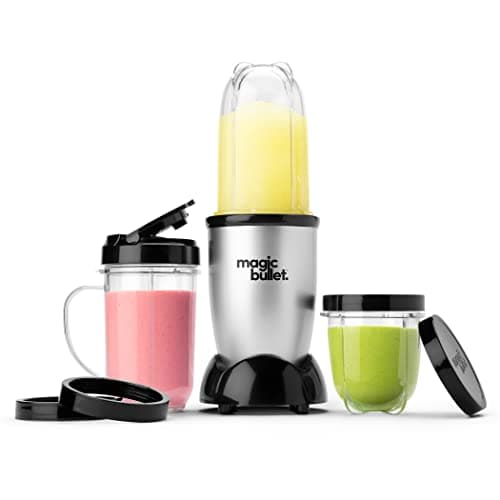
5. Magic Bullet 11-piece set — a chopper that also makes shakes. 250 watts. That is roughly a quarter of a mainstream bullet blender, and buying it expecting blender behavior is the most common mistake in this category. For a soft shake, a dressing or a dip it is genuinely competent and it is by a wide margin the cheapest thing here. Magic Bullet also publishes no ounce figure for any of the three cups it ships, which is an unusual gap and the reason its capacity cell below is empty rather than filled with a number from a retailer listing.
The five, side by side
| Machine | Published motor | Vessel | Warranty |
|---|
| Beast Mega 1200 | 1200 W | 1000 mL (33 oz) | 2 years, US and Canada, household use |
|---|
| NutriBullet Pro | 900 W | Two 32 oz cups | 1 year; excludes cups and accessories |
|---|
| NutriBullet Ultra | 1,200 W | 24 oz and 32 oz | 1 year machine; 5 years on the blade |
|---|
| NutriBullet 600 | 600 W | 24 oz tall, 18 oz short | 1 year |
|---|
| Magic Bullet | 250 W | Not published | 1 year |
|---|
Not one of the three brands publishes a decibel figure for any machine on this list. That is the honest state of the information, and it is why noise does not appear as a column.
Read the warranty column twice
NutriBullet’s warranty terms cover the machine for one year and exclude cups and accessories. Set that next to how these products actually fail. The motor base is a sealed unit that gets nothing but air; the cup gets dropped, the lid threads get cross-threaded, and the gasket in the blade assembly gets left in a hot dishwasher until it stops sealing and the thing leaks down the side of the base. The warranty is written around the part least likely to need it.
That is not a reason to avoid NutriBullet — it is a reason to know what you are buying, and it is why parts availability weighed as heavily as warranty length in this ranking. A replacement cup that costs a few dollars and arrives in two days is, practically, a better outcome than a warranty claim you cannot make. The Ultra’s five-year blade term is the exception worth naming: it covers the exact component the rest of the line excludes. Beast’s two years, in a class where one is standard, is the strongest headline term here. The full cross-category picture is in the warranty comparison.
Cup size is a specification, not a preference
A 12 oz shake in a 32 oz cup leaves the mixture sitting low, below the widest part of the vessel, and gives the blades a thin layer to work with rather than a column. It still works. It works less well than the same shake in an 18 oz cup, which is the single most persuasive argument for the NutriBullet 600 despite it having the smallest motor here.
Then check the boring things before you buy, because they are what determine whether the machine gets used: whether the drinking lid is in the box or sold separately, whether the cup fits your car’s cup holder, and whether the cup is dishwasher-safe while the blade assembly is not — that combination is normal, and it is exactly how gaskets get cooked. Rinse the blade assembly by hand, immediately, every time.
What a year of daily shakes costs to run
Nobody in this category publishes this, so here it is with the arithmetic visible. At the site-wide assumption of three minutes of blending a day, 365 days a year, and the US average residential rate of 18.34¢ per kWh:
1,200 W ÷ 1,000 × 18.25 h × 18.34¢ = $4.02 a year
900 W ÷ 1,000 × 18.25 h × 18.34¢ = $3.01 a year
600 W ÷ 1,000 × 18.25 h × 18.34¢ = $2.01 a year
250 W ÷ 1,000 × 18.25 h × 18.34¢ = $0.84 a year
The entire spread across a five-fold difference in motor power is three dollars a year. Running cost is not a reason to choose any of these over any other, and knowing that is useful precisely because it lets you stop weighing it. Substitute your own rate and your own habits on the running-cost guide.
When a personal blender is the wrong machine for this
If your shake routinely includes a full cup of frozen fruit and very little liquid, none of these will be comfortable — the narrow cup gives a thick mixture nowhere to move and the motor nowhere to cool, and repeated pulsing at near-stall is how a small motor dies. If you are making two shakes at a time, refilling a single-serve cup twice is worse than owning a pitcher, and a full-size machineis the honest answer. And nothing here is for hot liquid: the cup seals, steam expands, and NutriBullet’s own manual prohibits it. Ice specifically gets its own treatment in the guide on whether personal blenders handle ice.