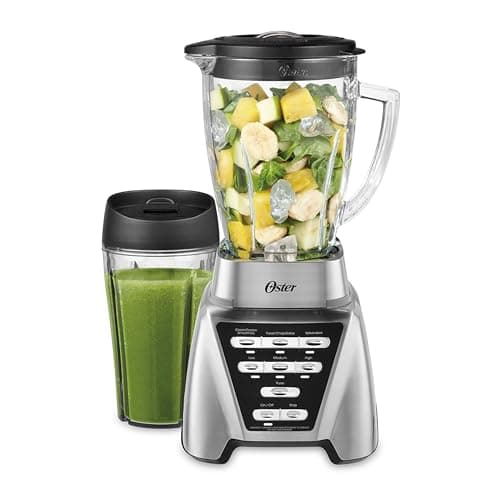
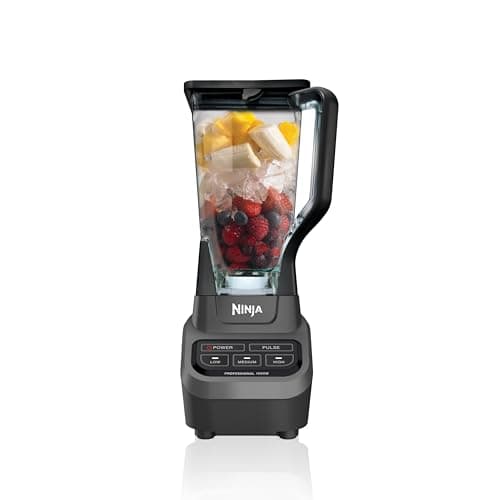
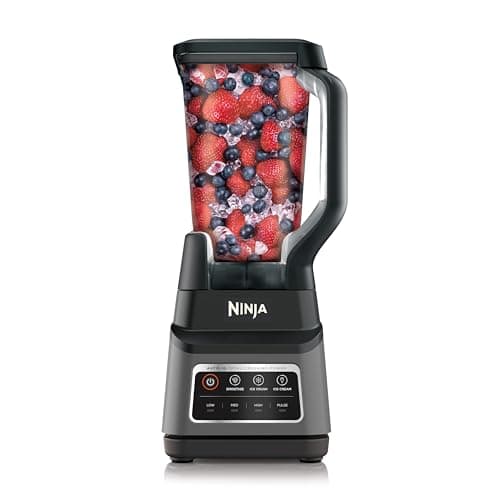
Buy the Ninja Professional Plus BN701. It is the only machine in this matchup whose manufacturer still publishes a specification table — 1,200 W continuous, 1,400 W peak, 72 oz total with 64 oz of usable liquid — and on a site built around citing manufacturer documents, a machine we can actually document wins a close call. Buy the Oster Pro 1200 only if a glass jar and a three-year warranty matter more to you than knowing what you bought, which is a defensible position and not the one we would take.
Almost every version of this comparison you will read puts a wattage next to a wattage. We cannot do that honestly, and the reason is the comparison.
The asymmetry that decides it
Oster’s own product page for the Pro 1200 returns HTTP 410 Gone. Not a redirect, not a 404 that might be a broken link — 410 is the status a server returns to say a resource has been deliberately removed. The model is delisted. That means the “1200” in its name is not a figure traceable to a manufacturer document, and neither is its jar capacity. We leave those cells empty on this site rather than repeat the numbers other sites quote, and we are not going to make an exception on a page whose whole subject is the comparison.
SharkNinja, for the BN701, publishes the opposite: both a continuous and a peak wattage, which almost nobody in this category does. Quoting only the flattering peak figure is the industry norm; publishing the continuous draw as well is a brand telling you what the motor actually does. It is the single most useful piece of candor in our whole catalogue, and it is why the BN701 appears in so many of our rankings.
So the trade is clear and it is unusual: three documented years of coverage on an undocumented machine, or one documented year on a fully documented one. Everything below is an attempt to work out which of those is worth more, because the usual tiebreakers do not apply.
Reading the two warranty documents
Oster publishes a three-year term on kitchen blenders, and the remedy it publishes is replacement rather than repair. That distinction is doing more work than the number of years. A claim does not get your machine fixed; it gets you a different machine, chosen by Oster from what they are selling at the time. On a delisted model that is close to a certainty rather than a risk — there is no Pro 1200 to replace it with.
SharkNinja publishes one year limited on the BN701. One year is short, and we say so in the product’s own badges, where it is marked as a caution rather than a feature. What that year does cover is a machine whose parts SharkNinja still sells individually: we cite their own listings for a replacement motor base and a replacement 72 oz pitcher elsewhere on this site. After year one you are paying for parts, but the parts exist.
That is the honest shape of it. Oster transfers more of the risk away from you for longer, and then resolves it with a machine that is not yours. Ninja transfers less risk and leaves you able to repair. Our full taxonomy of full, limited and replacement terms is on blender warranties compared.
Side by side
Manufacturer figures only. Where a maker has withdrawn the document, the cell says so rather than carrying a number recovered from a retailer listing. Annual cost assumes 3 minutes a day, 365 days a year at 18.34¢ per kWh. | Ninja Professional Plus BN701 | Oster Pro 1200 with glass jar | Ninja Professional Blender BL610 |
|---|
| Spec page live? | Yes — full published table | No — HTTP 410 Gone | No — withdrawn; specs only from parts listings |
|---|
| Published motor | 1,200 W continuous; 1,400 W peak | Not verifiable | 1,000 W, from the replacement motor base listing |
|---|
| Jar | 72 oz total, 64 oz max liquid, plastic | Glass; capacity not verifiable | 72 oz per the replacement-pitcher listing, plastic |
|---|
| Warranty | 1 year limited | 3 years, replacement remedy | Not published for this model |
|---|
| Cost per year to run | $4.02 | Not comparable — no published rating | $3.35 |
|---|
| Tamper | No | No | No |
|---|
Where Oster genuinely wins
Two places, and they are real. The first is the glass jar. Oster is one of only two machines in our entire catalogue that ships one, and glass does not cloud, does not hold onto garlic and does not worry anybody about plastic. If that is your reason for being here, no Ninja will give it to you at any price — the full picture is on best blenders with glass jars.
The second is the term itself, for a particular buyer. If you blend occasionally, do not intend to repair anything ever, and would rather a manufacturer handle a failure in year two than you handle it, three years of replacement cover is worth more to you than a parts catalogue you will never use. We think that reader is less common than the warranty length suggests, but they exist and this is their machine.
Where Ninja wins
On everything that can be checked. Usable liquid capacity is published at 64 oz, which is a family batch in one go. The motor figure is published twice, in the honest direction. The Auto-iQ programmes stop on their own. Parts are sold individually. And it is consistently cheaper than the Oster, which makes the warranty comparison less flattering still — you are not paying a premium for the shorter term.
The things Ninja does not give you are a tamper and a long warranty, and both matter. Without a tamper, thick low-liquid loads mean stopping and scraping, which is why we keep the BN701 off our nut-butter ranking and say so in its skip line. If you want this class of machine with a tamper, you are looking at the premium tier and the argument moves to Ninja vs Vitamix.
The third option: the cheaper Ninja
The BL610 is on this page because it is what many people actually mean by “a Ninja”, and because it makes the documentation point twice. SharkNinja has withdrawn its page too. Its motor figure survives only because SharkNinja still sells a replacement motor base for it and prints 1,000 W on that listing; its capacity survives only from a replacement-pitcher listing, which contradicts itself between 72 and 71 oz on the same page.
It is the least you can spend on a full-size machine that genuinely handles frozen fruit, and we recommend it on that basis in our budget rankings. But if documentation is what tipped you toward Oster’s rival in the first place, the BL610 has the same problem Oster has, and at that point you should simply buy the BN701. The two Ninjas are argued directly against each other on Ninja BL610 vs BN701.
What we are not going to tell you
We have not blended anything in any of these three machines. We publish no reliability comparison, no failure rate and no noise figure, because none of the three manufacturers publishes a decibel number and we have no lab. The empty cells in the table above are the point of this page rather than a gap in it: they are what a withdrawn product page looks like when somebody refuses to fill it in from memory. Our method is published in full.
How to decide between them in two minutes
Buy the Ninja BN701 if
You blend frozen fruit, you want 64 oz of usable capacity, you would like to know what you bought, and you are comfortable owning the risk after year one on a machine whose parts are still sold. This is most people, and it is why this machine appears in more of our rankings than any other.
Buy the Oster Pro 1200 if
A glass jar is non-negotiable, your blending is soft rather than frozen, and you would rather have three years of manufacturer cover than a documented specification. Go in knowing the remedy is replacement and the model is delisted — both are published facts, not speculation.
Buy neither if
You make nut butter or thick smoothie bowls. Neither machine has a tamper, and without one this load is a session of stopping and scraping on either. The ranking that actually solves it is best blenders for nut butter.
The check worth doing yourself
Before buying any blender, search the manufacturer’s own site for the exact model number. If the page loads, you can verify what you are being sold and you can usually find the parts. If it does not, you are buying on retailer copy, and everything in the listing — wattage, capacity, jar material — is unverifiable. That one search is the whole lesson of this comparison, and it applies to brands neither of these companies owns.