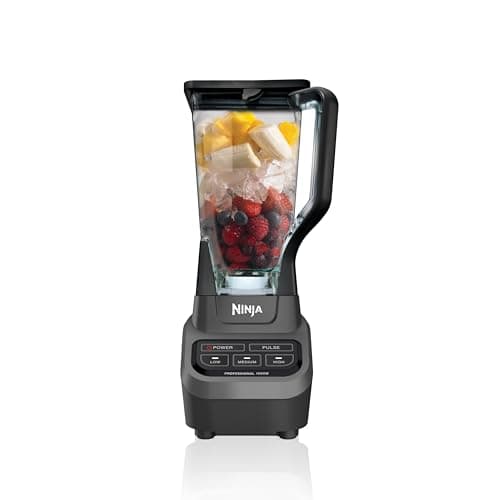
Start with the problem rather than the product. SharkNinja no longer publishes a specification page for the Ninja Professional BL610. The wattage, the pitcher capacity and the speed count that appear on every retail listing and in every roundup for this machine cannot currently be checked against a live manufacturer document. That is unusual for a model still sold in volume, and on a site whose entire method is tracing claims to primary sources, it is the most important fact about the BL610.
What that means in practice.Where other pages on this site print a specification, they print a link next to it. For the BL610 the pitcher capacity cell reads “not verifiable” rather than carrying the number everyone else quotes. That is not pedantry — it is the difference between a figure you can confirm in thirty seconds and a figure that has been copied between review sites for a decade with nobody checking whether the source still exists.
What SharkNinja still publishes
One thing, and it is a parts listing rather than a spec sheet: SharkNinja sells a 1,000 W motor base as a replacement part for this model, and its listing states the wattage. That is a manufacturer source and it is why the spec table above carries a 1,000 W figure at all. It should be treated as weaker evidence than the BN701’s live specification table, which gives both a continuous and a peak rating with the model number on the page.
It also carries no qualifier. There is no way to tell from a motor-base parts listing whether 1,000 W describes continuous draw, peak draw, or rated input. For the BN701 SharkNinja publishes 1,200 W continuous and 1,400 W peak side by side — which is precisely the kind of disclosure that is missing here, from the same manufacturer, on a cheaper machine. The wattage guide explains why an unlabeled watt figure is close to uninterpretable.
1,000 W × 18.25 h a year ÷ 1000 = 18.25 kWh
18.25 kWh × 18.34¢ per kWh = $3.35 a year to run
Three minutes a day at the US average residential rate. That figure inherits the uncertainty above: it is computed from a parts-listing wattage, not from a published motor specification, and it would move if the real continuous draw is lower.
The warranty
One year limited, which is SharkNinja’s standard blender term and is published on the BN701 specification page. One year is the shortest term of any machine in this site’s countertop list, and it sits alongside NutriBullet and Breville at the bottom of the full warranty table. For context, Hamilton Beach warrants its cheapest blender for three years in the US, and Oster warrants its kitchen blenders for three. Warranty length in this category does not track price, and the BL610 is one of the clearer illustrations of that.
What the machine is genuinely good at
Being cheap and working. The BL610 has been, for most of the last decade, the least you can spend on a full-size blender that will actually get through a jar of frozen fruit rather than humming at it. The controls are three speeds and a pulse, with nothing to learn. It has been sold in enormous numbers, which means replacement jars, lids and blade assemblies are easy to find and cheap — a practical form of repairability that has nothing to do with the warranty.
For the specific job most people buy a full-size blender for — frozen fruit, liquid, protein powder, once a day — it does the job, and the more expensive machines on this site will not make that particular drink noticeably better. That is worth saying plainly on a page that spends most of its words on what is wrong with the documentation.
What it is bad at
Thick, low-liquid loads. There is no tamper, so anything that stops circulating has to be managed by switching off, scraping the sides down, and starting again — and the stacked blade tower is in the way while you do it. Smoothie bowls and nut butter are the two jobs where this shows up immediately, and neither is a fair thing to ask of a one-year machine.
Cleaning. The stacked blade assembly has more surfaces than a single fixed blade, it is sharp, and it does not come apart. This is the standard trade-off of the Ninja design and it is the most common complaint owners raise about it.
And documentation, which is where this review started. If it matters to you that a manufacturer still stands behind a published specification for the thing you own, this is the one machine in this site’s countertop list that fails that test outright.
Why a withdrawn product page is not a small thing
It is tempting to treat this as bookkeeping. It is not, for four practical reasons.
A live product page is where the manual, the safety instructions and the parts diagrams normally sit. It is what a warranty claim is assessed against, and a one-year term leaves very little room for ambiguity about what was promised. It is the only place a specification can be corrected if it was wrong — a retail listing never gets updated. And it is the difference between a manufacturer treating a model as current and treating it as finished, which is a signal about how long parts will keep being made.
None of that stops the machine working. All of it changes what you can rely on, and it is the reason this model finishes last on the high-power roundup despite being more capable on frozen loads than the machine ranked above it.
If the warranty matters more than the power
There is a specific buyer for whom the BL610 is the wrong budget pick, and it is worth naming them. If you want the longest coverage available at the bottom of this market, the Hamilton Beach Power Elite carries three years in the US and five in Canada, against the BL610’s one — with a live spec page, a defined peak-power figure and a printed rating plate behind it.
The trade is blunt and goes the other way on capability: Hamilton Beach’s plate reads 3.7 A max, which works out to about 444 W of continuous draw, and a full jar of dry frozen fruit will stall it. So the honest framing is not “which is better” but “which failure would annoy you more” — a machine that dies in year two with no coverage, or a machine that needs liquid added and a smaller batch.
How it compares within the same brand
The obvious alternative is the Ninja Professional Plus BN701, from the same manufacturer, with a live specification page giving 1,200 W continuous, 1,400 W peak, a 72 oz pitcher with a 64 oz maximum liquid fill, and the same one-year warranty. It costs more. What the difference buys is Auto-iQ programs that stop on their own, more published capacity, and — the part this site weighs heavily — numbers you can actually verify.
If the extra money is not available, the BL610 is still a reasonable purchase and this page is not trying to talk you out of it. If it is available, the BN701 is the better machine on every axis this site can measure.
The decision rule
Buy the BL610 if the budget is genuinely fixed, the job is frozen fruit with liquid, and you accept a one-year warranty on a machine whose specifications you cannot check. Do not buy it if you make thick mixtures, if you want a tamper, or if the missing spec page bothers you as much as it bothers us. The rest of the budget field is on the under-$100 roundup, and the ranked full-size list is on the high-power roundup, where this machine finishes last for exactly the reason above.
If SharkNinja republishes a specification page for the BL610, this review will be updated and the update dated. If you have found one we have not, the correction address is on the contact page and we would rather hear it than not.