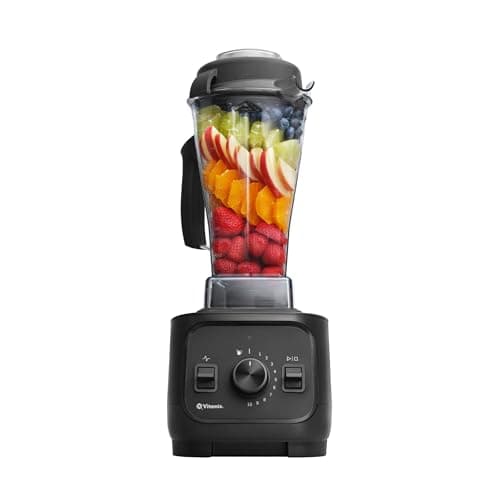
The case for the Vitamix VX1 is that it is the same 64 oz Classic container and tamper Vitamix ships on the 5200, on a base that finally publishes a watt figure, adds a pulse switch, a self-cleaning program and a count-up timer, and sits a step below the 5200 on price. The case against it is contained in one word on the spec sheet: the warranty is five years limited, where the 5200 carries seven years full and the Explorian E310 it replaces carried five years full. Vitamix also says, in its own manual, that the container is not dishwasher-safe.
What this review is.This assessment is specification- and documentation-based, not hands-on. Nobody at Basket & Blade has used a Vitamix VX1. Every claim below traces to Vitamix’s VX1 product page, the VX1 owner’s manual, its 5-Year Limited Warranty document, or arithmetic performed on those figures and shown in full. Where Vitamix publishes nothing, this page says so instead of filling the gap. The full method is on how we pick.
Why this page is about the VX1 and not the E310
This site planned an Explorian E310 review and never wrote one, and by the time it came up the honest version of that page had changed. Vitamix told CNET in April 2026 that “the E310 served as our entry-level blender for over a decade” and that the company launched the VX1 in February as its replacement for the first-time Vitamix buyer; the same report says the E310 has not been sold new on Vitamix’s own site since March 1, reconditioned units aside. When this site checked Amazon’s catalog through the Creators API on September 15, 2026, the black E310 listing returned “Currently unavailable” and the red one showed a single unit left. A page recommending a machine you cannot reliably buy is a page recommending nothing, so the review is of the machine that took its slot.
What actually changed is worth setting out from the two spec tables rather than from the press release, because some of the changes run in the buyer’s favor and some do not.
Explorian E310 against VX1, from Vitamix’s own product specification tables and the VX1 owner’s manual| Published by Vitamix | Explorian E310 | VX1 |
|---|
| Motor | 2 HP; 110-120 V; no watt figure | 2.2 HP; 120 V, 1,440 W |
|---|
| Container | 48 oz, with a mini-tamper | 64 oz Classic, with the classic tamper |
|---|
| Controls | Ten variable speeds, pulse | Variable speed 1-10, pulse, self-cleaning program, count-up timer |
|---|
| Container dishwasher-safe | Yes | No — hand-wash or the self-cleaning program |
|---|
| Assembled height | 18 in | 19.6 in |
|---|
| Cord | 4.5 ft | 3.5 ft |
|---|
| Warranty | 5 years, full | 5 years, limited |
|---|
Bigger jar, published watts, more control: for the buyer. A jar you cannot put in the dishwasher, an extra inch and a half of height, a foot less cord, and a warranty that went from full to limited: against. The rest of this page takes those one at a time.
The number Vitamix finally published
Vitamix’s specification table for the VX1 lists 2.2 HP and an electrical rating of 120 V, 1,440 W; the owner’s manual adds 12 A and 50-60 Hz. That matters more than it sounds, because for the 5200 Vitamix publishes horsepower and an 11.5 A nameplate and no wattage at all, and this site has to derive a figure from the amperage and label it as our arithmetic. Here the number is the manufacturer’s.
It is still a nameplate rating — the most the machine is rated to draw — not a continuous operating figure, so it does not belong in the same column as Ninja’s 1,200 W continuous rating or Hamilton Beach’s 700 peak watts. The wattage guide explains why those three kinds of number cannot be ranked against each other. The 2.2 HP figure cannot be converted into one either: horsepower is what the shaft delivers, watts is what the wall supplies, and the efficiency that links them is not published.
Vitamix VX1 — 1,440 W ÷ 1,000 = 1.440 kW
1.440 kW × 18.25 hours a year = 26.28 kWh
26.28 kWh × 18.34¢ per kWh = $4.82 a year
Three minutes a day at the US average residential rate, retrieved from the EIA in September 2026. Under five dollars a year, and about twenty cents more than the 5200’s derived figure. Whatever separates the two machines, electricity is not it.
Five years, limited: what the word costs you
The VX1’s warranty is a separate published document, and it is worth reading rather than assuming, because “5-year” is the part Vitamix prints large and “limited” is the part that changed. What the document actually promises is good: for five years from purchase or delivery, Vitamix will repair the machine with new or refurbished parts or exchange it, at its discretion and at no cost, and it will pay standard shipping in both directions. A repaired or replaced machine inherits the remaining term rather than starting a new one.
What “limited” adds is a set of boundaries. Cover extends to the original owner only, for a machine bought from Vitamix or an authorized retailer. Commercial or rental use is out, as are missing serial numbers, third-party parts, unauthorized repairs, cosmetic wear and consumables such as seals. All implied warranties are capped at the same five years, and Vitamix’s maximum liability is capped at what you paid. The Explorian’s five-year fullwarranty and the 5200’s seven-year full warranty are Vitamix’s own documents too, and the difference in wording is what separates them from this one.
Two practical consequences. First, “original owner” means a second-hand VX1 carries no Vitamix warranty at all, which is a real change for a brand whose machines change hands a lot. Second, the seller matters: the document says in terms that the warranty is not available in the United States or Canada for machines bought from unauthorized sellers, so before you buy from a marketplace listing, check who is actually selling it. Neither is a reason to avoid the machine. Five years of parts, labor and two-way shipping is still longer than any Ninja, NutriBullet, Blendtec Classic or Breville term in this site’s catalog, and the warranty table shows how far ahead of the field it remains. It is simply less than the E310 gave, and the price of the machine did not fall to match.
The jar is the 5200’s, and that is most of the argument
Vitamix’s product page says the 64-ounce container on the VX1 is “the same container featured on the iconic Vitamix 5200,” and the manual identifies it as the 64 oz Classic container, model VM0135, with the classic tamper in the box. That is the tall, narrow jar whose vortex pulls ingredients back onto the blades, and the tamper is how you keep a thick, low-liquid mixture moving when the vortex stalls. Together they are the reason a Vitamix finishes smoothie bowls, nut butter and frozen loads that wider jars with bigger headline motors give up on. The E310 had a 48 oz container and a mini-tamper; the upgrade to the full-size jar is the single biggest functional change in the VX1, and it is a change in the buyer’s favor for anyone blending for more than one.
The manual is specific about how to use the tamper, and the rules are worth knowing before you buy rather than after: never for more than 30 consecutive seconds, never with the container more than two-thirds full, and always through the lid plug opening with the lid locked, because the splash disk near the top of the tamper is what keeps it off the blades. Vitamix also says the base accepts its 64 oz low-profile containers, its 48 oz and 32 oz containers (including the dry-grains and stainless versions) and the Personal Cup Adapter — but that the 12-cup food processor attachment and the SELF-DETECT blending cups will not work on this base. So the jar can be sized to the job later, within that list.
The catch is height. Vitamix publishes 19.6 inches with the 64 oz container on the base, against 18 inches for the E310 — and 18 inches is the standard US worktop-to-cabinet clearance. Measure before you buy; the full-size machines that clear the gap are ranked in best blenders for small kitchens. A machine that lives in a cupboard gets used half as often, and that does more to decide whether the purchase was worth it than anything on the spec sheet.
Not dishwasher-safe, and what Vitamix offers instead
The VX1 owner’s manual states it twice, in a warning box and again under container cleaning: “The container is not dishwasher safe.” The E310’s specification table says the opposite for its 48 oz jar. This is the change most likely to annoy a real household, and it deserves a plain statement rather than a footnote.
What Vitamix offers instead is a self-cleaning program on the dial: fill the container half full with warm water, add a couple of drops of dish soap, lock the two-part lid, turn the dial to the self-cleaning position, press start, and the program stops by itself. The manual’s manual alternative is 30 to 60 seconds at speed 10 with the same water and soap. The tamper and the centering pad on the base are dishwasher-safe per the manual, which says nothing either way about the lid; the container is the part it rules out. Whether that is acceptable depends entirely on how you run your kitchen, which is why it is the first line of this machine’s “skip this if.”
The controls: a dial, two switches and a timer
The control panel is a variable speed dial from 1 to 10 with a standby position at the top and the self-cleaning program counter-clockwise from it, a pulse switch on the left that runs the blade at whatever speed the dial is set to, and a start/stop switch on the right. When the blend starts, a timer counts up in minutes and seconds — useful for the manual’s nut-butter rule below, and something the 5200 does not do. A status indicator dims after 30 seconds idle and flashes continuously if the motor overheats, at which point the manual says to unplug and wait 20 to 45 minutes.
There are no presets. No smoothie button, no soup program, no app. If you want a machine that runs a cycle and stops on its own, the Blendtec Classic 575 and the Ninja BN701 both do that for less money. What the VX1 has that they do not is the tamper and the ability to change speed at any moment during the blend, which is a different way of working rather than a lesser one.
Hot soup and nut butter: the manual’s rules
The VX1 manual allows hot liquids and says how: start at speed 1, keep skin away from the lid opening, and expect steam. It also sets a hard ceiling that is easy to miss: never expose the container to temperatures or ingredients over 210°F (99°C). Boiling water is 212°F. Let a soup come off the boil before it goes in. The hot-liquids guide covers the general rules; this is the VX1-specific number.
For nut butters and other oil-based loads the manual is equally specific: do not process for more than one minute after the mixture starts to circulate, because longer runs overheat the machine. That is where the count-up timer earns its place on the panel. The technique is on the nut-butter guide, and the machines ranked for that job are on the nut-butter roundup.
What Vitamix does not publish
No decibel figure. This class of machine is loud, and Vitamix — like every manufacturer in this site’s catalog — publishes no number to compare, so this page will not estimate one. No continuous wattage, only the nameplate rating discussed above. No container material on the spec table, so none is quoted here. And no statement anywhere in the manual or on the product page about which country the machine is assembled in; the page lists the manufacturer as Vitamix, Cleveland, Ohio, and that is all it says.
VX1 or 5200
Same 64 oz container, same tamper, both without presets. The 5200 gives you seven years full against five years limited, and nothing else the VX1 lacks. The VX1 gives you a published watt figure, a pulse switch, a self-cleaning program, a timer, and a lower price. So the question is whether two extra years of cover and the word “full” are worth the difference in price to you — which is a warranty question, not a blending one, because the jar doing the blending is identical.
If you expect to own the machine past year five, or you might sell it on, the 5200 is the better-protected purchase. If five years is a horizon you are comfortable with, the VX1 is more machine per dollar on every line except the warranty. The wider case for and against the brand at all is on is a Vitamix worth it, and the head-to-head against the obvious cheaper alternative is on Ninja vs Vitamix.
Who should not buy this
Anyone who wants the container in the dishwasher; Vitamix’s own manual rules it out. Anyone with an 18-inch cabinet gap who has not measured. Anyone buying a Vitamix specifically for the longest warranty the brand offers, which this is not. And anyone whose honest use is a drinkable smoothie a few times a week — the tamper and the jar are for thick, low-liquid work, and a machine from the under-$200 roundup makes that smoothie indistinguishably well.
The decision rule
Buy the VX1 if you make thick mixtures — bowls, butters, frozen loads — often enough to want the tamper and the 64 oz Classic container, you are content to hand-wash or self-clean that container, and a five-year horizon is long enough. If the first is true and the third is not, buy the 5200. If the first is not true, you are paying for a jar and a tamper you will not use, and a much cheaper machine is the right answer.