HUB 04 · Immersion Blenders
Immersion blender attachments explained
Every stick blender is sold as a kit, and the kit is where the margin is. Here is which attachment earns its place in the drawer and which one lives there permanently.
We earn a commission if you buy through our links. It does not change the price you pay, and it does not decide our picks — our selection criteria are published in full. How this works.
Short version: the whisk is worth having, the beaker gets used more than anything else in the box, the chopper is the piece that decides whether the kit premium is money well spent or a drawer full of plastic, and a masher is the one genuinely useful attachment that none of the three machines here publishes. Buy the kit for the chopper only if you do not own a food processor — not because it might be handy.
What these three actually publish in the box
Worth starting here, because attachment lists circulate widely and are frequently wrong. These are the published figures, and nothing else is stated because nothing else is published:
| Machine | Published in the box | Warranty |
|---|---|---|
| Braun MultiQuick 7 | A 500 ml chopper, plus a whisk. Beaker capacity not published | 3 years (US) |
| Breville Control Grip | A 42 oz blending jug and a 25 oz chopper bowl | 1 year |
| All-Clad immersion | Listed piece count of one — no beaker or chopper published | 2 years |
That last row is the one people miss. All-Clad’s is a bare stick: the highest published power of the three at 600 W, and nothing to blend in unless you already own something suitable. It is not a worse machine for that, but it is a different purchase, and comparing its price against a kit price is comparing two unlike things.
The whisk — worth having, within limits
A single wire whisk that clips on in place of the blade shaft. It is the attachment most likely to survive the first year in active use, because it does something the blade genuinely cannot: aerate. Whipped cream for two, a few egg whites, a small batch of pancake batter. Braun ships one with the MultiQuick 7.
Its limit is volume rather than capability. One fast whisk in a narrow beaker moves far less mixture than two beaters through a mixing bowl, so a double batch of cream or a meringue for a pavlova is the point at which you want the other tool. The full comparison with a hand mixer sets out exactly where that line sits. For a household that whips cream a few times a year, the whisk attachment removes the need for a second appliance entirely, and that is a real saving rather than a marketing one.
Verdict: justifies the kit. It is also the cheapest piece to include, which is why almost every kit has one.
The chopper — the piece the whole decision turns on
A small bowl with a blade in the base, driven by the same motor. Braun publishes a 500 ml chopper with the MultiQuick 7; Breville publishes a 25 oz chopper bowl with the Control Grip. Both are usable sizes for an onion, a handful of herbs, a couple of ounces of nuts, or breadcrumbs from a stale heel of bread.
The honest framing is this: a chopper attachment is a very small food processor with no feed tube, no slicing disc, one blade and no speed control worth the name. If you own a food processor, it will do nothing your processor does not do better, and it will live in a cupboard. If you do not own one — and for a lot of households that is a deliberate choice about counter space rather than an oversight — a 500 ml chopper covers the overwhelming majority of what people actually use a processor for, in a bowl small enough to wash by hand and store in a drawer.
So the chopper is not good or bad in the abstract; it is redundant or valuable depending on one fact about your kitchen. That is the question to answer before you pay a kit premium for it. The blender versus food processor comparison covers what a real processor does that neither a blender nor a chopper attachment can.
Verdict: justifies the kit only if you have no food processor and do not intend to buy one. Otherwise it is the definition of box-filler.
The masher — the useful one nobody here ships
Some manufacturers sell a masher attachment: a perforated plate driven up and down rather than a blade spun round. It exists because of the one job a stick blender does catastrophically badly. A spinning blade ruptures potato cells all at once and keeps working the freed starch until it hydrates into an elastic gel — glue, in the space of a few seconds, and unrecoverable.
A masher plate crushes without shearing, which is the correct mechanical action for potato, and it is the single attachment that adds a capability rather than duplicating one.
None of the three machines on this site publishes a masher in the box. Braun publishes a chopper and ships a whisk; Breville publishes a jug and a chopper bowl; All-Clad publishes a piece count of one. If a masher is what you want, verify it against the manufacturer’s own listing for the exact model number you are buying, because attachment sets vary between models within the same product family and retailer listings are not reliable on this.
Verdict: the attachment most worth paying for, and not available on these three as published.
The beaker or jug — quietly the most used piece
It looks like packaging and it is not. A tall narrow vessel does two things a mixing bowl does not: it keeps the blend below the bell so the mixture cannot climb the shaft and escape, and it constrains the liquid so a 280 W or 500 W motor is moving a column rather than chasing a puddle. Blending in a wide bowl is the most common reason people describe a stick blender as splashy.
Breville publishes a 42 oz blending jug, which is a genuinely useful working size — enough for a batch of smoothie or a soup portion without transferring anything. Braun publishes no beaker capacity that we could locate, which is an odd gap on a kit product and means the size cannot be stated here rather than taken from a retailer listing. All-Clad publishes none at all: its piece count is one.
For soup this matters less, because you blend in the pan the soup is already in — which is the entire safety advantage of the format, since an open pan has no sealed lid for steam pressure to build under. See the hot-liquid guide for the rules that still apply. For everything else, the beaker is the piece you reach for daily.
Verdict: justifies the kit, and its absence is a real cost on an otherwise-appealing machine.
What the kit premium is really buying
Two things, and only one is about attachments. The first is the pieces themselves, which are worth what they are worth on the assessment above. The second is that the attachments are typically the parts excluded from a warranty, or covered on shorter terms than the motor, which is worth reading before assuming a kit is covered end to end. What the motor is covered for is the number that matters most: our warranty comparison tabulates every term on the site against the manufacturer’s own document.
A blunt way to decide: total up the attachments you will genuinely use in a normal month. If the answer is the beaker and occasionally the whisk, buy the simplest kit that includes both and put the difference toward a machine with a longer warranty. Braun’s three US years against Breville’s one is a larger real-world difference than a chopper bowl you use twice a year.
What we cannot tell you
Attachment durability. No manufacturer publishes a service life for a whisk or a chopper coupling, and we have not run any of them, so nothing on this page is a claim about how long a plastic drive collar lasts. Nor can we state a beaker capacity Braun does not publish, or list attachments a manufacturer does not list — where a figure is missing above, it is missing because it is not published, and we would rather show the gap than fill it. The full method is published, including how to tell us we have something wrong.
The hardware
The hardware this guide is about
The products this guide refers to, with prices pulled live from Amazon. Prices last checked October 19, 2026. Where we have no verified live price we show none rather than a stale number. Full rankings live in the roundups linked above.
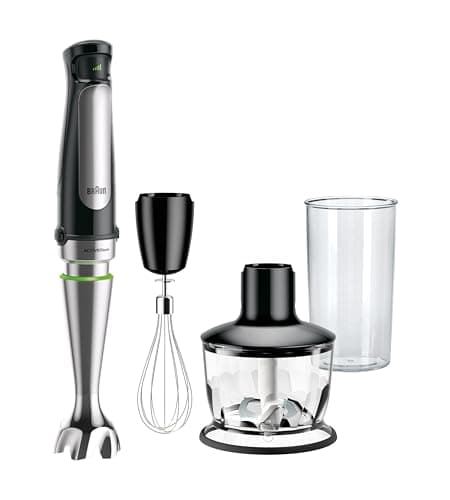
Soup, most weeks
Braun MultiQuick 7 MQ7035X
Three years of US warranty on a hand blender — triple what most rivals offer — and Braun publishes an input-power figure rather than a peak number.
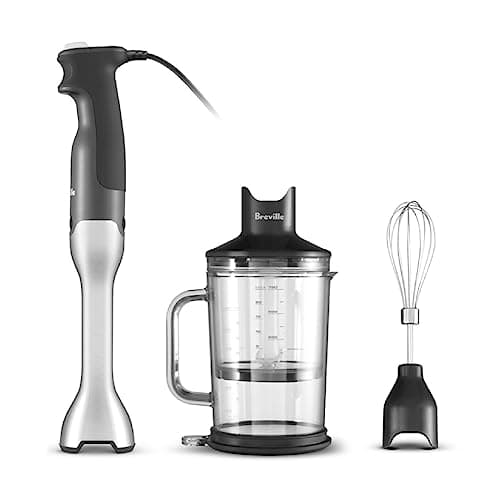
Not fighting the pan
Breville Control Grip BSB510XL
The bell has a vent designed to stop it suction-locking to the pan — the single most common complaint about stick blenders, engineered out. One year of warranty, though.
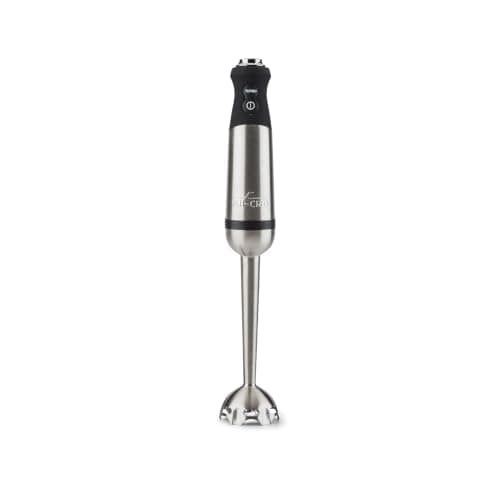
Power in a stick
All-Clad stainless steel immersion blender
600 watts and a two-year warranty covering parts and labor, in a body built like the pans. Priced like a premium tool and specified like one.
#ad · As an Amazon Associate we earn from qualifying purchases.
Questions
Frequently asked
Is the chopper attachment a substitute for a food processor?
Which attachment is genuinely worth paying extra for?
Does the All-Clad immersion blender come with a beaker?
Can I use the whisk attachment instead of buying a hand mixer?
Are attachments covered by the warranty?
Keep reading
Related
- Best immersion blenders for soupThe three machines above, ranked on warranty, published power and what is actually in the box.
- Immersion blender vs hand mixerWhere the whisk attachment stops being enough and a mixer starts earning its drawer space.
- Blender vs food processorWhat a real processor does that a chopper attachment cannot, before you decide the kit is enough.
- Best immersion blenders for protein shakesWhere the whisk attachment is the real tool.
Receipts
Sources
- Braun Household — MultiQuick 7 MQ7035X product page
- Braun Household US — warranty length by product type (article 25832)
- Breville — Control Grip BSB510XL product page and specification fields
- All-Clad — stainless steel immersion blender product page
- All-Clad — small electric appliance warranty (PDF)
We do not run a testing lab and we do not pretend to. Specifications come from the manufacturer's own published documents and from published standards; prices come from the live Amazon API. Where a figure is not published, the page says “not published” rather than guessing. Read the full method.