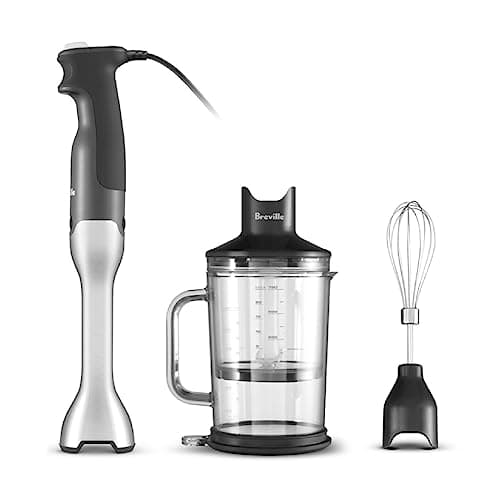
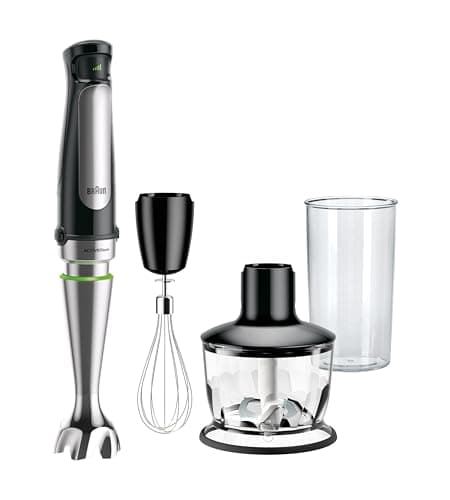
Buy the Braun MultiQuick 7 if warranty length is how you choose — three years of US coverage against Breville’s one is the single biggest difference here, at a similar price. Buy the Breville Control Grip if you have fought a stick blender that keeps suction-locking to the bottom of the pan, because its vented bell is engineered specifically to stop that. Both are genuinely good soup-and-sauce tools.
Immersion blenders are the softest, least-marketed corner of this category, and these two are among the best of them. They do not differ much on the core job — both are for soup, sauces, mayonnaise and anything you would rather not pour into a jar while hot. They differ on two specifics, and which one you weight decides it.
The two tools, side by side
Manufacturer figures. Braun publishes input power; Breville publishes an unqualified watt figure. Running cost is computed, not measured. Neither publishes a decibel figure. | Braun MultiQuick 7 MQ7035X | Breville Control Grip BSB510XL |
|---|
| Published motor | 500 W input power | 280 W |
|---|
| In the box | 500 ml chopper, whisk | 42 oz jug, 25 oz chopper bowl |
|---|
| Warranty (US) | 3 years, immersion blenders | 1 year limited |
|---|
| Est. cost to run / year | $1.67 | $0.94 |
|---|
Where they genuinely differ
Warranty: three years against one
Braun publishes a three-year US warranty for its immersion blenders, where one or two years is the norm — Breville’s Control Grip carries one. One caveat worth knowing: Braun’s printed manual guarantee is marked “For UK Only” at two years, and the three-year US term comes from Braun’s own knowledge base rather than the box, which is confusing but checkable. Either way, on paper Braun triples the coverage at a similar price.
The anti-suction bell
Breville’s answer is engineering, not paperwork. The Control Grip’s bell is vented specifically to stop it suction-locking to the bottom of a pan — the single most common complaint about cheap stick blenders, where the tool clamps down and you fight it the whole time. If that failure mode has annoyed you before, it is a genuinely useful fix, and the trigger and dial both fall under the hand already holding the tool, so you are not adjusting a control over a hot pot.
Power, in context
Braun publishes 500 watts of input power; Breville publishes 280. Braun’s figure is the honest kind — input draw rather than a peak marketing number — and it does give it more headroom on a dense pan of root vegetables. Neither is a machine for anything truly thick; a stick blender is for soup and sauce, not nut butter, whatever the wattage suggests.
What each one is bad at
The Braun’s beaker capacity is not published anywhere we could find, and the “For UK Only” note on the printed guarantee is genuinely confusing on the box. The Breville’s one-year warranty is hard to justify against Braun’s three, and its warranty page states no term at all, deferring to the product page — a poor way to publish a guarantee.
The decision rule.If you choose on warranty, buy the Braun — three years against one, for similar money, is not close. If you have specifically been frustrated by a stick blender sticking to the pan, the Breville’s vented bell is the feature you are buying, and it is worth the shorter warranty to you. Absent that specific grievance, the longer term wins.
For the wider category, including where the more powerful All-Clad fits, see the soup roundup and the immersion-and-chopper roundup.
How we picked
Blenders we claim to have tested: 0
Every site in this category tells you they blended twenty smoothies. We have not blended any, and we say so. Here is what we do instead: read the manufacturer's manual and spec sheet, record the published motor rating, jar capacity and warranty term, verify the warranty against the manufacturer's own warranty document, work out what the machine costs to run for a year and show the arithmetic, and cite all of it so you can check the work. Prices come live from Amazon's API and disappear rather than go stale.
The scores above are judgments from that documented research — not test results. The full rubric, including what disqualifies a product, is published in full.