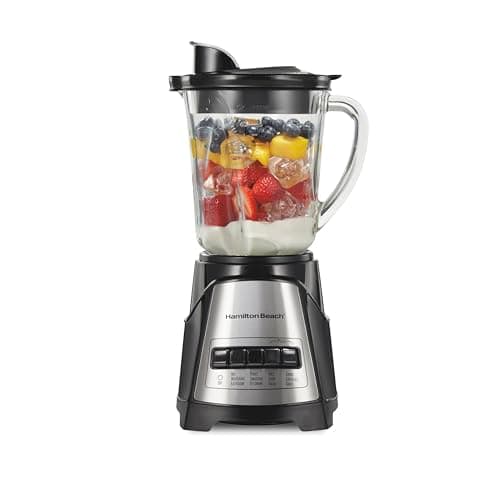
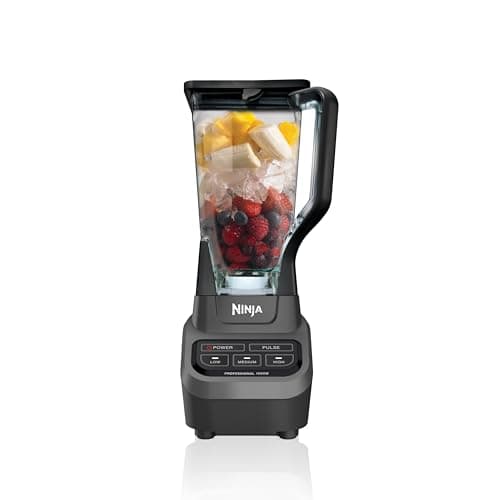
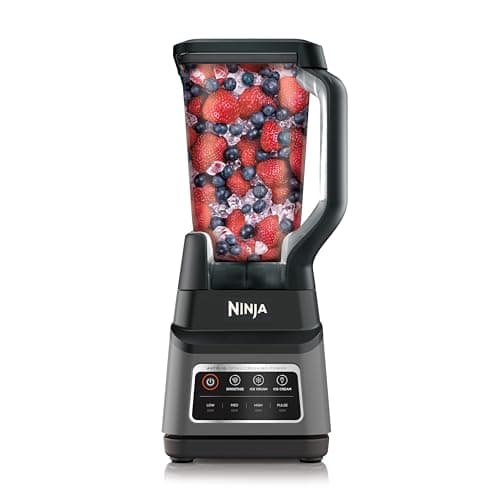
Buy the Ninja Professional Plus BN701if you will blend frozen fruit, ice or anything thick, or if you blend for more than two people. It publishes 1,200 continuous watts and carries a 72 oz pitcher, and nothing Hamilton Beach makes in this bracket is close on either count. Buy the Hamilton Beach Power Elite Wave Actionif your loads are soft — soups, milkshakes, dressings, smoothies with liquid added — and you would rather have a glass jar and a three-year warranty than a motor you will not use. The Ninja BL610 is the third option: the cheapest way into a full-size Ninja, and the one whose manufacturer page no longer exists.
This comparison is unusual because the budget brand wins the warranty by a wide margin. Hamilton Beach covers this blender for three years in the US and five in Canada. Ninja covers both of its machines for one. That is not a detail: it is the opposite of what the price tags imply, and it is the whole reason the answer is not simply “buy the Ninja”.
The wattage question, answered honestly on both sides
Hamilton Beach advertises “700 watts of peak blending power” and then does something almost no brand in this category does: it defines peak in its own use-and-care manual as the draw during the first seconds of operation, and prints the real rating plate next to it — 120 V, 60 Hz, 3.7 A max. Multiply it out and the continuous draw is about 444 W. We use the plate figure, because what matters over a three-minute blend is what the motor draws for three minutes.
Ninja publishes 1,200 W continuous and 1,400 W peak for the BN701 on a live specification page. For the BL610, SharkNinja’s product page returns a 404 and the 1,000 W figure survives only on the listing for its replacement motor base — which is weaker evidence, and we treat it as such on Ninja BL610 vs BN701.
So the real continuous gap is roughly 444 W against 1,200 W: not the 700-against-1,400 the boxes suggest, but a genuine factor of nearly three. That gap does almost nothing on a soup and everything on a jar of frozen strawberries. Why these numbers are so hard to compare in general is on blender wattage explained.
The three machines, side by side
Manufacturer figures only. The BL610 column comes from SharkNinja’s replacement-part listings because its product page has been withdrawn; we label it rather than quietly using it. | Ninja Professional Plus BN701 | Hamilton Beach Power Elite Wave Action | Ninja Professional Blender BL610 |
|---|
| Published motor | 1,200 W continuous; 1,400 W peak | 700 W peak; rating plate 3.7 A at 120 V (about 444 W) | 1,000 W, from the replacement motor-base listing |
|---|
| Jar | 72 oz pitcher, 64 oz max liquid; plastic | 40 oz glass | 72 oz pitcher; plastic |
|---|
| Warranty | 1 year | 3 years US; 5 years Canada | 1 year |
|---|
| Controls | Auto-iQ programs plus manual speeds and pulse | Wave Action jar, preset buttons and pulse; no variable dial | Three manual speeds plus pulse; no programs |
|---|
| Live manufacturer spec page | Yes | Yes, plus a published use-and-care manual | No — returns 404; parts listings only |
|---|
| Tamper | No | No | No |
|---|
| Noise | Not published | Not published | Not published |
|---|
| Electricity, 3 minutes a day, 365 days a year | about $4.02 a year | about $1.49 a year | about $3.35 a year |
|---|
Glass against plastic, which is a real difference here
The Hamilton Beach jar is glass. Both Ninjas are plastic. Glass does not cloud, does not hold the smell of garlic or onion, and goes in the dishwasher without anyone worrying about it. It is also heavy, and 40 oz of glass full of soup is a two-handed pour. Plastic is lighter, bigger and survives being knocked off a worktop. Neither is the right answer in general; we lay out the trade in full on glass vs plastic blender jars.
Capacity: 40 oz against 72 oz
This is the quiet dealbreaker. A 40 oz jar is one or two servings. A 72 oz pitcher is a family batch in one pass, and Ninja publishes 64 oz as the maximum liquid fill, which is the number that actually governs a soup. If you are blending for three or more people, the Hamilton Beach is the wrong machine regardless of everything else on this page. The family version of the ranking is at best blenders for family smoothies.
It cuts the other way too. If you are only ever making one drink, a 72 oz pitcher is as wrong as a 40 oz glass jar is for a family — a single serving in a big jar sits on the walls while the blade spins in a puddle. That case is argued on bullet blender vs Ninja, where an inverted cup beats its own watt figure.
Who each one is for
- Ninja Professional Plus BN701 — for the person blending frozen fruit or feeding a household, who accepts one year of cover in exchange for the motor and the pitcher.
- Hamilton Beach Power Elite Wave Action — for the person making soups, shakes and dressings for one or two, who wants glass and three years and will never miss the extra 750 watts.
- Ninja Professional BL610 — for the person who wants the Ninja pitcher for the least money, and does not mind that SharkNinja has taken the product page down.
The decision rule
One question: will you blend frozen fruit, ice or thick mixtures?If yes, buy the Ninja — Hamilton Beach says itself that its machine stalls on frozen fruit without added liquid, and 3.7 amps is the reason. If no, the Hamilton Beach is the better buy at the price, and the three-year warranty makes it the better buy on paper too. If you are unsure, you are probably in the first group: frozen fruit is what most people eventually put in a blender. The price-band answers are at under $50 and under $100, and the brand-level view is on best blender brands.