If you make cold-process soap, the useful question about a stick blender is not how many watts it has. It is what the wand is made of— and almost no review of this category answers it, because almost no maker leads with it. Four machines in our catalog state the answer in their own specification fields, and this page ranks those four. The pick is the All-Clad stainless steel immersion blender, which puts the material in the product name and covers parts and labor for two years. The budget pick is the Hamilton Beach 2 Speed Hand Blender, whose wand and whisk are both named as stainless steel on Hamilton Beach’s own page at the lowest price in this catalog.
Read this before the picks: what we are and are not telling you
No manufacturer in this catalog documents soap making.Every machine here is sold as a food appliance, every manual we read describes food uses, and not one of the four makers mentions lye, saponification or any non-food application. So this page makes no claim that any of these blenders is approved, rated or warranted for soap — it ranks them on published material and construction facts, which is a different and much narrower claim.
We also have not made soap with any of them. There is no test behind this order. And nothing on this page is lye-handling guidance: follow the safety instructions from your lye supplier and the use and care guide that came with your machine, both of which are written by people who know your specific materials and we are not.
Why wand material is the criterion
Soap makers reach for a stick blender for the same reason cooks do — it brings the blade to the vessel instead of the vessel to the blade, and it emulsifies. The difference is what it is emulsifying. A cold-process batch is a strongly alkaline mixture, and aluminum reacts with alkali; the standard guidance in the craft is stainless steel or certain plastics for anything that touches the batch, never aluminum. That makes the material of the shaft, the bell and the blade a genuine purchasing criterion rather than a detail — and it is one you can check against a document before you buy.
Here is what each maker publishes, in its own words:
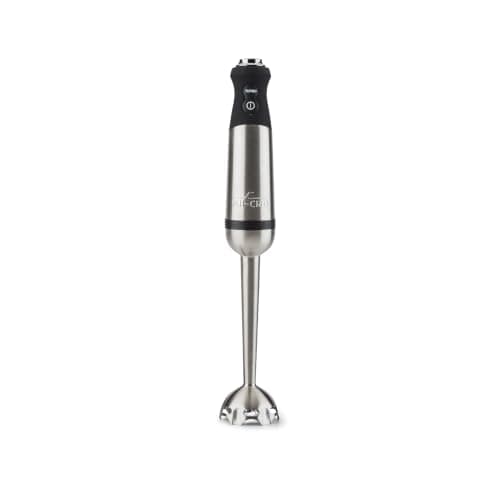
- All-Clad— the words “stainless steel” are in the product’s own name on All-Clad’s page, which also states 600 W. This is the most explicit material statement of the four.
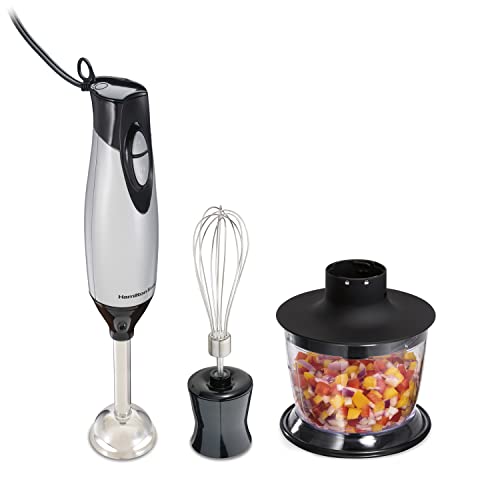
- Hamilton Beach— “durable stainless steel blades” on the product page, with a “stainless steel blending wand” and a “stainless steel whisk” both named in the attachment list.
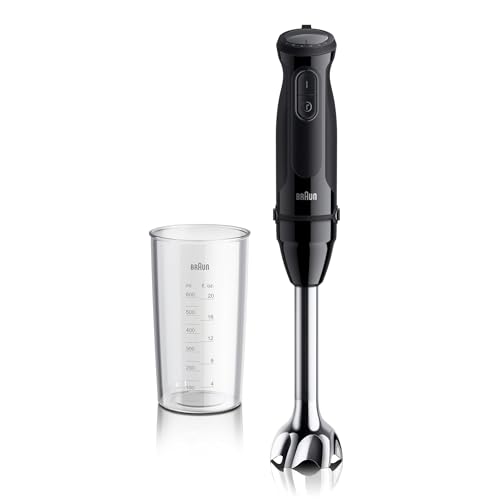
- Braun MultiQuick 5 MQ50001M— the specification table reads “Shaft type PowerBell VPlus metal shaft”, with the overall material given as “Plastic and Metal”. Braun says metal; it does not say which metal.
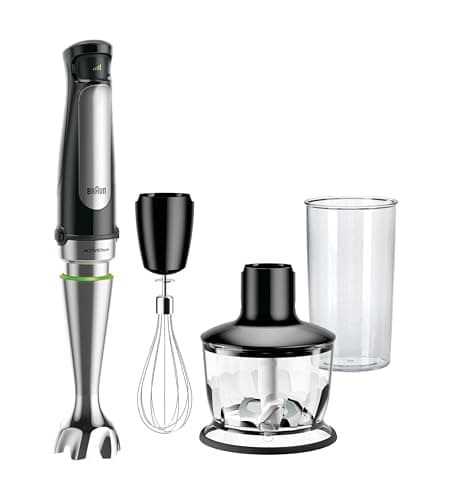
- Braun MultiQuick 7 MQ7035X— the same pattern: material “Metal and Plastic”, shaft type “Active blade w/powerbell Vplus”, and a “Metal Wand” listed in the pack.
That distinction matters and we are not going to paper over it. All-Clad and Hamilton Beach both write stainless. Braun writes metal. If the specific alloy is critical to your process, only two of these four machines put it in writing, and the ranking reflects exactly that.
The machine this page cannot rank, and why
The Ninja Power Duo CI201 is the obvious omission. It is a capable stick blender in the same price band as most of this page, and our under-$100 roundup ranks it third. But SharkNinja publishes no shaft material at allfor it — not in the specification block, not in the in-the-box list, not in the feature copy. Its guard is sold as PanProtect, “designed for scratch-free blending”, which tells you something about how it treats a pan and nothing about what it is made of. On the one criterion this page ranks, the document is silent, so the machine is named here as unrankable rather than quietly dropped or optimistically included.
The Breville Control Gripis absent for the same reason: Breville publishes 280 W, a 42 oz jug and a 25 oz chopper bowl, and no shaft material. It is the best anti-suction bell in the category and we recommend it elsewhere on this site; it simply cannot be ranked on a field its maker does not publish.
Why the all-metal machine leads, and what it costs you
All-Clad wins this page on three published points. The material is in the name. The motor is the most powerful of the four at a stated 600 W. And the warranty explicitly covers parts and labor for two years, which is a distinction most brands in this category skip past by covering parts only.
Two honest caveats, both from All-Clad’s own documents. The warranty runs to the original purchaser buying through an authorized seller, so a marketplace bargain may not be covered — a real condition rather than boilerplate, and one that matters when the replacement cycle is the point. And All-Clad publishes no beaker and no chopper in the box; the listed piece count is one. You supply the vessel. For a soap maker with a dedicated stainless pitcher, that is not a loss.
It is also the most expensive machine on this page by a wide margin, and it sits above the $100 bracket entirely. If you are buying a blender you expect to replace, that matters more than the specification does — which is the whole reason the next two picks exist.
The replaceable picks: Braun’s metal shaft and Hamilton Beach’s stainless wand
A soap maker’s stick blender is closer to a consumable than an appliance. So the second criterion on this page is the one the craft actually applies: how little does it cost to replace, and how long is it covered while you have it.
The Braun MultiQuick 5 MQ50001M is the strongest answer. It publishes a metal shaft, it publishes 21 speeds on a variable one-hand speed wheel— genuinely useful when you want to bring a batch to trace gradually rather than in one burst — and Braun covers immersion blenders for three years in the US, the longest term of any machine on this page including the All-Clad. At 2.02 lb it is also the lightest, which matters if you are holding it over a bucket. What it does not ship is a chopper or a whisk, which for this use is close to irrelevant.
The Hamilton Beach 59765is the budget pick, and the honest one. Its page names a stainless steel blending wand and a stainless steel whisk, all three attachments are stated dishwasher safe, and its rating plate — reproduced in its own use and care guide as “120 V~ 60 Hz 225 W MAX” — is the only nameplate figure we could read for any machine on this page. Two speeds and a nameplate 225 W are the least capable combination here, and the warranty is one year rather than the three Hamilton Beach gives its countertop blenders. At this price, for a tool you expect to wear out, that may be exactly the right trade.
The Braun MultiQuick 7 MQ7035X ranks fourth on this page and second on our under-$100 roundup, which is not a contradiction: it brings the same three-year term and the same published metal wand as the MQ50001M, plus a 500 ml chopper and a whisk that this particular job has no use for, at a higher price. For a kitchen it is the better buy. For a soap bench it is the MQ50001M with extras you will leave in the drawer.
What these cost to run
Not enough to factor in. At 18.16¢ per kWhand this site’s standard assumption of 3 minutes a day, 365 days a year, the 600 W All-Clad comes to about $1.99a year, the 500 W Brauns to about $1.66 each, and the 225 W Hamilton Beach to about $0.75. Stick blenders run in bursts of seconds, so the real figures are lower still. The arithmetic, and how to substitute your own rate.
What we are not telling you
We have made no soap, run no machine to failure and measured no corrosion. This ranking is built from four published facts per machine: the material its maker states, the motor rating its maker states, the warranty its maker writes, and what its maker lists in the box. Where a maker publishes nothing — shaft material on the Ninja and the Breville, alloy grade on either Braun, decibel figures on all of them — this page says so rather than inferring it. And no manufacturer here endorses this use; the ranking is ours and the documents are theirs.
How soap makers should shop this category
1. Buy the material statement, not the wattage
Power is almost irrelevant to this job — bringing a batch to trace is a low-resistance task, which is exactly why the craft runs on cheap stick blenders. What you are paying for is a wand you are confident putting in an alkaline mixture. Two makers in this catalog write “stainless steel”; two write “metal”; two write nothing at all. Shop in that order.
2. Prefer a detachable shaft, for a reason specific to this use
Every machine here publishes a detachable arm — Braun calls the fitment “Easy Click Plus”, Ninja’s 9 in arm lifts off its PowerBase, Hamilton Beach’s attachments come off. It matters more here than in a kitchen: the part that goes into the batch is the part you want to wash thoroughly and separately, and the motor housing must never go near water. Immersion blender attachments explained covers which fittings swap between bodies.
3. Treat variable speed as a batch-control feature
A single-speed machine gives you one lever: how long you run it. A 21-speed wheel lets you start slow, which is the difference between easing a batch toward trace and overshooting it. This is the same mechanical argument our mayonnaise page makes about emulsions, and it is why the least powerful machines on this site keep outranking the most powerful ones on emulsion jobs.
4. Buy for the replacement cycle
If you expect to replace the machine, the warranty term is worth more than the specification. On this page that points at Braun: three years in the US on immersion blenders, longer than the premium machine at the top of the ranking. If you expect to keep one machine for a decade and look after it, the All-Clad’s parts-and-labor cover is the better document — as long as you buy from an authorized seller, because its warranty says so explicitly.
5. Keep it dedicated
Not a specification point, just the obvious one: whatever you buy for this, do not also use it for food. That is another argument for the cheap end of the page — two machines from the budget bracket cost less than one from the top of it.
6. Keep the bell submerged, exactly as in a pan
The same rule that stops a stick blender redecorating a kitchen applies here, and it is the commonest cause of a ruined batch: break the surface while the motor is running and you whip air in. The bell is engineered to work under liquid. Blending hot liquids safely covers the mechanics, and they do not change with what is in the vessel.
7. Check what the box actually contains
All-Clad publishes a piece count of one — no beaker, no chopper. Braun publishes a beaker with no capacity figure. Hamilton Beach publishes the most: wand, whisk and a 3 cup chopping bowl. None of those extras is needed for this job, which is worth knowing before you pay for a set.