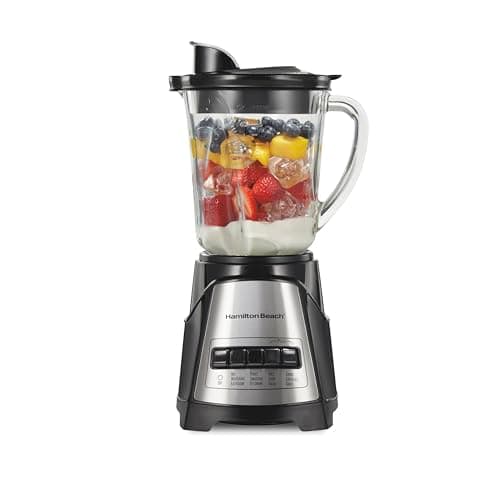
The case for the Hamilton Beach Power Elite is candor and a glass jar: it costs less than anything else we cover, carries a three-year US warranty where the premium bullet blenders give one, and — uniquely in this catalog — defines what its “peak” wattage means and prints the true rating-plate amperage next to it. The case against it is that 3.7 amps is genuinely low power, and it shows on a full jar of frozen fruit.
What this review is.This is a specification- and documentation-based assessment, not a hands-on test. Nobody at Basket & Blade has used a Power Elite. Every claim traces to Hamilton Beach’s own product page, its use-and-care manual, or its warranty terms, and the running-cost arithmetic is shown in full. Where Hamilton Beach publishes nothing — a decibel figure, for instance — this page says so. Our full method is published.
The wattage, and why this one is honest
Hamilton Beach publishes “700 watts of peak blending power”, and most brands stop there — a peak number is flattering and rarely defined. Hamilton Beach does something almost no one else does: in its own manual it definespeak power as the draw during the first seconds of operation, and prints the rating plate — 120 V, 60 Hz, 3.7 A maximum — which is the real continuous draw. That makes the honest figure computable:
3.7 A × 120 V = 444 W continuous draw
444 W × 18.25h a year ÷ 1,000 = 8.10 kWh
8.10 kWh × 18.34¢ per kWh = $1.49 a year to run
We use the 444 W plate figure for the running cost, not the 700 W peak, because what a machine costs to run depends on what it draws for three minutes, not for the first second. It is the cheapest machine here to run as well as to buy. The willingness to print both numbers, and define the marketing one, is more transparency about wattage than any premium brand in this catalog shows — which is exactly why it scores well on candor and why the wattage guide uses it as the worked example.
The glass jar and the three-year warranty
Two things punch above the price. The jar is 40 oz glass rather than plastic — no clouding, no odor retention, and dishwasher-safe without anxiety — and it pours without dribbling down the side, which sounds trivial until you own one that does not. The warranty is three years in the US (five in Canada), which is triple what Ninja and NutriBullet offer at several times the price. Warranty length is the number this site weights most heavily, and here it is doing real work at the bottom of the market. The full warranty table puts it in context.
Where the low power actually bites
There is no way around 3.7 amps. This is a fraction of what the premium machines draw, and on a full jar of frozen fruit with no added liquid the Power Elite will stall — no amount of pulsing changes the arithmetic. It is a fine machine for smoothies with liquid,milkshakes, batters, dressings and soups; it is the wrong machine for a packed frozen load or for making nut butter. The 40 oz jar is also small for a family batch, and the glass makes it heavy. There is no tamper and no variable dial.
Who should buy it, and who should not
Buy it if your budget is the smallest, you value a glass jar and a real warranty over raw power, and your blending is mostly smoothies-with-liquid and everyday jobs. Skip it if you regularly blend frozen fruit dry, or if you need to feed a household in one batch — for those, step up to a 1,000 W-plus machine in the under-$100 roundup. Against the other budget option, the trade is simple: the Ninja BL610 has far more power but no published warranty at all, while the Power Elite has the paperwork and the glass and less muscle.
The glass jar is a bigger deal than the wattage
Most of the budget market ships a plastic jar that clouds, holds odors and scratches; the Power Elite’s 40 oz glass jar does none of that and goes in the dishwasher without a second thought. Over years of daily use that is a real quality-of-life difference, and it is rare at this price. The trade is weight — glass is heavy — and 40 oz is modest, so it suits a one-or-two-person kitchen rather than a family batch.
How to get the most from a low-power motor
At roughly 444 W continuous, technique is everything. Add liquid first, keep frozen loads small, and pulse rather than hold, and it makes a perfectly good smoothie; ask it to grind a full jar of dry frozen fruit and it will stall, and pulsing a stalled motor is how you kill it. Think of it as a capable everyday jar for smoothies-with-liquid, milkshakes, batters and soups — not a frozen-load machine.
If dry frozen fruit is your routine, the extra money for a 1,000 W-plus machine in the under-$100 tieris well spent. If it is not, the Power Elite’s three-year warranty and glass jar are the better value — and against the other budget pick, the Ninja BL610, the trade is simply power versus paperwork: the Ninja has more muscle but no published warranty, this has less muscle and the documentation.
How we picked
Blenders we claim to have tested: 0
Every site in this category tells you they blended twenty smoothies. We have not blended any, and we say so. Here is what we do instead: read the manufacturer's manual and spec sheet, record the published motor rating, jar capacity and warranty term, verify the warranty against the manufacturer's own warranty document, work out what the machine costs to run for a year and show the arithmetic, and cite all of it so you can check the work. Prices come live from Amazon's API and disappear rather than go stale.
The scores above are judgments from that documented research — not test results. The full rubric, including what disqualifies a product, is published in full.