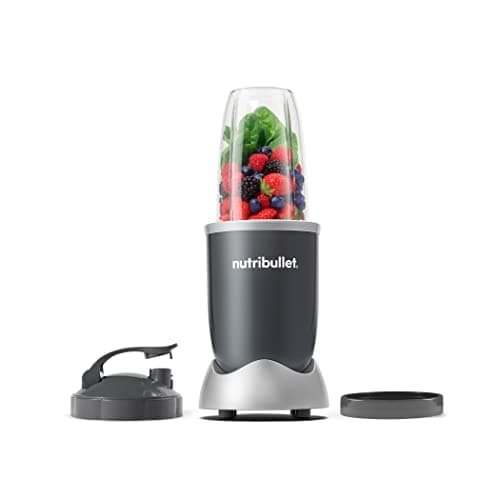
The NutriBullet 600 is the entry point to the range and the only machine in it with a genuinely small cup: an 18 oz short cup alongside a 24 oz tall one. 600 watts is enough for what it is actually bought for — a modest daily shake of soft fruit, powder and yogurt — and it is the cheapest way into NutriBullet’s widely stocked accessory ecosystem. It runs out of headroom on a cup packed with dry frozen fruit.
What this review is.A specification-based read from NutriBullet’s own product page and warranty terms, not a hands-on test — this site owns no blenders. Every figure is NutriBullet’s and the running cost is computed and shown. Our method is published.
The cup nobody else in the range offers
The underrated feature is the 18 oz short cup. Every other NutriBullet starts at 24–32 oz, so if you make one modest shake, the Pro and Ultra blend it in a vessel bigger than it needs — more to wash, and a cup that will not sit in a holder. The 600 is the only one right-sized for a single serving, which makes it the better-designed machine for that specific buyer, not merely the cheaper one.
600 watts, and running cost
600 watts is the least power in NutriBullet’s line, published with no peak or continuous qualifier. It is plenty for banana, yogurt, protein powder and a handful of frozen berries with liquid. At the wall it is trivial to run:
NutriBullet 600 — 600 W ÷ 1,000 = 0.600 kW
0.600 kW × 18.25 hours a year = 10.95 kWh
10.95 kWh × 18.34¢ per kWh = $2.01 a year
Under two dollars a year at 3 minutes a day, 365 days a year — nothing to weigh. As ever, the electricity column decides nothing (the full reasoning is here).
Where it runs out of road
A cup packed with frozen fruit and little liquid is where 600 watts struggles, and pulsing a stalled bullet repeatedly is how the motor gets cooked. It also runs at a single speed — you control it by how long you press — and the one-year warranty is standard for the class. None of this is a surprise at the price; it is simply the ceiling. If dry frozen loads are your routine, step up to the 900 W Pro, as the 600-vs-Pro comparison lays out.
Who it is for
Buy it if you want a genuinely single-serving blender for soft-fruit-and-powder shakes at the lowest sensible price, and you value cheap, everywhere-available replacement cups and blades. Skip it if your shakes are frozen-fruit-heavy or you want more than one speed — the Pro is the better fit there, and the personal-blender roundup ranks the whole class.
Living with a 600 W bullet
On any bullet blender the gasket, not the motor, is usually what ends its life — and it is a cheap, widely stocked part, so check it is seated before you blame the machine. NutriBullet excludes the cups and accessories from the one-year warranty, so budget a few dollars every year or two for a replacement gasket and treat that as the running cost that actually matters, not the electricity, which is under two dollars a year.
Loading order does more for results than wattage at this level. Liquid first, then powder and soft fruit, then a small amount of frozen on top, and pulse rather than hold. A 600 W motor asked to grind a packed frozen cup for thirty seconds straight is a motor being cooked; short pulses with enough liquid keep it alive for years.
When to size up instead
If you find yourself adding frozen fruit to every shake, or blending for a second person, the 600 is the wrong end of the range and you will feel it. The 900 W Pro is the honest next step for frozen-heavy shakes — the difference is laid out in 600 vs Pro — and a full-size pitcher is the answer for more than one serving. Bought for its actual job, though — one modest, mostly-soft shake — the 600 is not a compromise. It is the correctly sized tool, and the only NutriBullet whose short cup fits a cup holder.
How we picked
Blenders we claim to have tested: 0
Every site in this category tells you they blended twenty smoothies. We have not blended any, and we say so. Here is what we do instead: read the manufacturer's manual and spec sheet, record the published motor rating, jar capacity and warranty term, verify the warranty against the manufacturer's own warranty document, work out what the machine costs to run for a year and show the arithmetic, and cite all of it so you can check the work. Prices come live from Amazon's API and disappear rather than go stale.
The scores above are judgments from that documented research — not test results. The full rubric, including what disqualifies a product, is published in full.