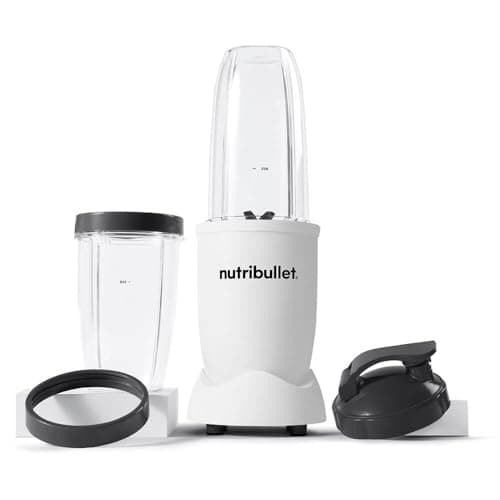
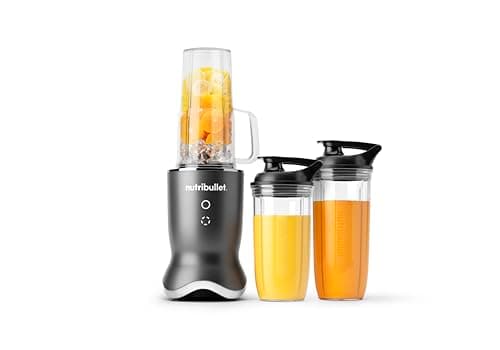
Buy the NutriBullet Ultra if you want the most power in the bullet class, a longer blade warranty, and a second cup size in the box, and you are willing to pay roughly double for it. Buy the NutriBullet Pro if your daily shake is banana, powder, yogurt and a handful of frozen berries — because 900 watts already does that job, and most of what the Ultra adds is headroom a single serving rarely uses.
This is the cleanest kind of upgrade question: same brand, same inverted-cup design, same replaceable-parts ecosystem, and the same one-year warranty on the machine itself. So the decision comes down to three concrete differences and one marketing claim that does not survive contact with the spec sheet.
The two machines, side by side
Manufacturer figures throughout. NutriBullet publishes its wattages with no peak/continuous qualifier, so the numbers are comparable to each other but not to a brand that publishes peak watts. | NutriBullet Ultra (1200 W) | NutriBullet Pro (900 W) |
|---|
| Published motor | 1,200 W | 900 W |
|---|
| Cups | 24 oz and 32 oz | Two 32 oz cups |
|---|
| Machine warranty | 1 year | 1 year (excludes cups) |
|---|
| Blade warranty | 5 years, Ultra Rapid Extractor blade | Same 1 year as the machine |
|---|
| Est. cost to run / year | $4.02 | $3.01 |
|---|
| Noise | Marketed “quietest” — no dB published | Not published |
|---|
Where they genuinely differ
The blade warranty is the real upgrade
The single most useful difference is not the wattage — it is the blade. NutriBullet covers the Ultra’s Rapid Extractor blade for five years against one year on the machine. That split matters because on bullet blenders the blade assembly and its gasket are the usual failure point, not the motor, and NutriBullet’s standard terms explicitly exclude cups and accessories. Five years on the exact part most likely to wear out is a more concrete benefit than the extra 300 watts.
Power you will mostly not use
1,200 watts is genuinely the most in the bullet class here, and it will chew through a denser frozen load with less complaint than 900. But a single-serving cup only holds so much, and the everyday shake most people make does not tax 900 watts to begin with. The power is real; whether you will feel it depends entirely on whether you regularly load the cup with frozen fruit and little liquid.
Two cup sizes, and an honest label
The Ultra ships a 24 oz and a 32 oz cup, and NutriBullet’s page is consistent about it. The Pro ships two 32 oz cups — and NutriBullet’s own product page has, at times, contradicted itself about which cups are in the Pro’s box, so confirm the current listing before you buy on the strength of the accessories.
The quietness claim, and why we discount it
NutriBullet markets the Ultra as its quietest single-serve blender and publishes no decibel figure to back the claim — not for the Ultra, not for the Pro, not for anything in the range. A quietness claim with no number behind it is unverifiable, and paying a premium for an unverifiable claim is exactly the trap this site exists to talk you out of. Treat the “quietest” label as marketing, not a spec.
What each one is bad at
The Ultra costs roughly double the Pro for a power increase most single servings will not use, and its headline quietness figure does not exist. The Progives you only the one-year warranty on everything, has no small cup — two 32 oz vessels and nothing more modest — and, like every sealed bullet, is not for hot liquid.
The decision rule. Choose the Ultra if you blend dense frozen loads often or you value the five-year blade coverage enough to pay for it — that warranty is the honest reason to trade up. Choose the Pro if your shake is soft-fruit and powder and you would rather keep the money, because 900 watts already clears that bar. Do not choose the Ultra for the quietness — there is no number to justify it.
If you are not sure you need 900 watts at all, the entry point is a rung lower again — see NutriBullet 600 vs Pro. And if a different brand’s two-year warranty appeals more than NutriBullet’s one, read Beast vs NutriBullet.
How we picked
Blenders we claim to have tested: 0
Every site in this category tells you they blended twenty smoothies. We have not blended any, and we say so. Here is what we do instead: read the manufacturer's manual and spec sheet, record the published motor rating, jar capacity and warranty term, verify the warranty against the manufacturer's own warranty document, work out what the machine costs to run for a year and show the arithmetic, and cite all of it so you can check the work. Prices come live from Amazon's API and disappear rather than go stale.
The scores above are judgments from that documented research — not test results. The full rubric, including what disqualifies a product, is published in full.