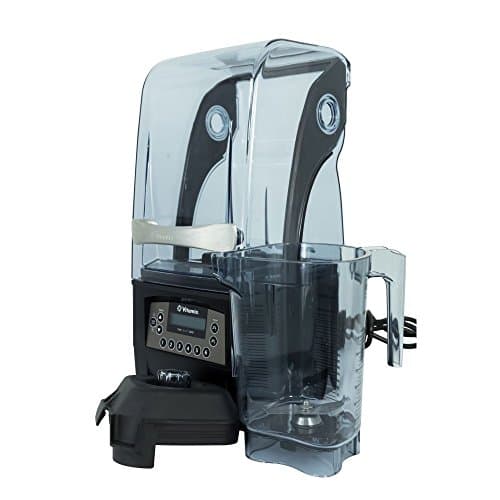
The case for The Quiet One is that Vitamix publishes almost everything a foodservice buyer needs to plan around: the complete nameplate rating of 120 V, 50-60 Hz, 15.0 A, a footprint of 18.0 x 8.5 x 10.7 inches, the 24.5-inch height with the lid openthat decides whether it fits under your shelf, and 19.2 lbs so you know whether it stays put on a wet counter. The case against it is one absence: for a blender named The Quiet One and sold on “unparalleled sound reduction,” Vitamix publishes no decibel figure of any kind.
What “three-year warranty” actually means here.Vitamix’s own page states three years on motor base parts and one year on labor, with the blade assembly and container also covered for one year. That is a materially shorter commitment than the phrase implies, and it is the opposite shape from Vitamix’s household terms, which are FULL warranties covering parts, performance, labor and two-way shipping for seven or ten years. Buy this machine understanding that in year two a failure is a parts claim and a labor bill. That is normal for foodservice equipment, and it is still not what most people hear in “three-year warranty.”
What Vitamix publishes, in full
This is unusually complete for this category, and it is the main reason the machine scores well on documentation here.
- Motor:approximately 3 peak output horsepower. Vitamix publishes no watt figure — but it does publish the nameplate, 120 V at 15.0 A, which works out to 1,800 W. That is our arithmetic on their numbers, shown so it can be checked, and it is a maximum draw rather than a continuous operating figure.
- Container: 48 ounces, BPA-free plastic, the Advance container, with laser-cut stainless-steel blades.
- Controls: six program buttons driving 34 optimized settings.
- Noise:“Patented Noise Reduction,” described as air management working with the motor to reduce noise, improve reliability and minimize downtime. No number.
- Footprint: 18.0 x 8.5 x 10.7 inches (H x W x D), and 24.5 inches high with the lid open.
- Weight: 19.2 lbs, or 23.1 lbs boxed.
- Cleaning:container and lid are dishwasher-safe, and Vitamix gives a self-clean procedure with a time on it — a drop of dish soap and warm water, blended for 35 seconds.
- Warranty: three years on motor base parts, one year on labor, one year on the blade assembly and container.
And what it does not publish:a decibel figure, a model number, any NSF or other foodservice certification, a list of included accessories, or a recommended daily blend volume. Three of those four absences matter to a buyer, and the fourth — the daily volume — is the one that costs it the top spot in our commercial blender roundup, where Blendtec publishes 150+ blends a day for the Connoisseur 825 and Vitamix publishes nothing comparable.
The quiet claim, examined
A blender called The Quiet One invites exactly one question, and it is the question Vitamix will not answer numerically. What the page offers is a mechanism and an adjective: “air management” plus a 3 peak output horsepower motor “reduces noise, improves reliability, and minimizes downtime,” under the tagline “the ultimate blender with unparalleled sound reduction.”
We are not going to supply the missing number. We own no sound meter, we have not run this machine, and a decibel figure invented on a buyer’s behalf would be worse than no figure at all. What we can do is point out that the mechanism claim is coherent and that a competitor does better on the disclosure. Blendtec’s commercial page for the Stealth describes “a sound level comparable to a normal conversation”— still not a decibel figure, but an anchored comparison a buyer can picture. In a category where nobody publishes dB, that is the current best practice, and Vitamix does not match it on the machine whose entire name is the claim.
The mechanism itself is real and worth understanding, because it tells you what the money buys. Blender noise is mostly not the motor; it is the load cavitating and the jar radiating sound like a drum. Why blenders are so loud goes through it properly. Engineering noise reduction into the machine rather than bolting on a separate enclosure is why this one stays 8.5 inches wide, and on a counter where every inch is revenue that is a genuine design win regardless of how many decibels it is worth.
15 amps is the whole story on installation
The nameplate figure is the single most useful number on the page and almost nobody in this category prints it. At 15.0 A this machine’s rated draw is the full nameplate rating of a standard US 15-amp branch circuit, which in practice means it wants an outlet it is not sharing with anything else that pulls hard — not an espresso machine, not a toaster oven, not an extension lead running three other things. Vitamix’s own Drink Machine Advanceis rated 11.5 A on the same voltage, which is a meaningfully smaller ask for the same 48-ounce container, and it is nearly 8 lbs lighter at 11.5 lbs.
The 24.5-inch lid-open height is the other number to act on before you buy. Almost no manufacturer publishes it, and it is the figure that decides whether you can actually lift the lid under the shelf you intended to put the machine beneath. Publishing it is a small thing that suggests the page was written by someone who has installed one.
48 ounces is the real limitation
Everything above is about documentation. This is about capacity, and it is the thing most likely to make you regret the purchase. A 48-ounce container is the smallest in the commercial set: Blendtec’s machines ship with jars nearly twice the size. Four large smoothies is two passes with a rinse between them, and once there are six people in the queue that matters more than horsepower does. The honest framing is that this is a front-of-house machine for a counter where the blender is visible and the volume is moderate — not a batching machine for a lunch rush.
The flip side is that 48 ounces plus a published self-clean time of 35 seconds is a genuinely fast turnaround between drinks, and the container and lid going in a dishwasher at the end of service is not a given on commercial equipment.
The one performance claim, and its footnote
Vitamix makes exactly one head-to-head performance claim on this page: the Advance blade container “creates faster, smoother pours.” The claim carries the footnote “Based on internal testing.”
We think that footnote deserves credit rather than a sneer. Vitamix is telling you where the number came from, which is more than most brands in this catalog do with a comparative claim — and it is also an admission that nobody outside Vitamix can reproduce it. Both things are true at once. Treat it as a design intention rather than a measured advantage, and note that the same Advance container is fitted to the much cheaper Drink Machine Advance, so it is not a reason to pick this machine over that one.
Who should buy it, and who should not
Buy it if the blender sits within a few feet of a paying customer, the room is quiet enough that a normal commercial machine would be rude, counter width is tight, and your volume is moderate rather than relentless. You are buying a documented footprint, a complete electrical rating, consistency across shifts from the 34 settings, and an engineered answer to noise rather than a box around the machine.
Do not buy itif you batch for a queue — 48 ounces will beat you, and the Blendtecs in the cafe roundup exist for that. Do not buy it on the quiet claim alone, because there is no figure behind it to verify. And do not buy it for a home kitchen: at this price the household Vitamix line gives you a full seven- or ten-year warranty covering parts, labor and shipping both ways, and the 5200 or the Ascent X3is the better machine for that money in a house. The one exception is the reason a household warranty cannot be used here at all: Vitamix’s household terms are “for personal household use only” and explicitly void for commercial use, which is the whole reason commercial machines exist. Blender warranties compared sets the three-year commercial term against the seven and ten-year household ones.
What we have not done
We have not blended anything in this machine. We do not own one, we have run no timed tests, and we have measured no sound level — which is the only honest position available given that the manufacturer has not published one either. Every figure above is read off Vitamix’s own commercial product page, re-read on 1 November 2026, with the arithmetic from the nameplate shown so it can be checked. How we pick is the full method, including what disqualifies a product.
There is also no annual running-cost figure on this page, and that is deliberate. Every cost figure on this site rests on an assumption of three minutes of blending a day, which is a household pattern and the wrong one for a machine bought to run a counter. Vitamix publishes no duty-cycle or daily-volume figure for The Quiet One that we could substitute, so rather than publish a number built on an assumption we know to be wrong, we publish none.
How to read a commercial blender spec sheet
Separate the warranty term from the warranty scope
“Three-year warranty” on foodservice equipment almost never means three years of everything. Here it means three years of motor base parts, one year of labor, one year of container and blade. The question to ask any supplier is not “how long” but “how long on what, and who pays the technician.” Vitamix publishes the answer, which is to its credit; plenty of brands make you ask.
Find the nameplate, not the horsepower
Peak output horsepower is a motor-test figure and it is not something you can plan an installation around. Volts times amps is. Vitamix gives 120 V and 15.0 A here and 11.5 A on the Drink Machine Advance, and that difference — same container, same brand, meaningfully different circuit demand — is the kind of thing a horsepower figure hides completely. Blender wattage explained covers why peak, continuous and horsepower figures are not interchangeable.
Treat a quietness claim with no number as a design intention
Nobody in this category publishes decibels, so a quiet claim is never verifiable from the documents. What you can assess is whether the maker describes a mechanism and whether that mechanism is plausible: an enclosure, air management, a slower blade at higher torque, a damped jar. A claim with a mechanism behind it is worth more than an adjective on its own, and both are worth less than a figure nobody is providing. The same test applies at the consumer end of the market, where our quiet blender roundup found exactly one brand willing to anchor the claim to anything at all.
Check capacity against your worst ten minutes, not your average hour
A 48-ounce jar is fine all day and then fails at 8:40 on a Saturday. Commercial capacity planning is a peak problem, and the right figure to use is the biggest simultaneous order you take, not the daily total. If your peak needs two passes, you will buy a second machine inside a year, which costs more than the bigger jar would have.
Ask for the certification in writing
Vitamix lists no NSF or other foodservice certification on this page. That is not evidence the machine lacks one — commercial certifications are frequently documented elsewhere — but if your health inspector or your insurer asks, a product page that does not mention it is not going to help you. Request it from the supplier before you buy rather than after.
Know what a household machine would cost you here
A household Vitamix is cheaper, better warranted and, for most jobs, just as capable. It is also uninsured the moment the machine earns money: the household terms are extended “for personal household use only” and do not apply to products used commercially. What professional kitchens actually use goes through the duty-cycle side of the same question.