Skip to content
BasketBlade

HUB 06 · Comparisons

Hand Blender vs Food Processor

One purees in a pan; the other chops in a wide bowl. The difference is geometry rather than wattage, and once you see which shape does which job, the choice makes itself.

By Stephen V.Updated How we pick
#ad

We earn a commission if you buy through our links. It does not change the price you pay, and it does not decide our picks — our selection criteria are published in full. How this works.

The short answer

Quick picks

#ProductBest forScorePrice
01
Braun Braun MultiQuick 7 MQ7035X
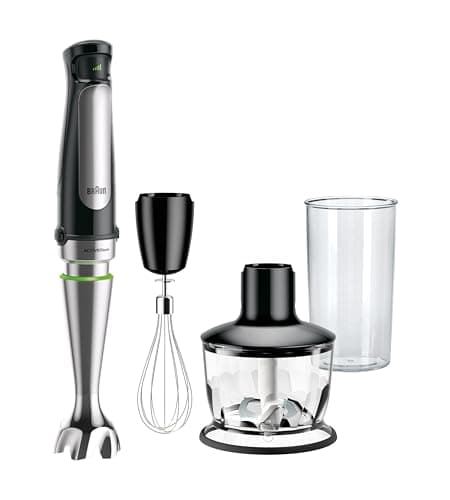
Braun MultiQuick 7 MQ7035X

Three years of US warranty on a hand blender — triple what most rivals offer — and Braun publishes an input-power figure rather than a peak number.

Soup, most weeks
8.6
$79.95Amazon
02
Breville Breville Control Grip BSB510XL
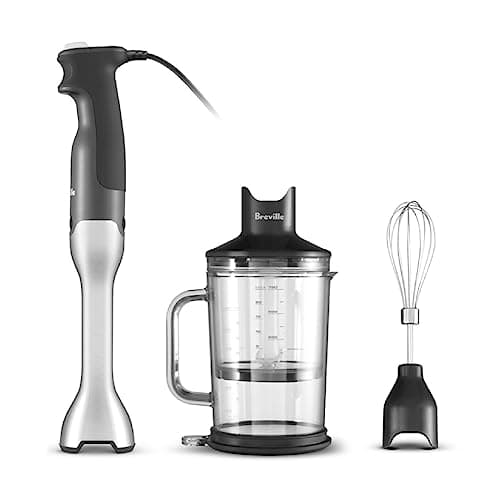
Breville Control Grip BSB510XL

The bell has a vent designed to stop it suction-locking to the pan — the single most common complaint about stick blenders, engineered out. One year of warranty, though.

Not fighting the pan
7.2
$148.97Amazon

#ad · Prices pulled live from the Amazon Product API, last checked Aug 18, 2026. Where we have no verified live price we show none — we would rather leave a gap than print a number that has gone stale. Scores are our own, compiled from published specs; they are not test results.

Buy a hand blender if you want smooth: soup, sauces, purée, mayonnaise, anything pourable. Buy a food processor if you want pieces: chopped onion, sliced vegetables, grated cheese, pastry, dough. A hand blender that ships with a chopper bowl covers a useful share of the second list at small scale, which is why it is the better first purchase for most kitchens.

The real difference is the shape of the vessel

A hand blender puts a fast blade inside a bell-shaped guard. Liquid is drawn up through the bell, cut, and thrown out sideways, which pulls more liquid in behind it. That loop needs liquid to exist. Give it a pan of cooked vegetables in stock and it will circulate the whole pan through a two-inch blade in under a minute.

A food processor puts a slower blade near the base of a wide, shallow bowl. Dry ingredients get thrown outward, hit the wall, and fall back down into the cut — over and over, without ever needing liquid. That is how you get diced onion instead of onion soup, and it is a shape a blending vessel cannot have, because a wide shallow bowl cannot hold a vortex.

Neither can be fixed with a bigger motor. This is worth stating plainly because wattage is the number both categories advertise, and it is the least relevant specification in the comparison.

Which tool wins each job, and why.
JobWinnerWhy
Hot soupHand blenderBlends in the pan — no transfer of near-boiling liquid, no sealed vessel
Sauces and puréesHand blenderSmooth is what a bell and a vortex produce
Mayonnaise and emulsionsHand blenderA tall narrow beaker is what makes the emulsion hold
Chopping onionsFood processorWide low bowl keeps pieces falling back into the cut
Slicing and gratingFood processorDisc attachments; a hand blender has no equivalent
Pastry and doughFood processorVolume and a dough blade; a bell cannot do this at all
Herbs, nuts, breadcrumbsEitherA hand blender’s chopper bowl is a small processor with the right shape
Nut butterFood processorNo free liquid, so a bell has nothing to circulate — the full reason
Smoothies and frozenNeitherThat is a countertop blender’s job — see the ranking

The chopper bowl changes the maths

Most hand blenders sold above the very cheapest tier include a chopper bowl, and it is the most under-appreciated item in the box. It is wide and low with a blade sweeping near a flat base — genuine food-processor geometry, at 500 ml to 25 oz rather than three litres.

For an onion, a handful of herbs, some nuts or a slice of stale bread, that is the whole job. What it does not do is scale: a batch of coleslaw, a food-processor-sized quantity of pastry, or anything needing a slicing disc. So the honest question is not “which tool is better” but “how often do you prepare more than a bowlful at once?” For most households the answer is rarely, and the hand blender wins on storage alone.

The two hand blenders we track with a chopper included. Running cost assumes 3 minutes a day, 365 days a year at 17.45¢ per kWh (US EIA, Electric Power Monthly — average residential price, US total, retrieved July 2026).
MachinePublished motorChopper bowlWarrantyCost / year
Braun MultiQuick 7 MQ7035X500 W input power500 ml, plus a whisk3 years (US)$1.59
Breville Control Grip BSB510XL280 W, no qualifier25 oz, plus a 42 oz jug1 year limited$0.89

Braun MultiQuick 7 MQ7035X — the better hand blender of the two

500 watts published as inputpower rather than a peak figure, three years of US warranty against the category’s usual one, and a 500 ml chopper plus a whisk in the box. Speed responds to grip pressure, which matters when the other hand is holding a hot pan. Its honest limit is the one every stick blender shares: no ice, no nut butter, no frozen loads.

Breville Control Grip BSB510XL — bigger bowl, shorter warranty

A 25 oz chopper and a 42 oz jug, so the processing side is roughly half again the Braun’s, and a vented bell engineered to stop the head suction-locking to a pan. At 280 watts it is the weakest here on dense loads, and one year of warranty against three at a similar price is the clearest reason to prefer the Braun.

The short version.Buy the hand blender first. It does the jobs a food processor does badly (hot soup, emulsions, purée), its chopper covers small-scale chopping, and it lives in a drawer. Add a food processor later if you find yourself wanting slices, dough, or more than a bowlful at a time — and note that we do not rank food processors, because we only rank machines we hold verified listings and published specifications for.

Related comparisons

The countertop version of this question is blender vs food processor. If you are choosing between form factors of blender, see blender vs immersion blender. And if what you actually want is one appliance doing both, blender and food processor combos explains what that phrase really covers.
In detail

The picks, in full

01
Braun Braun MultiQuick 7 MQ7035X

Soup, most weeks

Braun MultiQuick 7 MQ7035X

3-year US warrantyInput watts, not peak
8.6/10

Three years of US warranty on a hand blender — triple what most rivals offer — and Braun publishes an input-power figure rather than a peak number.

Warranty
8.5
Hot liquids
9.5
Cleaning
9
Attachments
8
Value
8

What it gets right

  • Three years of US warranty on a hand blender, where one or two is the norm
  • Braun publishes an input-power figure rather than a peak marketing number — the honest way round
  • Variable speed responds to grip pressure, so you can modulate mid-blend without reaching for a dial
  • Comes with a chopper and whisk, which covers most of what a stick blender is asked to do

What it doesn't

  • Braun's printed manual guarantee is marked 'For UK Only' at two years — the US term is three, from Braun's own knowledge base, and the discrepancy is confusing on the box
  • No decibel figure published for the US market
  • Beaker capacity is not published anywhere we could find

What it costs to run

About $1.59 a year in electricity, at 3 minutes a day, 365 days a year and 17.45¢ per kWh.

Braun's own product data field is labeled input power and reads 500 W. That is a more conservative and more useful figure than a peak rating, because it is what the motor actually draws. The full arithmetic is published.

Skip this if…

you want one machine for everything — a stick blender will not crush ice, will not make nut butter, and will not blend a frozen load, whatever the wattage suggests.

$79.95on Amazon

$109.9527% off

Price last checked Aug 18, 2026. Prices move constantly — Amazon's at checkout is the one that counts.

#ad · we may earn a commission from this link to Braun MultiQuick 7 MQ7035X

02
Breville Breville Control Grip BSB510XL

Not fighting the pan

Breville Control Grip BSB510XL

Anti-suction bell1-year warranty
7.2/10

The bell has a vent designed to stop it suction-locking to the pan — the single most common complaint about stick blenders, engineered out. One year of warranty, though.

Warranty
3.5
Hot liquids
9
Cleaning
8.5
Attachments
8.5
Value
6.5

What it gets right

  • The vented bell genuinely addresses suction lock, which is the thing that makes cheap stick blenders infuriating
  • Trigger and speed dial fall under the hand that is already holding it, so you are not adjusting a control over a hot pan
  • 42 oz jug and a 25 oz chopper included, both properly sized rather than token
  • Breville publishes a plain, unqualified watt figure

What it doesn't

  • One year of warranty against Braun's three at a similar price — the clearest reason not to buy this one
  • 280 W is modest; it is enough for soup and emphatically not enough for anything thick
  • Breville's warranty page states no term at all, deferring to the product page, which is a poor way to publish a warranty

What it costs to run

About $0.89 a year in electricity, at 3 minutes a day, 365 days a year and 17.45¢ per kWh.

Breville publishes 280 W with no qualifier — the words peak, continuous and max appear nowhere on the product page or in the US manual. The full arithmetic is published.

Skip this if…

warranty length is how you choose — Braun offers three years on the same kind of tool for similar money, and one year is hard to justify against that.

$148.97on Amazon

Price last checked Aug 18, 2026. Prices move constantly — Amazon's at checkout is the one that counts.

#ad · we may earn a commission from this link to Breville Control Grip BSB510XL

How we picked

Blenders we claim to have tested: 0

Every site in this category tells you they blended twenty smoothies. We have not blended any, and we say so. Here is what we do instead: read the manufacturer's manual and spec sheet, record the published motor rating, jar capacity and warranty term, verify the warranty against the manufacturer's own warranty document, work out what the machine costs to run for a year and show the arithmetic, and cite all of it so you can check the work. Prices come live from Amazon's API and disappear rather than go stale.

The scores above are judgments from that documented research — not test results. The full rubric, including what disqualifies a product, is published in full.

Questions

Frequently asked

Can a hand blender replace a food processor?

For small-scale chopping, yes — the chopper bowl that comes with most hand blenders has the right wide, low shape. It cannot slice, grate, make dough, or handle more than a bowlful at a time. For those, you need the real thing.

Which should I buy first, a hand blender or a food processor?

A hand blender, for most kitchens. It does hot soup in the pan, sauces, purées and mayonnaise — jobs a processor does poorly or not at all — and its chopper covers the everyday chopping a processor is usually bought for.

Is a food processor better than a hand blender for soup?

No. A processor means transferring near-boiling liquid into a bowl, which is both awkward and the point at which scalds happen. A hand blender purées in the pan with no transfer and no sealed vessel — see blending hot liquids safely.

Which has more power, a hand blender or a food processor?

Food processors generally publish higher figures, but it is the wrong comparison. Power is not what separates them — bowl shape is. A 600 W hand blender still cannot dice an onion, and a 1,000 W processor still makes a poor job of soup you have to carry across a kitchen.

Keep reading

Receipts

Sources

We do not run a testing lab and we do not pretend to. Specifications come from the manufacturer's own published documents and from published standards; prices come from the live Amazon API. Where a figure is not published, the page says “not published” rather than guessing. Read the full method.