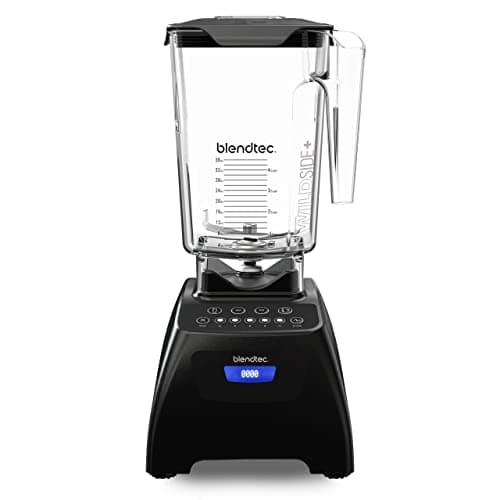
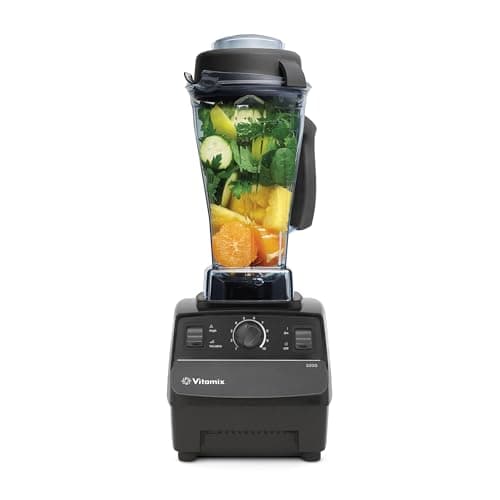
This comparison is normally decided on a fact that is not true. Search it and you will read, repeatedly, that Blendtec backs its machines for eight years, which makes the Classic 575 look like the better-protected buy against a Vitamix. Blendtec’s own warranty schedule says something else: the Classic 575 carries two years of parts and two years of labor. The eight-year term belongs to the Designer 625–725 and Professional 750 lines. Reading the actual document reverses the usual conclusion, and that is the entire reason this page exists.
The published specifications, side by side
| Published spec | Vitamix 5200 | Blendtec Classic 575 |
|---|
| Motor rating, in the manufacturer’s own words | 2 HP; 120 V, 50/60 Hz, 11.5 amps. Vitamix publishes no watt figure | 1,560 watts, unqualified — no peak or continuous label given |
|---|
| Container | 64 oz | WildSide+ jar, maximum liquid fill up to 36 oz. Total capacity not published |
|---|
| Warranty | 7 years, full | 2 years parts / 2 years labor |
|---|
| Warranty conditions | Parts, labor and shipping both ways | Residential use only; commercial use is presumed above 3,000 cycles a year |
|---|
| Blade | Sharp, removable assembly; tamper included | Blunt and fixed; no tamper needed |
|---|
| Controls | Fully variable dial; no presets, no timer | Preset cycles that stop on their own |
|---|
| Published noise figure | Not published | Not published |
|---|
| Price | Live from Amazon with the date checked, in the panel above. It disappears rather than going stale |
|---|
The eight-year Blendtec warranty belongs to a different Blendtec
Blendtec publishes a warranty schedule organized by model, and the terms are not uniform across the range. The Classic 575 appears on that schedule at two years of parts and two years of labor, for residential use. The eight-year figure that circulates so widely attaches to the Designer 625–725 and Professional 750 machines — different products, at different prices, from the same brand. Quoting one line of a schedule against a machine on a different line of the same schedule is how a wrong number becomes the consensus.
Vitamix 5200: 7 years full — parts, labor and shipping
Blendtec Classic 575: 2 years parts / 2 years labor
Gap in covered ownership: 5 years
Five years is not a rounding difference. It is most of a machine’s expected life, and on two products competing at this end of the market it is the most decisive published fact available — precisely because a warranty term is not a marketing claim but a legally binding statement of how long the manufacturer expects its own motor to survive. If you were buying the 575 for its warranty, read Blendtec’s schedule first and then decide again.
One more clause worth reading before you buy: Blendtec’s residential warranty presumes commercial use above roughly 3,000 cycles a year, and commercial use voids it. That is unlikely to affect a household, but it is a real condition on the two years, not a formality.
For context on where both of these sit in the category — including the Vitamix Ascent line’s ten-year term, which is the only thing here that comfortably beats the 5200 — the whole set of documents is tabulated in the warranty comparison.
The blade is the other genuine difference, and it favors Blendtec
The 575’s blade is blunt and fixed into the jar. That is not a cost saving, it is a design decision with three consequences that all fall on the buyer’s side. It is markedly safer to clean than a sharp removable assembly, which is the part of a blender most likely to cut somebody at the sink. It cannot be reassembled wrong, which removes a category of leak and a category of accident. And it works by blunt-force impact rather than by slicing, which is why Blendtec ships no tamper: the mechanism does not depend on you pressing food onto the blade.
Vitamix takes the other route — a sharp removable blade assembly plus a tamper you use to push the load back into the blades on thick mixtures. Both approaches work. The Blendtec approach means fewer parts, less washing and nothing to keep track of; the Vitamix approach gives you direct control over a stubborn load while the machine is running. If the idea of reaching into a jar to clean around a sharp blade is something you actively dislike, that is a legitimate reason to prefer the 575 and it has nothing to do with power.
Height: the difference that quietly decides it for some kitchens
The Blendtec jar is short. Standard US worktop-to-cabinet clearance is about 18 inches, and full-size blenders commonly run 17 to 20 inches assembled — which is how people end up storing an expensive machine in a cupboard and using it half as often. The 575 clears a standard 18-inch gap. The 5200’s jar is tall and narrow, which is the geometry that generates the best vortex and also the geometry most likely not to fit.
Measure the gap between your worktop and the underside of your wall cabinets before you spend anything, and measure the jar height with the lid on rather than the base height. If your clearance is tight, this single dimension is worth more to you than any spec on the table above, because a blender you have to lift out of a cupboard is a blender you stop using.
The power figures are not comparable, and Blendtec says so itself
Blendtec publishes 1,560 watts for the Classic 575, without labeling it peak or continuous. Vitamix publishes no watt figure at all for the 5200, only 2 HP and an 11.5 amp nameplate. There is no honest way to put those two in a single column and declare a winner.
Blendtec Classic 575, published: 1,560 W (unqualified)
Vitamix 5200, published: 2 HP + 11.5 A nameplate; no watt figure
Derived from the Vitamix nameplate: 11.5 A × 120 V = 1,380 W — our arithmetic, not a Vitamix spec
Blendtec also publishes a sitewide disclaimer that peak horsepower does not denote operational horsepower, which is a more candid thing for a blender company to say than most of its competitors manage. Take it at face value: it means the impressive number on the box is not a promise about what the motor sustains. The practical reading of this whole section is that both machines have ample power for anything a domestic kitchen will ask, and the difference between 1,560 and a derived 1,380 will not be the thing you notice. Why these figures are not interchangeable is worth ten minutes if you are still shopping on wattage.
Capacity is the other place the documents disagree
Vitamix publishes a 64 oz container, plainly. Blendtec publishes a maximum liquid fill of up to 36 oz for the WildSide+ jar and does not publish a total capacity at all. The widely quoted 90 oz figure for that jar is not a manufacturer number, so it does not appear on this site. What that means in practice is that the honest published comparison on batch size favors the Vitamix, and anyone telling you the Blendtec jar holds more is quoting something Blendtec has not printed.
What neither company publishes
Two gaps are worth naming, because a comparison built on published documents should be as clear about the empty cells as about the full ones. Neither Blendtec nor Vitamix publishes a decibel figure for these machines. That means any statement about which of them is quieter — including the ones you will read elsewhere with apparent confidence — is either somebody’s impression of a machine in a different kitchen or an invention. Noise is a genuine buying criterion in an apartment or an early-morning household, and the honest state of the information is that it is not available from either manufacturer.
The second gap is comparability itself. One brand publishes watts with no qualifier, the other publishes horsepower and an amperage. Neither publishes a continuous rating alongside a peak one the way Ninja does on its far cheaper machines, which is a small but real point against both of them: the more you pay in this category, the less consistently the power figure is explained. Where a manufacturer publishes nothing, this site writes “not published” and leaves the cell empty rather than filling it from a competitor’s review, and that is why two rows of the table above look thinner than you might expect.
What each one is bad at
The Blendtec Classic 575 is bad at long-term coverage.Two years of parts and labor is a quarter of what the same money buys from Vitamix’s Ascent line and far less than the eight years commonly misattributed to it. Its capacity is under-published, so you cannot size a batch from the manufacturer’s own figures. It has no tamper — which is by design, but does mean you have no way to intervene in a stubborn load beyond stopping the machine. And the warranty carries a commercial-use presumption most buyers never read.
The Vitamix 5200 is bad at fitting and at features. The tall jar is the most common reason this machine ends up in a cupboard. There are no presets, no timer and no self-clean cycle; you are paying for a motor and a warranty. The blade assembly is sharp and removable, with the cleaning caution that implies. And like the Blendtec, it publishes no decibel figure, so nobody can tell you which of these two is louder.
The decision rule
Measure your worktop-to-cabinet gap first. If it is under about 18 inches, buy the Blendtec Classic 575 — a machine that fits is worth more than five years of warranty on a machine that lives in a cupboard. If the height is not a constraint, buy the Vitamix 5200, because at this price point you are buying longevity and seven years of full coverage against two is the clearest statement either company has made about how long its own motor is expected to last.
The condition that flips the answer is physical clearance, not power and not features. It flips it because clearance is the one factor here that a warranty cannot compensate for: an uncovered machine you use every day beats a covered one you have to wrestle out of a cabinet. The secondary flip is the sharp-blade question — if cleaning around a removable blade genuinely bothers you, the 575’s fixed blunt blade is a real quality-of-life difference and a legitimate reason to accept the shorter term.
If both machines now look like more money than the job deserves, that is a reasonable place to land, and the honest next step is the under-$200 roundup rather than a longer argument about which premium jar is taller.
What this comparison is not
It is not a head-to-head test. Neither machine has been blended in for this page. Every figure above is quoted from a manufacturer specification page or warranty schedule, all listed below, with the single exception of the derived nameplate arithmetic, which is marked as ours. The warranty correction at the top of this page is the reason to check those links rather than take our word for it: the whole point of publishing a source is that you do not have to.