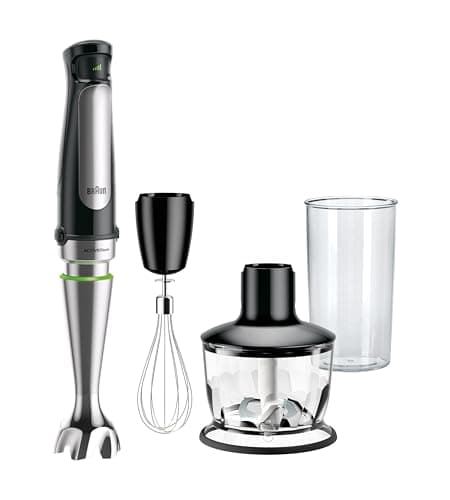
This assessment is specification- and documentation-based, not hands-on. We do not own this blender, there is no test kitchen behind this page, and nothing below is a description of using one. What it is: Braun’s published product data, Braun’s printed manual and Braun’s US warranty article, read carefully and set against the two machines it competes with. Two things in those documents are genuinely worth a buyer’s attention, and one of them is a contradiction Braun has left in print.
The power figure, and why its label matters more than its size
Braun publishes 500 watts for the MQ7035X, in a product data field labeled input power. That label is the whole story. Input power is what the motor draws from the outlet in normal operation. A peak figure is what a motor draws at the instant of maximum resistance, measured under conditions the manufacturer selects and holds for a fraction of a second.
These are not the same measurement and they are not comparable, which is why a spec table that lists both in one column without saying which is which is quietly misleading. Across the wider blender market, the peak number is the one that gets printed on the box, because it is bigger. Braun published the conservative one and named what it is. That is worth noticing on a spec sheet, and it is the reason a 500 W Braun should not be mentally ranked below a machine advertising a bigger unlabeled number.
Set against the rest of the field: All-Clad publishes 600 W with no qualifier at all, and Breville publishes 280 W, also unqualified. So Braun sits in the middle on raw figures and at the top on how honestly the figure is described. For soup, which is what this machine is for, the practical gap between 280 W and 600 W is small — the ingredients are already cooked soft and already hot. It widens on a dense pan of root vegetables blended with very little liquid, and that is about the only place it widens at all. The wattage explainer takes the peak-versus-continuous problem apart properly.
The warranty discrepancy you will hit in the box
This is the finding that justifies the page. Braun’s printed manual for the MultiQuick range carries a guarantee of two years, marked For UK Only. Braun Household’s US knowledge base states that immersion blenders carry three yearsin the United States. Both documents are Braun’s. Both are current. They state different terms because they describe different markets — but only one of them is in the box you opened.
If you buy this machine in the US, the paper guarantee in the box understates your cover by a year, and it does so in a way that most people will never question. Keep your receipt for three years, not two, and if you are ever told the term is two years, the answer is Braun’s own US warranty article — linked in the sources at the bottom of this page.
It is worth being precise about what this is and is not. It is not a broken promise: the US term is the longer one, so the error runs in the buyer’s favor and nobody is being shortchanged on cover. It is a documentation failure — a print run that was never localized — and the cost of it is that some owners will believe their machine is out of warranty twelve months before it is. That is a real thing to have gone wrong, and it is exactly the class of detail that only surfaces if somebody reads the paperwork rather than the headline.
Three years is the reason to buy it
In the immersion category, one year is normal and two is generous. Braun writes three, in the US, on immersion blenders as a product class. That is the manufacturer stating, in a document they have to honor, how long they expect the motor, the seal and the bearing to last under domestic use.
| Machine | US warranty | What the document covers |
|---|
| Braun MultiQuick 7 | 3 years | Immersion blenders, per Braun Household’s US warranty article |
|---|
| All-Clad immersion | 2 years | Parts and labor, original purchaser, authorized sellers only |
|---|
| Breville Control Grip | 1 year | Limited; Breville’s warranty page states no term and defers to the product page |
|---|
Triple the cover for similar money is not a marginal advantage. On a tool that lives in hot liquid and gets carried to the sink wet, it is the difference that will actually show up in your kitchen — long after any argument about 220 watts has stopped mattering. The full category tabulation is in the warranty comparison.
What is in the box, as published
Braun publishes a 500 ml chopper with this kit, and the machine ships with a whisk. Those two cover most of what a stick blender is asked to do beyond pureeing: the whisk handles cream and egg whites in small quantities, the chopper handles herbs, nuts and an onion at a time. Neither replaces a real food processor and neither is pretending to.
Braun publishes no beaker capacity that we could locate, which is an odd omission on a kit product and means the blending vessel size is not something this page can state. Rather than repeat a figure from a retailer listing, that cell stays empty. What each attachment is worth is argued out in the attachments guide.
The control that matters most is the speed. Braun’s variable speed responds to grip pressure, so the adjustment is made by the hand already holding the machine. Over a hot pan that is not a luxury: the alternative is reaching for a dial with your other hand while the head is submerged in something at boiling point.
What it will not do
It will not crush ice. It will not make nut butter — the load is too thick for the blade to move and this is not a motor designed to sit near stall for several minutes. It will not blend a frozen load, whatever 500 watts sounds like it should manage. And it will not do a large volume of anything thick, because you are holding it, and your arm is the limiting component long before the motor is.
None of that is a criticism of this particular machine; it is the format. The mistake worth avoiding is buying a hand blender as your only blender. The format comparison sets out which jobs land on which side of the line.
What it costs to run
At the site-wide assumption of three minutes a day, every day — 18.25 hours a year — and the US average residential electricity rate of 18.34¢ per kWh:
500 ÷ 1000 × 18.25 h × $0.1834 = $1.67 a year
One dollar and fifty-nine cents. Publishing that is useful precisely because the answer is boring: electricity cost is not a reason to choose or avoid any blender, and a number this small settles the question for good. Your own rate and your own habits substitute straight into the sum; the running-cost guide shows the model in full.
Who should buy it, and who should not
Buy it if you make soup regularly and want the machine to still be covered in year three. That is the case, and it is a strong one: the longest published warranty in this comparison, on the honest side of the power-figure argument, with a chopper and whisk already in the box.
It is worth stating what that recommendation is not built on. Not a smoothie somebody blended and described. Not a decibel reading, because Braun publishes none for this market. Not a beaker capacity, because Braun publishes none we could locate. It rests on two documents — a product data page that labels its power figure honestly, and a warranty article that commits the manufacturer to three years — plus the arithmetic above, which you can redo. If that seems like a thin basis for a recommendation, it is a thinner one than a lab with 137 machines could offer and a considerably firmer one than most of what is published in this category, and we set out exactly where the line is.
Do not buy it if you were hoping to replace a countertop blender — it cannot, and no attachment changes that. Do not buy it for quietness, because Braun publishes no decibel figure for the US market and an unverifiable claim is not something to pay for. And if the thing that irritates you most about stick blenders is the head sealing itself to the bottom of the pan, Breville is the brand that publishes a vent designed to stop it — you would be trading two years of warranty for that, which is a real trade and a defensible one.