The Ninja Professional Plus BN701 is the pick: 1,200 watts of published continuous power, 64 oz of usable liquid capacity, and a price that makes it a reasonable machine to work hard. But the more useful thing this page can tell you is what ice does to a blender. Repeated dry ice-crushing blunts blades and stresses the coupling between motor and jar, and nearly every manual in this category tells you to add liquid — that recommendation is about the machine’s life, not about the texture of your drink.
What ice actually does to a blender
Ice is harder than anything else a domestic blender meets. Frozen fruit has sugar and fiber in it and gives way; a bar cube does not. Each impact is a small shock load transmitted from the cutting edge, through the blade shaft, into the drive coupling between the jar and the motor — and that coupling is the part that typically fails first on inexpensive machines. It is also the part nobody mentions in a review.
Two things follow. The first is that blades dull. Blender blades are not razor-sharp by design — most are closer to blunt, and they work by impact rather than by slicing — but they do get measurably less effective after a lot of dry ice work, and a dull blade takes longer to do the same job, which means more heat in the motor. The second is that dry crushing is the worst case for cooling. The motor is near stall, drawing hard, with no fluid in the jar to move the load around, and many machines have a thermal cut-out that will simply stop the job.
Add liquid.A splash in the bottom of the jar changes the load from a series of impacts into something that circulates, which is easier on the blade, easier on the coupling and cooler for the motor. This is why the manuals say it. Hamilton Beach’s Power Elite manual is one of the clearer examples, and it also prints the rating plate that most brands leave off — 3.7 A, which is the real number behind the 700 peak watts on the box.
The four, side by side
For an ice load, the specifications worth tabulating are the published motor rating in the manufacturer’s own words, the actual nameplate draw where anybody publishes one, and the warranty — because if a machine is going to be given the hardest job in the kitchen regularly, how long the maker will stand behind it stops being an abstraction.
Estimated running cost assumes 3 minutes of blending a day, 365 days a year, at the US average residential rate of 18.34 cents per kWh (US EIA). The Vitamix figure uses the nameplate rating Vitamix publishes, 11.5 A x 120 V, because Vitamix publishes no watt figure; the Hamilton Beach figure uses the 3.7 A rating plate in its manual rather than the 700 peak watts on the box.| Machine | Published motor | Nameplate draw | Jar | Warranty |
|---|
| Ninja Professional Plus BN701 | 1,200 W continuous / 1,400 W peak | Not published | 72 oz, 64 oz max liquid | 1 year |
|---|
| Vitamix 5200 | 2 HP, no watts published | 11.5 A at 120 V | 64 oz | 7 years |
|---|
| Blendtec Classic 575 | 1,560 W, unqualified | Not published | 36 oz max liquid (WildSide+) | 2 years |
|---|
| Hamilton Beach Power Elite | 700 W peak | 3.7 A at 120 V | 40 oz glass | 3 years (US) |
|---|
1. Ninja Professional Plus BN701 — the one to work hard
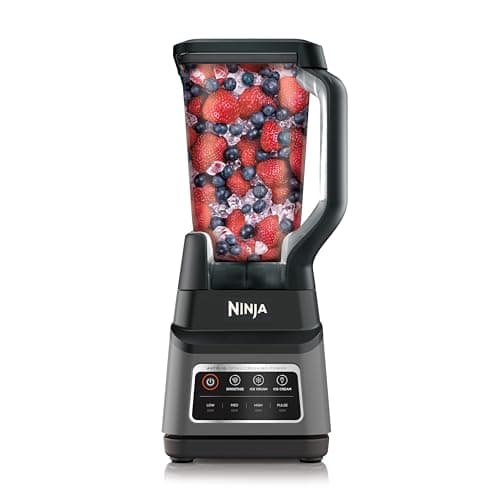
Ninja publishes 1,200 watts continuous, which is the figure that matters for a load the motor has to sustain rather than survive for a second. That single piece of disclosure is why this machine tops an ice page: for every other brand here you are comparing a peak number, an unqualified number or a horsepower claim, and only Ninja tells you what the motor holds. Add 64 oz of usable liquid capacity and a stacked blade assembly that puts cutting edges at several heights in the jar rather than only at the bottom, and this is the most ice-capable machine here per dollar.
The reason it is the one to work hard is partly the price. A one-year warranty on a machine that costs a fifth of the premium options is a very different proposition from a one-year warranty on a $500 machine. The negatives stand, though: one year is one year, there is no tamper, and the stacked blade tower is more surfaces to wash and more edges to dull.
2. Vitamix 5200 — the one that will still be doing it in seven years
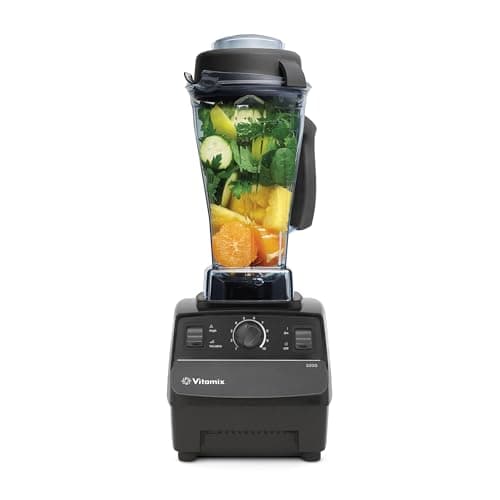
Vitamix publishes no watt figure at all — 2 HP and a nameplate of 11.5 A at 120 V, which works out to 1,380 W, and we show that sum wherever the number appears rather than presenting it as something Vitamix said. What Vitamix does publish, at length, is a seven-year full warranty covering parts, labor and shipping in both directions, which is the longest term on anything in this list.
For ice specifically, the tamper and the tall narrow jar are the hardware that matters. Cubes bridge above the blades; the tamper pushes them down while the machine runs, so you are not stopping and restarting under load. Vitamix also sells replacement parts, so a coupling worn out by years of ice is a repair rather than a write-off — which is the practical difference between an appliance and a disposable one.
It sits second because the same reasoning as the smoothie page applies: for the ice job alone, the Ninja’s published continuous rating and larger usable capacity get the drink made, and the Vitamix premium is warranty rather than performance. If you crush ice weekly for years, invert that and buy the Vitamix.
3. Blendtec Classic 575 — most watts, blunt blade, short warranty
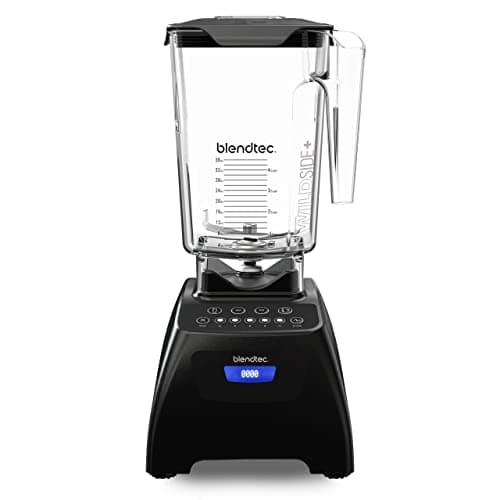
1,560 watts is the biggest unqualified watt figure in our catalog, and the fixed blunt blade is genuinely well suited to ice: it works by impact rather than by edge, so there is less edge to lose. It cannot be installed wrong and it is safer to clean than a sharp removable assembly. Preset cycles stop by themselves, so ice does not get over-blended into water while you are looking elsewhere.
Two published facts pull it down to third. The warranty is two years of parts and labor — Blendtec’s own schedule, not the eight years the internet keeps attributing to this model — and the warranty presumes commercial use above 3,000 cycles a year, which voids it. Blendtec also publishes only a 36 oz maximum liquid fill for the WildSide+ jar and no total capacity, so the batch ceiling is lower than the machine’s reputation suggests.
4. Hamilton Beach Power Elite — the honest cautionary entry
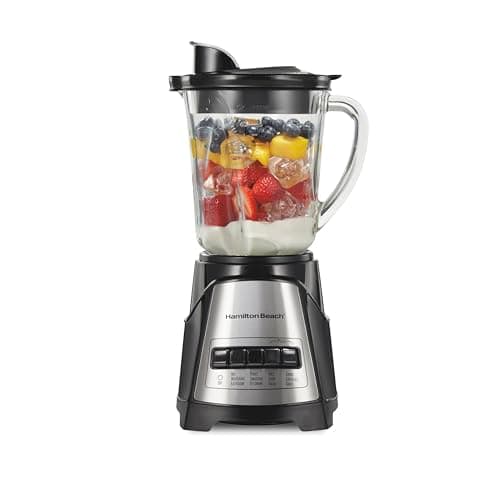
This is on the page as a warning with a source attached, and the source is Hamilton Beach’s own manual. The box says 700 peak watts. The manual defines peak as the draw during the first seconds of operation, and then prints the rating plate: 120 V, 60 Hz, 3.7 A max. That is the honest continuous figure, and the arithmetic is not close to the premium machines:
3.7 A x 120 V = 444 W continuous draw
Ninja BN701, published continuous = 1,200 W
444 / 1200 = 37%of the Ninja’s sustained power
At 444 watts, a jar packed with ice and no liquid will stall this machine, and pulsing it repeatedly under stall is how a motor gets cooked. That is a genuine limitation and it is the reason this pick is fourth. What earns it a place at all is candor and warranty: three years in the US and five in Canada at the lowest price here, a glass jar that will not cloud, and a manufacturer that publishes the unflattering number next to the flattering one. For ice in liquid, in small quantities, it is fine. For a jar of dry cubes it is the wrong machine, and Hamilton Beach effectively tells you so on its own rating plate.
Crushed, shaved and blended are three different results
“Crushed ice” usually means irregular chips for a glass — short pulses, ice plus a little water, poured through a strainer. “Shaved” is much finer and drier, and a blender is honestly not the right tool for it; the blades melt as much as they cut. “Blended” is what happens in a frozen cocktail, where the ice is incorporated into a liquid rather than served as ice. The machine that does the first well is not necessarily better at the third, and a page that treats them as one job is not answering any of them.
Pulse rather than hold
Short bursts do more useful work on cubes than a continuous run, for two reasons. Each pulse lets the load fall back down onto the blades instead of packing into a rotating ring around the wall of the jar, and each gap gives the motor a moment that is not spent near stall. A continuous thirty-second run on dry ice is the hardest thing you can do to a blender that is not nut butter. If your machine has an ice-crush or pulse program, that is what it is doing — cycling the motor rather than holding it.
Glass or plastic, on an ice load specifically
Only one machine on this page ships a glass jar: the Hamilton Beach, at 40 oz. Glass does not cloud, does not scratch and does not hold odors, and on a job that involves throwing hard objects around inside the vessel that is not a trivial advantage — plastic jars pick up a fine haze of scratches from ice over years, which is the real reason an old blender jar looks foggy. Glass is also heavy, breakable and, in this case, small. The premium machines all use plastic because a 64 oz glass jar full of ice would be genuinely unwieldy. It is a trade rather than a ranking factor, but if you crush ice constantly and hate a cloudy jar, it is the trade you would pick.
What we cannot tell you
How loud any of these are. Not one of the four manufacturers publishes a decibel figure, and ice is the loudest thing a blender does, so this is precisely the page where that absence is most annoying. We have no test lab and we will not publish a number we did not measure. We also cannot tell you how a given coupling holds up after three years of weekly ice, because nobody publishes failure data — the closest public proxy is the warranty term, which is exactly why it is a column in the table above rather than a footnote. Our method is published in full.
Who should skip all four
If you want ice in a glass every day, a $30 ice tray designed for small cubes plus a $15 manual ice crusher will do it more cheaply and with no wear on anything expensive. If what you actually want is a frozen cocktail, ice is only half the problem and the ratio is the other half — start with the frozen drinks guide. And if you are hoping a personal blender will handle a cup of cubes, the honest answer is in can personal blenders handle ice, and it is a qualified no.