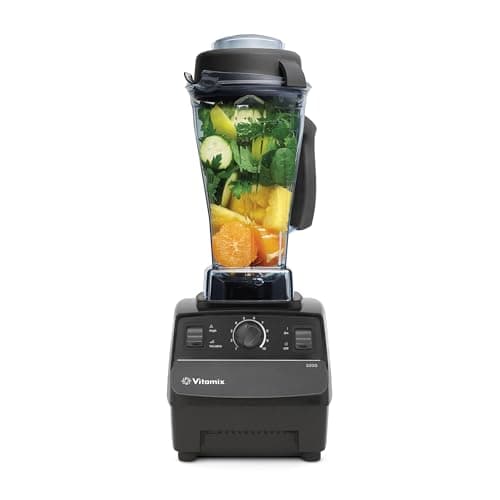
The case for the Vitamix 5200 is a seven-year full warranty covering parts, labor and shipping both ways, a fully variable speed dial rather than presets, and a tall narrow 64 oz jar sold with a tamper. The case against it is that Vitamix publishes no watt figure, no decibel figure, no timer, no presets and no self-clean cycle, and charges premium money for a machine whose everyday output a hundred-dollar blender will match.
What this review is.This assessment is specification- and documentation-based, not hands-on. Nobody at Basket & Blade has used a Vitamix 5200. Every claim below traces to Vitamix’s own product specification table, its published warranty terms, or arithmetic performed on those figures and shown in full. Where Vitamix publishes nothing, this page says so instead of filling the gap. The full method is on how we pick.
The motor, and the number Vitamix will not give you
Vitamix’s specification table for the 5200 lists a 2 HP motor and a nameplate of 120 V, 50/60 Hz, 11.5 amps. It does not list a wattage. This is worth dwelling on, because the single number most buyers use to rank blenders is the number this manufacturer declines to state for its best-known machine.
You can convert the nameplate yourself, and this site does, transparently: 11.5 amps at 120 volts is 1,380 watts of maximum rated draw. That figure appears in the spec chips above with its basis attached, because it is our arithmetic on Vitamix’s published numbers rather than something Vitamix published. It is a ceiling — the most the machine is rated to pull — not a continuous operating figure, and it is not directly comparable to Ninja’s published 1,200 W continuous rating or Hamilton Beach’s 700 peak watts. The wattage guide explains why those three numbers cannot share a column.
11.5 A × 120 V = 1,380 W nameplate maximum
1,380 W × 18.25 h a year ÷ 1000 = 25.19 kWh
25.19 kWh × 18.34¢ per kWh = $4.62 a year to run
Three minutes a day at the US average residential rate, retrieved from the EIA in September 2026. Four dollars and change. Whatever the argument for this machine is, electricity is not part of it.
The warranty is the actual product
Vitamix’s 7-Year Full Warranty is a separate published document, and the word “full” is doing real work in it: parts, labor, and two-way shipping. You are not paying to send a failed machine back at your own cost, which is a distinction several competing warranties quietly rely on.
Seven years is the longest term on any machine in this site’s countertop list except Vitamix’s own Ascent line, which runs ten. It is worth understanding what a warranty length actually is: a company’s written estimate of how long its motor will survive, backed by an obligation to pay when the estimate is wrong. It is the least marketable and most informative number a blender manufacturer publishes, which is exactly why this site tabulates every one of them.
One consequence people miss: Vitamix publishes and sells replacement parts. A failure in year eight is a repair rather than a write-off, which is a genuinely different ownership model from a machine whose maker treats it as disposable. Oster, by contrast, publishes a three-year warranty whose remedy is replacement rather than repair — a shorter term and a different philosophy behind it.
What “2 HP” is doing on the spec sheet
Horsepower is a unit of mechanical power — what the shaft delivers — while watts, as published by every other brand here, is a unit of electrical power drawn from the wall. They are not the same quantity measured in different units, and the relationship between them depends on the efficiency of the specific motor, which Vitamix does not publish either.
So a 2 HP rating cannot be converted into a figure you can line up against Ninja’s 1,200 W continuous rating, and anybody who does the arithmetic anyway is quietly assuming an efficiency they were not given. This is not a Vitamix-specific complaint: Blendtec publishes a sitewide disclaimer that peak horsepower does not denote operational horsepower, which is a manufacturer warning about exactly this unit. Treat 2 HP as a statement of class rather than a comparable number, and take the seven-year warranty as the load-bearing fact instead.
The jar and the tamper: the part that does the work
The 64 oz container is tall and narrow, which produces the vortex that pulls ingredients back down onto the blades. The tamper is in the box. Together those two are the reason this machine finishes jobs that stall wider jars with bigger motors — smoothie bowls, low liquid ratios, nut butter, anything where the mixture is thick enough that it stops moving on its own.
A manufacturer that ships a tamper is being honest about physics: past a certain thickness, no domestic blender circulates a load without help. Machines sold without one are not immune to the problem, they simply hand it to you as stopping, scraping and restarting. The nut butter guide covers what is realistic on each type of machine.
The height is the practical catch. Full-size blenders commonly stand 17 to 20 inches assembled and standard US worktop-to-cabinet clearance is 18 inches. Measure with the lid on, before you buy. This is how expensive machines end up in cupboards, and a machine in a cupboard gets used half as often — which is a far bigger determinant of whether the purchase was worth it than any spec on the sheet.
What it does not have
No presets. No timer. No self-clean cycle. No app, no touchscreen, no Bluetooth. The 5200 is a dial, a switch and a pulse. For some buyers that is the appeal and for others it is a reason to buy something else, and both are legitimate — but it should be a decision rather than a surprise. If you want programs that stop on their own, the Blendtec Classic 575 and the Ninja BN701 both have them and both cost less.
Vitamix also publishes no decibel figure for the 5200. This class of machine is genuinely loud, and if you blend at 6 a.m. in an apartment that matters — but there is no published number to compare it against, and this site will not estimate one it did not measure.
The reconditioned route, and what it costs you in warranty
Vitamix publishes a separate warranty document for certified reconditioned machines: five years on most of the range, three years on reconditioned Explorian models. That is a real reduction from the 5200’s seven-year new term, and it is also a longer warranty than any Ninja, NutriBullet or Breville machine carries brand new.
Worth setting against the alternative. A refurbished Blendtec carries one year regardless of what the model’s new term would have been — so the same decision costs you far more warranty at that brand than at this one. If the new price of a 5200 is the obstacle rather than the machine, the reconditioned program is the option that keeps most of what you were buying it for, and the terms for both brands are tabulated on the warranty comparison.
Who should not buy this
Anyone whose honest use is a drinkable smoothie four times a week. Most of what the price buys here is the seven-year term and the tamper, and neither shows up in a banana-and- frozen-berry smoothie that a competent hundred-dollar machine makes just as well. If that is you, the money is better left in your pocket and the under-$200 roundup is the right page.
Anyone with tight cabinet clearance who has not measured. Anyone who wants presets. Anyone buying primarily to make single servings to drink on the way out of the door — that is a personal blender, and a 64 oz jar is the wrong tool for one cup.
The decision rule
Buy the 5200 if two things are true: you make thick, low-liquid mixtures — bowls, butters, doughs — more than occasionally, and you intend to still own this machine in seven years. Both conditions have to hold. If only the first is true, a cheaper machine with a tamper gets you most of the way. If only the second is true, you are buying an insurance policy on a job you are not asking the machine to do. If neither is true, buy something else and do not feel bad about it.
If you are weighing this against the obvious alternative, the head-to-head is on Ninja vs Vitamix, and the Blendtec question is settled on Blendtec vs Vitamix — where the warranty gap turns out to be much wider than the price gap suggests.