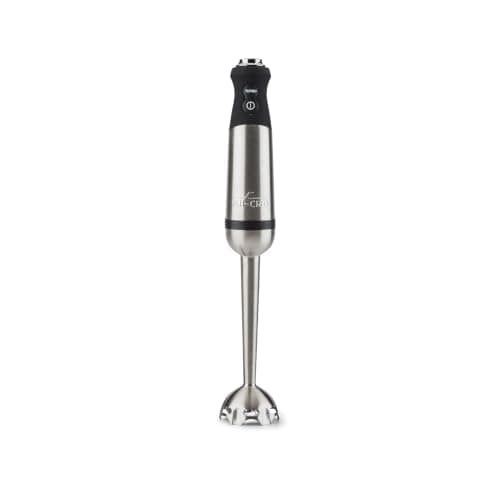
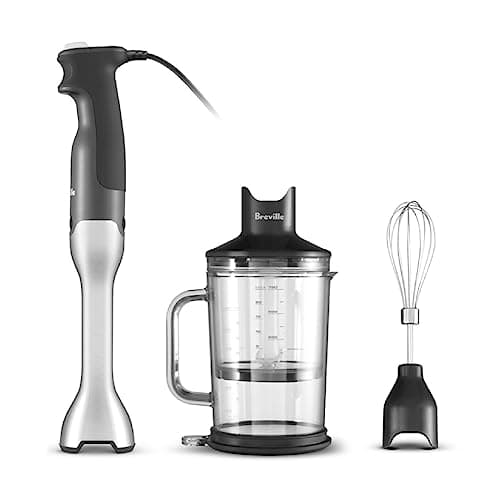
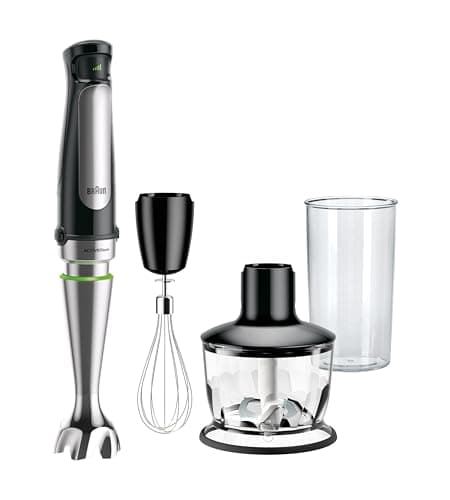
If soup is the job, buy the Braun MultiQuick 7. It is not the most powerful stick blender here — All-Clad publishes 600 watts against Braun’s 500 — and it is not the one with the cleverest head. It wins because Braun writes a three-year US warranty on it, against All-Clad’s two years and Breville’s one, and on a tool whose whole life is spent in hot liquid, the length of the manufacturer’s own guarantee is the most decisive published fact anyone has put in writing.
Why this ranking runs on warranty rather than watts
A stick blender is not fighting a jar of frozen fruit. It is working in liquid that is already soft and already hot, which is why the whole category draws a fraction of what a countertop machine draws and why nobody is ever disappointed by a hand blender for lacking power on soup. Between 280 watts and 600 watts there is a genuine difference on a dense pan of root vegetables, and effectively none on a pan of cooked squash and stock. Ranking these three on their motor figures would sort them by the spec that matters least.
Warranty length is different. It is a legally binding statement from the manufacturer about how long they expect their own motor, seal and bearing to survive — written by the party who has to pay if they are wrong. When Braun writes three years and Breville writes one, that gap is an actuarial judgment, not marketing copy, and both documents are free to read. It is also the number that separates these three most sharply, which is exactly why it decides the order.
The three, side by side
| Published fact | Braun MultiQuick 7 | All-Clad immersion | Breville Control Grip |
|---|
| Motor, as published | 500 W input power | 600 W, unqualified | 280 W, unqualified |
|---|
| US warranty | 3 years | 2 years, parts and labor | 1 year limited |
|---|
| Vessels published in the box | 500 ml chopper, plus a whisk | Listed piece count of one — no beaker or chopper published | 42 oz blending jug, 25 oz chopper bowl |
|---|
| Vented bell against suction lock | Not published | Not published | Yes — designed against suction lock |
|---|
| Noise | Not published for the US market | Not published | Not published |
|---|
| Running cost, a year | $1.67 | $2.01 | $0.94 |
|---|
Every figure in that table comes from the manufacturer’s own page or warranty document, listed at the bottom of this page. Where a cell says “not published”, that is the honest state of the information rather than a gap we chose to fill.
1. Braun MultiQuick 7 — the one to buy
Two published facts put it first. The first is the warranty: three years in the US on a category where one and two years are the norm, which means Braun is carrying the risk on this motor for triple the term Breville is willing to carry on theirs. The second is quieter and says something about the company. Braun’s own product data field is labeled input power and reads 500 W — that is what the motor draws, not a peak figure captured at the instant of maximum load under conditions the marketing department chose. Almost every brand in the wider blender market publishes the flattering number. Publishing the conservative one, and naming it, is the honest way round.
For the actual job it is well matched. Variable speed responds to grip pressure, so you can back off mid-blend without letting go of a machine held over a hot pan and reaching for a dial. Braun publishes a 500 ml chopper in the kit and includes a whisk, which between them cover most of what a stick blender gets asked to do beyond soup.
The mark against it is a documentation problem rather than a hardware one. Braun’s printed manual carries a two-year guarantee marked For UK Only, while the US term from Braun’s own knowledge base is three years. A buyer reading the paper in the box will conclude they have two years of cover, which is the wrong conclusion in this market. That is worth knowing before you file the paperwork, and it is unpicked in full in the MultiQuick 7 review.
Skip it if you want one machine for everything. A stick blender will not crush ice, will not make nut butter and will not blend a frozen load, whatever the wattage suggests.
2. All-Clad stainless steel immersion blender — the powerful one
600 watts is the most published power in this list, and unlike a peak rating it comes with no qualifier attached — All-Clad prints the figure plainly. On a dense pan of root vegetables, where a stick blender genuinely can bog down, that margin is the one place raw power earns its keep in this category. The body is metal rather than plastic, which tolerates heat and staining better over a decade of soup.
Its warranty is the interesting part. Two years is less than Braun’s three, at a higher price, but All-Clad’s document explicitly covers parts and labor — a distinction most brands skip past entirely, and one that decides whether a repair costs you nothing or costs you a bench fee. It is a shorter term of better-specified cover.
Two real limitations. All-Clad publishes no beaker and no chopper: the listed piece count is one, so this is a bare stick and you will be blending in a pan or a vessel you already own. And the warranty applies to purchases from authorized sellers only, which makes a marketplace bargain an uncovered machine — the exact trap that turns a two-year warranty into a zero-year warranty without anyone lying to you.
Skip it if you buy from marketplace sellers. An unauthorized purchase is outside the terms of the document you are paying a premium for.
3. Breville Control Grip BSB510XL — the best-designed head, the worst warranty
The single most common complaint about stick blenders is that the bell suction-locks to the bottom of the pan: you press down, the guard seals against the metal, the blend stops and the machine hops. Breville built a vent into the bell specifically to stop that happening. That is a real piece of engineering aimed at a real annoyance, and it is the reason this machine has the reputation it has.
It is also the best-equipped of the three on published vessels — a 42 oz blending jug and a 25 oz chopper bowl, both properly sized rather than token — and the trigger and speed control sit under the hand already holding it.
Then the warranty: one year. Against Braun’s three at similar money, that is hard to argue for, and Breville makes it worse by publishing no term on its warranty page at all and deferring to the product page instead. The 280 W motor is the lowest here too — ample for soup, and emphatically not enough for anything thick. If the vented bell is worth more to you than two extra years of cover, this is a defensible choice; for most people it is not.
Skip it if warranty length is how you choose. Braun offers three years on the same kind of tool for similar money.
The decision, in one line each
If you want the machine still covered in year three and you are not going to argue about 220 watts you will never notice on soup, buy the Braun. If you routinely blend dense pans of root vegetables with very little liquid, already own something to blend in, and buy from an authorized seller, the extra power and the parts-and-labor cover make the All-Clad defensible. If the thing that has always irritated you about stick blenders is the head sealing itself to the bottom of the pan, and you accept twelve months of cover as the price of solving it, buy the Breville. Those are the three conditions that flip the answer; everything else in the spec sheets is noise.
What a year of soup costs to run
Nobody in this category publishes this, and it is not because it is difficult. Motor power, divided by a thousand, multiplied by hours of use a year, multiplied by what you pay for electricity. At three minutes a day every day — 18.25 hours a year, which is generous for a stick blender — and the US average residential rate of 18.34¢ per kWh:
Braun MultiQuick 7 — 500 ÷ 1000 × 18.25 h × $0.1834 = $1.67 a year
All-Clad immersion — 600 ÷ 1000 × 18.25 h × $0.1834 = $2.01 a year
Breville Control Grip — 280 ÷ 1000 × 18.25 h × $0.1834 = $0.94 a year
The entire spread across the three is about a dollar a year. That is the point of showing it: power draw should play no part whatsoever in this decision, and now you can stop weighing it. Substitute your own electricity rate and your own minutes and the sum still works — the running-cost guide walks through the whole model.
Why a stick blender is the right tool for hot soup at all
Blending hot liquid in a sealed jar is a pressure problem, not a heat problem. Steam expands, pressure builds under a clamped lid, and the lid leaves along with the contents. An immersion blender removes the mechanism entirely: there is no sealed vessel, so there is no steam pressure to build, and you blend in the open pan the soup is already in. What remains is a splash-and-depth problem, which is managed by keeping the bell fully submerged before the motor starts and stopping it before you lift. The same no-jar, no-lifting argument is why a stick blender leads our ranking for seniors.
The safety rules that still apply — fill depth, when to start and stop the motor, and why you never lift a running head clear of the surface — are set out with a manufacturer document behind each one in the hot-liquid safety guide. This is a burn-risk topic and not one to be casual about.
What all three are bad at
Ice. Frozen fruit straight from the freezer. Nut butter, because the load is too thick for the blade to move and none of these motors is designed to sit near stall for minutes at a time. Dry grinding. And any large volume of thick mixture, because you are holding the motor — your arm gives out well before the machine does. None of that is a fault in these particular models; it is what the format is. If those jobs are your jobs, the honest answer is a countertop machine, and the format comparison shows exactly where the line falls.
What we cannot tell you
Noise. Not one of these three manufacturers publishes a decibel figure — Braun publishes none for the US market, All-Clad none, Breville none — so there is nothing to compare and we will not invent a reading. Braun publishes no beaker capacity anywhere we could locate, so that cell stays empty rather than being filled from a retailer listing. And we have blended nothing: this ranking is compiled from manufacturer specification pages, manuals and warranty documents, all listed below, and the full method is published including what would disqualify a product from this list.