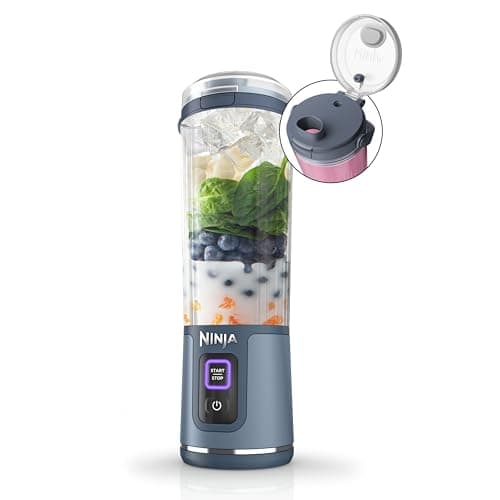
The Ninja Blast BC151 is the cheapest sensible way to blend away from a socket from a brand that has a real service operation behind it. It charges over USB-C, makes an 18 oz serving in the vessel you drink from, and carries a one-year warranty. The oddity: Ninja’s own specification table lists its wattage as 0 W and its peak wattage as 0 W — a data-entry failure that is, accidentally, the most honest thing on the page, because there is no meaningful mains-comparable power figure for a small battery blender.
What this review is.Specification-based, not hands-on — this site owns no blenders. Every figure is from SharkNinja’s own BC151 specification table. Where the spec sheet gives no usable number, this page says so. Our method is published in full.
The zero-watt spec sheet
Read SharkNinja’s specification table for the Blast and the power fields read 0 W and 0 W peak. It is plainly a data-entry error — the machine obviously drawssomething— but the effect is that no usable wattage is published for it at all, and the only power-related figure Ninja gives is a 7.4 V USB-C rechargeable base. Since there is no published wattage, there is no running-cost figure, and we will not manufacture one from a battery voltage. For a portable, wattage was never the point anyway; battery life and capacity are.
What it is genuinely good at
Three real strengths. It is among the cheapest cordless blenders you can buy from a brand with actual service behind it, rather than a no-name. It uses USB-C rather than a proprietary charger. And 18 oz is a sensible single serving in a vessel that doubles as the drinking cup — the whole point of a portable. Ninja’s blade geometry also handles soft frozen fruit better than the price suggests, within the limits of any battery machine.
The limits
The 7.4 V base is half the voltage of the Beast GO’s 11.1 V battery, and battery blenders are already the least powerful category here — so this is firmly a soft-load machine: powder, soft fruit, liquid, maybe a little soft frozen fruit with room to move. The warranty is one year, shorter than Beast’s two on a comparable portable, and no power figure is published to compare it on. If you want the better-documented, longer-warranted cordless, that is the Beast GO; if you want the cheapest from a real brand, this is it.
Who it is for
Buy it if you want an inexpensive, brand-backed portable for soft shakes on the move and USB-C is a must. Skip it if you want to compare it on power (there is no number), need to blend anything hard-frozen, or value a two-year warranty over one — the Beast GO is the step up, and the portable roundup ranks them together.
A cheap portable from a brand with real service
The reason to pay a little for a Ninja Blast over an anonymous portable is not the specs — it is that SharkNinja runs an actual service and returns operation, so a machine that fails in the first year is a support ticket rather than a dead end. USB-C charging is the other quiet win: no proprietary brick to lose. Treat the 18 oz vessel as one drink, and the drinking lid as the whole point of owning it.
The honest limits, and the step up
Ninja publishes no usable wattage — the spec table literally reads zero — and the 7.4 V base is half the voltage of the Beast GO’s battery, so this sits at the gentle end of an already-gentle category. Soft fruit, powder, liquid, and a little soft frozen fruit with room to move are its comfort zone; a packed cup of hard frozen fruit is not.
If you want a longer warranty and published cycles-per-charge, the Beast GO is the upgrade for more money. If you want the cheapest brand-backed way to blend a shake away from a socket, the Blast is exactly that — provided you keep your expectations to soft loads. Both are ranked in the portable roundup.
How we picked
Blenders we claim to have tested: 0
Every site in this category tells you they blended twenty smoothies. We have not blended any, and we say so. Here is what we do instead: read the manufacturer's manual and spec sheet, record the published motor rating, jar capacity and warranty term, verify the warranty against the manufacturer's own warranty document, work out what the machine costs to run for a year and show the arithmetic, and cite all of it so you can check the work. Prices come live from Amazon's API and disappear rather than go stale.
The scores above are judgments from that documented research — not test results. The full rubric, including what disqualifies a product, is published in full.