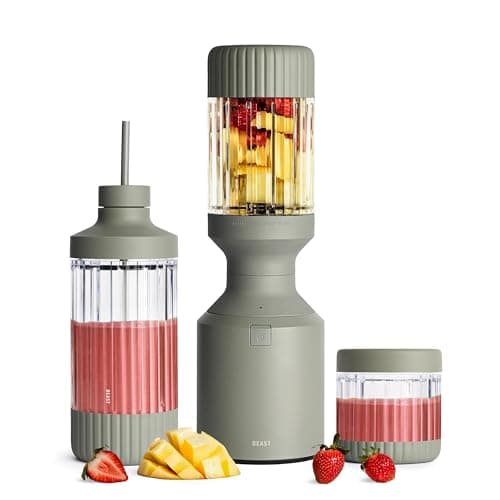
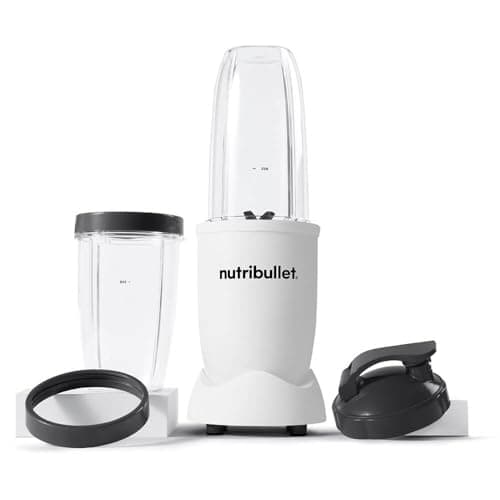
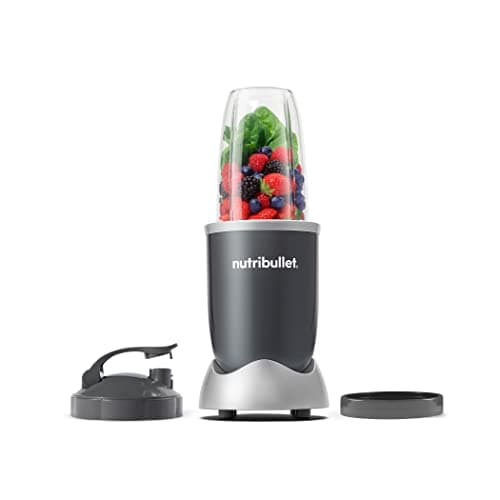
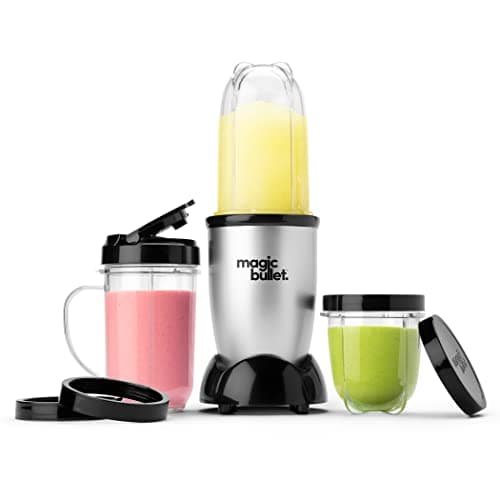
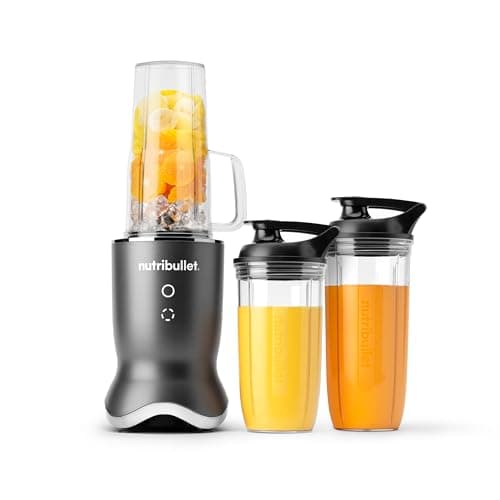
Buy the NutriBullet Ultra. It is for the person who makes one drink at a time and does not want to replace the machine in two years: 1,200 W into a 24 oz or 32 oz cup, five years of warranty on the blade assemblyrather than the usual one, and — the part nobody else mentions — the only NutriBullet on this page that its own maker has not discontinued. The budget pick is the Magic Bullet 11-piece setat 250 W: genuinely the cheapest thing here that still does small jobs properly, and honestly labelled as such.
Two of the five picks here are discontinued by their own manufacturer. nutribullet.com’s product pages state that the Pro 900 is replaced by the nutribullet Turbo and the 600 by the 700 W Personal Blender. Both machines are still stocked and still priced, which is why they are still ranked — a discontinued model is often the best value on the shelf, because the replacement carries the new price. But the warranty is one year, it excludes cups and accessories, and on a format where the cup is the vessel, that exclusion is the whole risk.
Who each one is for, in one line
- NutriBullet Ultra— for a daily single-serve habit you want to keep: the most power, the longest blade cover, still in production.
- Beast Mega 1200— for the buyer who wants honest numbers: a published 1000 ml vessel capacity and two years of warranty instead of one.
- NutriBullet Pro— for the best power-per-dollar in the format, if you can live with a discontinued model and two 32 oz cups.
- NutriBullet 600— for one modest shake a day, with a short cup as well as a tall one.
- Magic Bullet 11-piece set— the budget pick: 250 W for very small jobs, and eleven pieces to lose.
What the bullet format actually is, mechanically
It is worth being precise, because the design decides what the machine is good at far more than the wattage does. A bullet blender has no jar. You fill a cup, screw a blade assembly onto the open end, invert the whole thing onto the motor base and press down. Three consequences follow, and all three are the reason the format survives against machines with ten times the motor:
- Gravity feeds the blades. Because the load sits on top ofthe blades rather than above them in a tall jar, a thick low-liquid mixture cannot form the air pocket that stalls a pitcher machine. This is why a 900 W bullet handles a thick smoothie that frustrates a 1,200 W pitcher.
- The cup is the serving vessel.Nothing is decanted and nothing is poured, so the washing-up is a cup and a blade. On part count alone the format beats every full-size machine in this catalog — the easiest blenders to clean ranks the whole catalog that way.
- Capacity is capped by what you can hold in one hand.Between 18 and 33 oz on everything here. There is no version of this format that makes a family pitcher, and anything claiming to is a pitcher machine with cups bundled — which is a different buy, covered in the Combo vs DUO comparison.
The cost of the design is the seal. Every bullet blender puts a threaded gasket between the drink and the counter, and it is the part that fails: the one component that wears, the one that leaks, and the one that nearly every warranty in the format explicitly excludes.
Why the cup ecosystem is the real buying decision
On a pitcher machine, the jar is a $30 spare you buy once in a decade. On a bullet blender, the cups and the blade are consumables, and they are excluded from NutriBullet’s one-year warranty by name. That makes two questions more important than power:
Is the model still made?Spare cups, gaskets and blade assemblies for a discontinued line get harder and dearer to find over the life of the machine. Two of the five here are in that position today. The Ultra and the Beast Mega are not. The NutriBullet range on its own, with each model’s production status against it, is ranked in the best NutriBullet blenders.
What does the maker promise on the part that wears?This is where the Ultra separates from the rest of the format: five years on the Ultra Rapid Extractor blade, against one year with cups excluded on the Pro and the 600. Beast takes the other route — two years on the whole machine rather than a long term on one component. Both are better than one year with carve-outs.
Power, and where it stops mattering
The published spread here is 250 W to 1,200 W — a factor of nearly five. It is real, and it decides exactly one thing: whether the machine will take frozen fruit and ice as a habit rather than as an occasional strain. At the top, the Ultra and the Beast Mega both publish 1,200 W. At the bottom, the Magic Bullet’s 250 W will chop, blend soft fruit and make dressings, and will not make a frozen smoothie without thawed fruit and added liquid.
Between those extremes it matters less than the marketing implies. A 600 W machine makes a perfectly good banana-and-protein shake, and thawing frozen fruit for ten minutes is the free fix that closes most of the gap. At 18.16¢ per kWh and 3 minutes a day, 365 days a year the running costs are indistinguishable anyway: about $3.98a year for the 1,200 W machines, $2.98 for the Pro, $1.99 for the 600 and $0.83 for the Magic Bullet. Full arithmetic.
Who should not buy a bullet blender
Anyone blending for more than one person, anyone making hot soup, and anyone who wants to blend and then pour. The format has no answer to any of those — see family smoothies and whether personal blenders handle hot liquids (the short version: a sealed cup and steam are a bad combination). And if what you actually want is to blend away from a socket, no corded bullet qualifies at all; best portable blenders covers the two machines in this catalog that do.
What we have not done
We have not tested these machines or blended anything in them. Every wattage, cup size, weight and warranty term above is read off the manufacturer’s own product page or warranty document, cited below, and the discontinuation notices are quoted from the makers’ own pages. Prices come live from Amazon with the date they were checked.
How to buy a bullet blender
1. Check the manufacturer’s page before the retailer’s
It takes thirty seconds and it is the single most useful thing you can do in this format. The discontinued notice is usually at the top of the product page, and it tells you how long spare cups and blades will stay easy to buy. Two of the five machines on this page carry one right now.
2. Read what the warranty excludes, not how long it runs
“One year” on a bullet blender usually means one year on the motor base, with cups and accessories excluded by name. Since the cup is the vessel and the gasket is the part that fails, that is a warranty on the component least likely to break. Prefer a long term on the blade assembly, or a shorter term with nothing carved out.
3. Count the cups you will actually use
Eleven pieces sounds generous and means eight things in a cupboard. Two cups is usually right: one in the dishwasher, one in use. Anything beyond that is storage you did not ask for.
4. Match the cup size to the drink, not to the biggest number
A 32 oz cup fills to about 24 oz of drink once the blades and headroom are accounted for. If your drink is 12 oz, a smaller cup blends it better, because the load has further to travel in a big cup before it meets the blade. Best blenders for one person makes that case across formats.
5. Treat the 250 W machines as choppers that also blend
That is not a criticism; it is the honest description. At a quarter of the power of the top of the format, the Magic Bullet is excellent for dressings, dips, soft fruit and small chopping, and poor at ice. Buy it for what it is and it will not disappoint you.
6. Expect to buy a gasket, and price that in
Across the whole format, the rubber seal between the cup and the blade is the consumable. It is cheap on an in-production model and awkward on a discontinued one. This is the real argument for paying more up front, and it has nothing to do with watts.