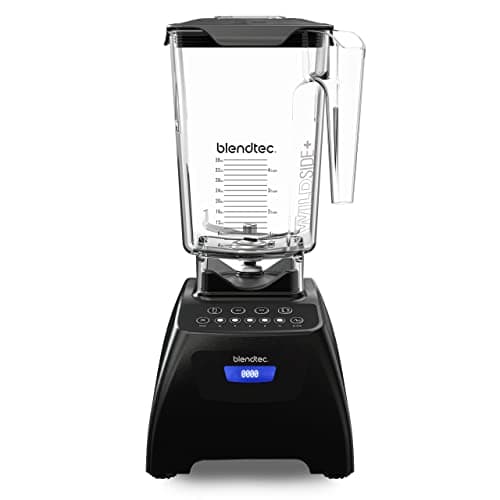
For a home kitchen, buy the Blendtec Classic 575. It is the only machine of the three written for residential use, it is the cheapest of them by a wide margin, and it carries the things Blendtec is actually known for: a 1,560 watt motor, a blunt unremovable blade you never have to install correctly, preset cycles that stop by themselves, and a short WildSide+ jar that clears a standard worktop-to-cabinet gap. Read its warranty before you buy it, though — that is the rest of this page.
Who each one is for, in one line
- Blendtec Classic 575— for the home kitchen with a wall cabinet over the worktop that wants real published power and no tamper to fuss with.
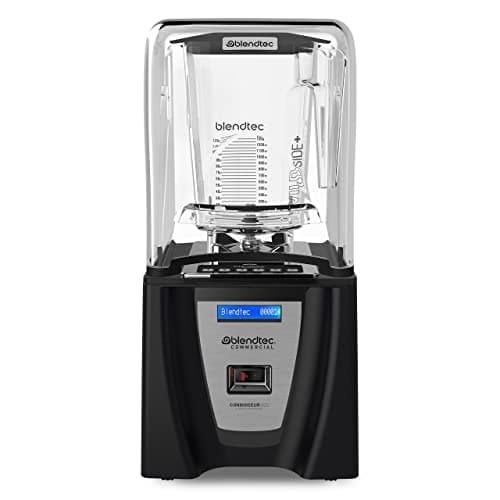
- Blendtec Connoisseur 825— for a busy smoothie counter: the one machine in this catalog whose maker publishes a daily duty figure, with the sound enclosure in the box.
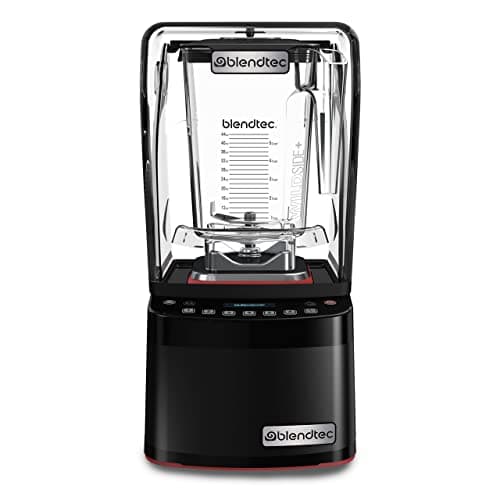
- Blendtec Stealth 885— for a quiet room with a fixed menu, where you want to store your own cycles on a USB stick and have the machine disappear into the conversation.
The eight-year warranty is not a Blendtec Classic 575 warranty
This is the most repeated fact about this machine and it is wrong. Blendtec’s own warranty schedule puts the Classic 575 at two years parts and two years labor, residential use only. The eight-year terms that get quoted belong to other lines in Blendtec’s catalog, not to this model. It matters because the 575 is most often bought as a cheaper substitute for a seven-year Vitamix, and the paperwork is a quarter of the length — which inverts the reason many people choose it.
There is a second clause worth reading in the same document: Blendtec’s residential warranty presumes commercial use above roughly 3,000 cycles a year, and commercial use voids it. Three thousand cycles is about eight a day. A household will never get near that; a home business making drinks to sell very easily might, and would discover the clause at exactly the wrong moment.
Our full method, including what disqualifies a pick, is on how we pick. The brand-by-brand version of this warranty comparison is in blender warranties compared, and how long does a Blendtec last works through what the documents imply about service life.
What Blendtec publishes, and what it refuses to
Blendtec is good about watts and bad about capacity. The Classic 575 is sold with a plain 1,560 watt figure and no “peak” label, and both commercial machines publish 1800 watts. Blendtec also prints a sitewide footnote warning that its peak-horsepower ratings do not denote operational horsepower — a manufacturer disclaiming its own marketing number, which is more candor than most of this category manages. So we quote the watt figures and leave the horsepower alone.
Jar capacity is the opposite story. Blendtec publishes a maximum liquid fill of 36 ozfor the WildSide+ jar and no total capacity at all, which means the widely quoted 90 oz and 96 oz figures are retailer copy rather than manufacturer specifications. Neither commercial page states a jar capacity either. If you need to know how much the jar holds before you buy, you are relying on a seller’s description, and we say so rather than reprinting the number. Blendtec FourSide vs WildSide+ is the jar decision on its own.
Nobody at Blendtec publishes a decibel figure for anything, including the model called Stealth. What the Stealth’s page does say is that it operates “at a sound level comparable to a normal conversation” — a claim you can at least picture, which is more than any other maker in this catalog offers, but still not a number you can compare or plan a room around. Best quiet blenders explains why the whole category behaves this way.
The two commercial machines, and why most people should not buy them
Both are four-figure purchases before you have bought a spare jar, and a spare jar is not optional in a business. What they buy you is not more blending capability for a household — it is duty and repeatability. The Connoisseur 825 is the one machine in this entire catalog whose maker publishes a recommended daily volume (150+ blends), runs fifty preprogrammed cycles so the drink is the same whoever is on shift, and ships its sound enclosure with the machine rather than as an accessory. The Stealth 885 is the same 1800 W platform in a quieter shell, with a USB port and up to fourteen custom BlendWizard programs stored on the machine.
Both carry three years of warranty that stays valid while the machine earns money — which no household blender’s does. That is the real trade: a shorter term than a household Vitamix, for a promise that does not evaporate the moment you sell a smoothie. If you are equipping a counter rather than a kitchen, best commercial blenders for a cafe ranks these two against the Vitamix commercial pair, and what blenders professional kitchens use covers why the answer is so consistent.
One inconsistency to note, because it is Blendtec’s own: the Stealth’s page lists 50 preprogrammed cycles in its feature copy and 42 in its model section. Treat exact cycle counts across the commercial range as approximate — the maker is not consistent with itself on a single page.
What a Blendtec costs to run for a year
At 18.16¢ per kWh and this site’s standard assumption of 3 minutes a day, 365 days a year, the Classic 575 works out at about $5.17a year and either 1800 W commercial machine at about $5.97. Those are the highest running costs in this catalog and they are still less than a couple of coffees, which is the point: power is not where the money goes in this category, and a cafe running a hundred and fifty blends a day is doing arithmetic on a different usage figure entirely. What a blender costs to run shows the sum and how to substitute your own rate and usage.
Which Blendtec to skip
Skip both commercial machines for a home kitchen. You pay three to four times the money, and you are buying a duty rating and a fixed-cycle interface rather than a better smoothie. Skip the Classic 575 if the long warranty was the reason you shortlisted it — Blendtec vs Vitamix is two years against seven, and if covered years per dollar is your criterion, that comparison does not go Blendtec’s way. Skip the brand entirely if your honest use is a smoothie four times a week: the best blenders under $200 makes that drink indistinguishably well.
And if what drew you here was the blunt fixed blade and the no-tamper design rather than the badge, alternatives to a Vitamix explains why the 575 is the closest machine in this catalog on published power, and our Classic 575 review is the single-model reading in full.
What we have not done
We have not tested any of these machines. We own none of them, we have blended nothing, and we have run no timed trials. Every watt figure, cycle count, dimension and warranty term above is read off Blendtec’s own product page or warranty schedule, cited in full below. Where Blendtec publishes nothing — jar capacity, decibels — this page says so instead of borrowing a retailer’s number. Prices come live from Amazon and carry the date they were checked.
How to choose a Blendtec without reading the marketing
1. Decide whether you are buying residential or commercial paperwork
This is the only decision that really splits the range. The Classic 575’s two years are residential-only and presume commercial use above about 3,000 cycles a year. The commercial pair’s three years are written for a business. If money will change hands over the drinks, the cheap machine’s warranty is not a warranty you have.
2. Measure your worktop-to-cabinet clearance
The short jar is the Classic 575’s best practical feature and the reason plenty of people choose it over a taller rival they cannot leave assembled under a cabinet. Blendtec publishes real dimensions and a weight for the Stealth (17.3 in high, 18.1 lbs) and does not for the Connoisseur 825, so plan around the one you can actually look up. Best blenders for small kitchens is the clearance question across every brand.
3. Understand what the blunt blade buys you
Blendtec’s blade is dull and fixed in the jar. You cannot install it wrong, you cannot cut yourself washing it, and the jar geometry is designed so you do not need a tamper to keep a thick load moving — which is a genuine difference from the tall narrow tamper-and-dial machines. Are blender blades sharp explains why blunt is deliberate, and what a blender tamper is used for covers the alternative approach.
4. Preset cycles are a preference, not an upgrade
Blendtec machines run timed programs that stop on their own, so you are not standing over the jar. That is excellent for repeatability and limiting for improvising — a variable dial lets you hold a speed the load needs, and a cycle does not. What pulse does on a blender covers the manual half of this trade-off.
5. Budget for a jar, especially commercially
Jars are a separate decision on all three machines and Blendtec does not state a capacity on any of the three product pages. In a business, a second jar is the difference between serving and washing. Price the machine with the jar you intend to use.
6. Do not buy a Stealth for a kitchen because of its name
There is no decibel figure. The quiet claim is a comparison to a normal conversation, made by the manufacturer, unaccompanied by a number, about a machine built for a dining room with a fixed menu. In a home kitchen you would be paying a four-figure premium for an unverifiable claim, which is precisely the sort of purchase this site exists to talk you out of.