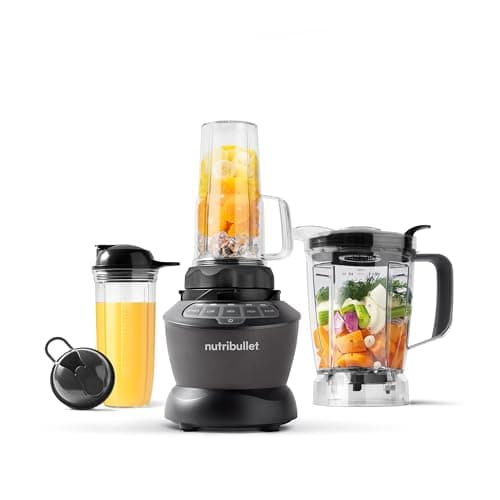
The NutriBullet 1200 W Blender Combo puts a genuine 64 oz family pitcher and two single-serve cups on one motor base, usually for less than a standalone full-size blender costs. If you want both jobs from one footprint at the lowest honest price, this is the machine. The compromises are a one-year warranty that excludes the cups, no tamper, and no presets.
What this review is.A specification-based assessment from NutriBullet’s own product page and warranty terms — not a hands-on test. Nobody here has used one. Every figure below is NutriBullet’s, and the running-cost line is computed from the published wattage and shown in full. Here is how we pick.
What one base actually covers
The value case is real: a 64 oz pitcher is batch capacity, not a token jar, and the 32 oz and 24 oz handled cups take drinking lids, so the same base makes a family smoothie and a grab-and-go shake. Most machines make you choose; this one does not, and it does it for less than many single-purpose pitchers. NutriBullet also publishes a plain, unqualified 1,200 W figure rather than a peak marketing number — an honest way to state it, even if it means you cannot compare it directly to a brand that separates continuous from peak.
Running cost is a rounding error
At 1,200 W, 3 minutes a day, 365 days a year, at the US average residential rate:
NutriBullet 1200 W Blender Combo — 1200 W ÷ 1,000 = 1.200 kW
1.200 kW × 18.25 hours a year = 21.90 kWh
21.90 kWh × 18.34¢ per kWh = $4.02 a year
A few dollars a year, like everything else in this catalog. Nothing in the electricity column should decide a blender purchase — the running-cost guide works out why in full.
The compromises, stated plainly
Three of them. The warranty is one year, and NutriBullet’s terms explicitly exclude the cups and accessories — the parts that most often fail on this kind of machine. There is no tamper, so a thick, low-liquid load in the big pitcher means stopping and scraping. And running two vessel systems is simply more to store and wash than a single-jar machine. None of these is a dealbreaker; all of them are the reason the price is what it is.
Who it is for
Buy it if you genuinely want both a pitcher and cups and want to spend as little as possible to get them, and if cheap, widely available replacement parts appeal — the cups and blades are the standard NutriBullet ones, sold everywhere. Skip it if you will only ever use the pitcher, because then you are paying for cups that will live in a cupboard, and a single-jar machine at the same price usually carries a longer warranty. The head-to-head with the Ninja version of this idea is in NutriBullet Combo vs Ninja DUO.
The value math, and where the compromises land
The Combo’s whole case is that one 1,200 W base covers a family pitcher and single-serve cups for less than many standalone pitchers cost — so it only makes sense if you will use both vessels. If the cups end up in a cupboard, you paid for versatility you do not use, and a single-jar machine at the same price usually carries a longer warranty and gives you less to store. Be honest about whether the grab-and-go cups fit your routine before you buy the flexibility.
Living with it
No tamper means thick, low-liquid loads in the big pitcher need stopping and scraping; add a little more liquid and start slow and most smoothies come out fine. The cups and blades are the standard NutriBullet parts, sold everywhere, which keeps it running cheaply — but the one-year warranty excludes those cups, so treat a replacement gasket every year or two as the real running cost, not the electricity.
Against the Ninja version of the same idea, the Combo usually wins on price and the Ninja on presets and pitcher size — the full split is in Combo vs DUO. And if you know you will only ever use the pitcher, skip the combo entirely and buy a single-jar machine on a longer warranty.
How we picked
Blenders we claim to have tested: 0
Every site in this category tells you they blended twenty smoothies. We have not blended any, and we say so. Here is what we do instead: read the manufacturer's manual and spec sheet, record the published motor rating, jar capacity and warranty term, verify the warranty against the manufacturer's own warranty document, work out what the machine costs to run for a year and show the arithmetic, and cite all of it so you can check the work. Prices come live from Amazon's API and disappear rather than go stale.
The scores above are judgments from that documented research — not test results. The full rubric, including what disqualifies a product, is published in full.