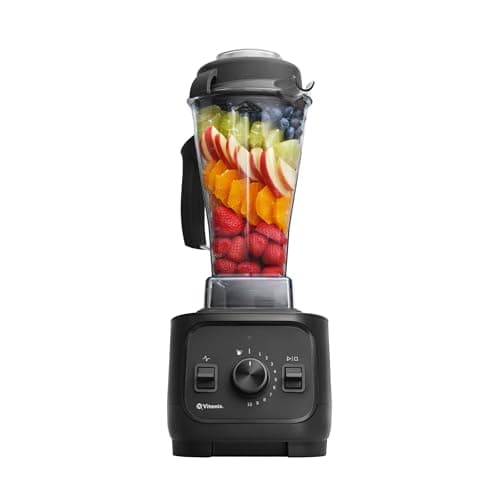
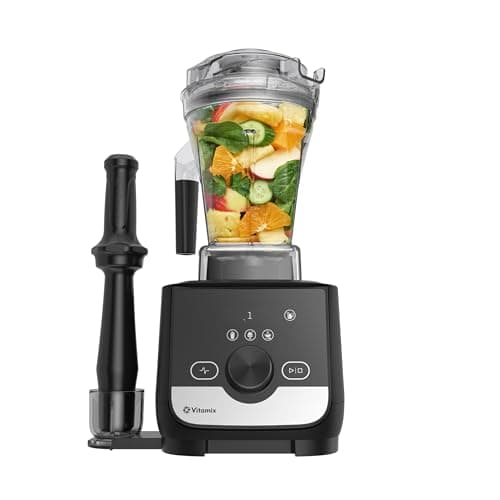
Buy the Ascent X3 if you will keep it. Ten years of full, transferable warranty against five years limited is the largest documented difference between these two machines, and it is not close. Buy the VX1 if you blend for a family.Its 64 oz container is a third bigger than the X3’s 48 oz jar, and it costs meaningfully less. Everything else — the motor, the tamper, the self-clean program — is close enough that it should not decide this for you.
The same motor, stated two different ways
Both machines publish 2.2 horsepower. Vitamix also publishes a watt figure for each, which it notably does not do for the 5200: 1,500 Won the X3’s specification list and 1,440 Won the VX1’s, the latter backed by a 12 A rating table in the owner’s manual.
Treat the 60 W gap as noise. Both are nameplate maximum draws at 120 V rather than continuous operating figures, neither is comparable to the continuous ratings Ninja publishes, and 4% on a rated draw is not something you will feel in a jar. If the number itself is what you are shopping on, the reason it tells you less than you think is on blender wattage explained.
The three differences that are real
1. Warranty: ten years full against five years limited
The X3 carries Vitamix’s 10-Year Full Warranty: parts, performance, labor and standard two-way shipping, and the document allows ownership to be transferred to a new owner. The VX1 carries a 5-Year Limited Warranty: parts, labor and standard two-way shipping, original owner only, with implied warranties capped at five years and liability capped at the purchase price.
That is twice the term, a stronger class of cover, and resale value the other machine does not have. On a machine you expect to own for a decade it is the single most consequential line on either spec sheet, and it is the reason the X3 leads this page despite losing on jar size and price. One documentation footnote we will not bury: the X3 product page’s own specification list labels the cover “10 Year Standard Warranty” while the document it links to is titled and reads as Full. We cite the document, and we think you should read it before you buy. Every term in the catalog sits in one table on blender warranties compared.
2. Jar: 48 oz against 64 oz
This is the X3’s real cost, and it is a third of the capacity. The VX1 ships the 64 oz Classic container — the same jar Vitamix puts on the 5200 — and a family batch of smoothies, a double batch of soup or a large nut-milk pressing all fit in one pass. On the X3 the same job is two passes, and two passes means two washes.
The X3’s compensation is that a smaller jar is a better jar for small loads. Under-fill a 64 oz container with a single drink and the blade spins in a cavity above the mixture; a 48 oz jar holds that same drink against the blade. If you blend for one or two people the X3’s jar is not a compromise at all, and if you blend for four it is the reason to buy the other machine.
3. Height: 17 inches against 19.6
The standard American worktop-to-cabinet gap is about 18 inches. The X3 is 17 inches tall with its container on, so it lives under the cabinet with the jar in place. The VX1 is 19.6 inches, so it does not — it comes out, goes back, or lives somewhere else entirely.
This sounds like a detail and it is the thing most likely to determine whether you use the machine daily. A blender that has to be lifted out of a cupboard gets used on weekends. The full set of published heights against that 18-inch gap is on best blenders for small kitchens.
The fourth difference, which only shows up in the manuals
The X3’s 48 oz SELF-DETECT container is stated by Vitamix to be dishwasher-safe, container and lid both. The VX1’s 64 oz Classic container is stated in its own owner’s manual to be not dishwasher-safe, with the self-cleaning program offered as the substitute.
Two machines, one brand, opposite answers — which is exactly why generic advice about whether a blender goes in the dishwasher is useless. We surveyed eight manufacturers on that question for can you put a blender in the dishwasher, and this pair is the clearest case in the whole set. Whether it matters depends entirely on how you clean: the 30-second blend-with-soap routine works identically on both jars, and if that is your habit the difference is academic.
The two, side by side
Manufacturer figures only, from Vitamix’s own specification lists, owner’s manual and warranty documents. Every cell traces to the source list at the foot of this page. | Vitamix Ascent X3 | Vitamix VX1 |
|---|
| Published motor | 2.2 HP; 120V, 1500W | 2.2 HP; 120 V, 1,440 W (12 A on the manual’s rating table) |
|---|
| Container | 48 oz, BPA-free, with SELF-DETECT | 64 oz Classic — the same jar as the 5200 |
|---|
| Container dishwasher-safe? | Yes, container and lid | No — self-clean program is the stated substitute |
|---|
| Tamper | S2 low-profile tamper and holder in the box | Included |
|---|
| Height with container on | 17 in — clears a standard 18 in cabinet gap | 19.6 in — does not |
|---|
| Controls | Three programs (Smoothies, Frozen Desserts, Soups), pulse, variable speed, digital timer, self-clean | Pulse switch, count-up timer, self-clean program, variable dial |
|---|
| Warranty | 10 years FULL — parts, performance, labor, two-way shipping; transferable | 5 years LIMITED — parts, labor, two-way shipping; original owner only |
|---|
| Cord | 3.5 ft | 3.5 ft |
|---|
| Noise | Not published | Not published |
|---|
What SELF-DETECT actually buys you
The X3’s containers are recognized wirelessly by the base, which adjusts its programs to whichever jar is fitted. On day one this does nothing you would notice. It matters later, when you add a second container — a smaller jar for single drinks, or a different vessel for dry work — and the machine simply knows, with no settings to learn and no risk of running a 64 oz program on a 20 oz load.
The VX1’s base is more conventional and more flexible in a different way: it accepts Vitamix’s 48 oz and 32 oz containers and the Personal Cup Adapter, so the jar can be sized to the job later too — you just do the thinking yourself. Neither approach is better; one is automatic and one is cheaper.
Running cost, for completeness
At 18.34¢ per kWh (US EIA, Electric Power Monthly — average residential price, US total, retrieved September 2026) and 3 minutes a day, 365 days a year, the X3’s 1,500 W rated draw works out at about $5.02 a year and the VX1’s 1,440 W at about $4.82. The difference is small change, and both are nameplate figures rather than what the motor pulls in normal use, so the real gap is smaller still. Electricity is not a reason to choose either machine; the arithmetic in full is on how much a blender costs to run.
Who should buy which
Buy the Ascent X3 if
You intend to own one blender for a decade, you blend for one or two people, your worktop has a cabinet above it, or you want the container in the dishwasher. The ten-year full term is worth real money on a machine at this price, and it is transferable, which nothing else in our catalog is.
Buy the VX1 if
You blend for a household, you want the 64 oz jar that Vitamix has shipped for decades, or the price gap matters more to you than the warranty gap. It is the cheaper way into a current Vitamix with a tamper and a jar you can batch in, and the five-year limited term is still longer than any Ninja, NutriBullet, Blendtec Classic or Breville cover.
Buy neither if
The 5200 is still on sale at a price you like and you want the longest full term Vitamix offers on a classic machine — seven years full, with the same 64 oz jar as the VX1 and no pulse button at all. Both comparisons against it are already written: Ascent X3 vs 5200 and VX1 vs 5200. And if you are not yet sure a Vitamix is the right spend at all, is a Vitamix worth it is the page that argues both sides.
What we have not done
We have not blended anything in either machine. We own no blenders and we make no claim to have tested these. Every figure on this page is from Vitamix’s own specification lists, the VX1 owner’s manual and the two warranty documents, all linked below. Neither machine has a published decibel figure — no manufacturer in our catalog publishes one for any model — so there is no noise comparison here, and anyone offering you one without a measurement is guessing. The longer version of each machine on its own is in the Ascent X3 review and the VX1 review.
How to decide between two machines with the same motor
Start with the warranty, not the spec sheet
When the horsepower figure is identical, the covered years are the real product difference. Read for three things: the term, whether it says Full or Limited, and whether it transfers. All three differ between these two machines, and all three are in the documents rather than on the box.
Then measure your cabinet
Hold a tape measure from the worktop to the underside of the cupboard. If the gap is under 19.6 inches, one of these machines lives on the counter with the jar on and the other does not. That decides daily use more reliably than any feature list.
Then count the servings you actually make
Not the biggest batch you can imagine — the batch you make on a Tuesday. One or two drinks fits a 48 oz jar better than a 64 oz one. Four fits neither well in a single pass on the smaller machine.
Treat the watt figures as a tie
1,500 against 1,440 is a 4% difference in a nameplate rating, not in delivered performance. Both are 2.2 HP by the manufacturer’s own statement. If you find yourself weighing this number, you are weighing the wrong one.
And check how you intend to clean it
If the dishwasher is your habit, only one of these containers is rated for it. If the 30-second self-clean blend is your habit, both machines do it identically and the difference vanishes.