HUB 07 · Guides
What Is a Blender Tamper Used For?
That plastic baton in the box has exactly one job: pushing food back into the blade when a thick mixture stops circulating. Knowing when not to use it matters as much as knowing when to.
We earn a commission if you buy through our links. It does not change the price you pay, and it does not decide our picks — our selection criteria are published in full. How this works.
A tamper is the plastic baton that comes with premium blenders, and it has one job: pushing food down into the blade when a thick mixture has stopped circulating on its own. That is it. It is not a spoon, it is not for stirring, and it is not a way to make a weak machine stronger. If you make nut butter, thick smoothie bowls or hummus, it is the single most useful accessory in the box. If you only make drinkable smoothies, you may never need to take it out of the holder.
We treat “tamper included” as a deciding factor across a dozen rankings on this site without ever having explained what it does. This page is that explanation.
The problem a tamper solves: a collapsed vortex
A blender works by circulation, not by chopping. The blade flings the mixture outward and up the walls, it falls back down the middle, and the whole load passes through the cutting zone again and again. That loop — the vortex — is the product. A thin smoothie makes one easily and keeps it.
Thick, low-liquid mixtures do not. Nut butter, a smoothie bowl made with barely any liquid, hummus, a frozen load with no juice in it: in all of these the mixture is too stiff to fall back down the middle. It climbs the walls, parks there, and leaves the blade spinning in an air pocket underneath. This is cavitation, and it is why a 1,500 watt machine can sit there roaring with a ring of untouched almonds halfway up the jar.
More power does not fix it, and neither does more time. The blade has nothing to cut. What fixes it is physically pushing the stalled material back down into the blade while the machine runs — which is a thing you cannot safely do with a spoon, and exactly what a tamper is shaped for.
How to use one properly
Run the machine, drop the tamper in through the opening in the lid, and push the material at the walls down toward the centre. Work around the jar rather than straight down the middle; the goal is to feed the stalled ring into the circulation, not to mash the bottom. Short bursts, then stop and look. You will hear the vortex restart — the pitch of the motor drops as it finds load again, which is the most useful feedback the machine gives you.
Three rules, and all three are about restraint:
- The lid stays on. The tamper is designed to be used through the lid opening with the lid in place. That is the whole reason it exists in that shape rather than as a spatula.
- Never substitute a utensil. A wooden spoon, a spatula or a chopstick in a running blender is how people destroy blades, jars and fingers. If the tamper for your container is lost, stop the machine and scrape instead.
- Use the tamper that came with your container. This is the part almost nobody knows, and it is the next section.
Tampers are matched to containers, not to brands
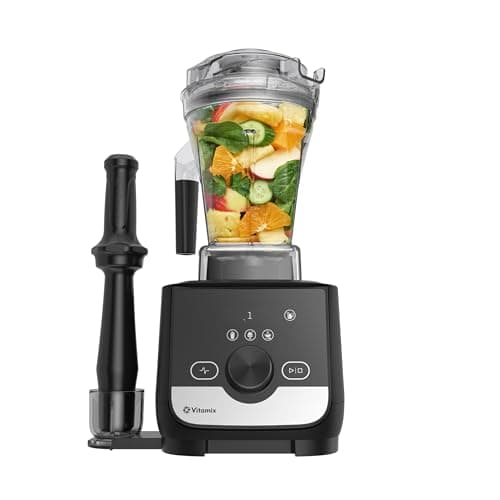
Vitamix ships the Ascent X3 with what its own in-box list calls an S2 low-profile tamper, plus a holder. “Low-profile” is doing real work in that name: the X3’s container is 48 oz, shorter than the 64 oz Classic container that ships on the Vitamix 5200 and the Vitamix VX1, and a tamper sized for the taller jar is the wrong length for the shorter one. Same brand, same accessory category, different part.
That is why “will a tamper fit my blender” has no general answer. The length is set by how deep the container is and how far the blade sits from the lid, so a tamper from a different container can be too short to reach the stalled material or long enough to reach something it should not. Buy the one listed for your container, and if you have two containers, keep them separate.
What a tamper is not for
Dry grinding.This is the most common misuse and it is the opposite of helpful. In a dry load — grain, spices, coffee — there is no vortex to restore, because there is no liquid to carry anything. Pushing dry grain into a spinning blade packs it harder and makes the problem worse. Dry work is decided by the container, and the ranking is on best blenders for grinding grains and spices.
Mashed potato. Also the opposite of helpful, for a different reason: with potato the goal is less blade contact, not more, and a tamper exists to increase blade contact. We explain why on best blenders for mashed potatoes.
Hot liquids.Do not open the lid of a jar of hot liquid to insert anything. The hazard with hot blending is pressure in a closed vessel, and the moment the lid moves is the moment it releases — blending hot liquids safely covers it properly.
Making a weak machine strong. A tamper restores circulation; it does not add torque. A low-amperage machine fed a thick frozen load will still stall, and tamping it only loads the motor further.
Blendtec’s answer: no tamper at all
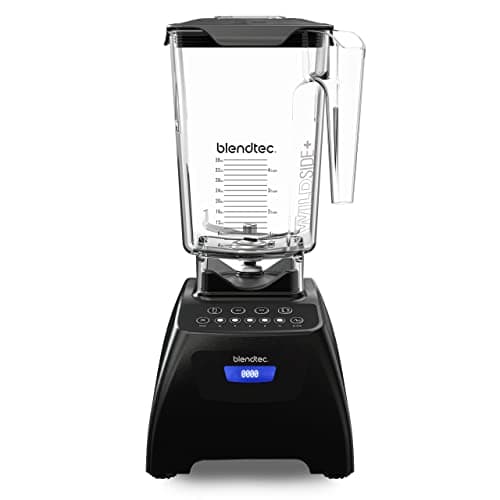
The Blendtec Classic 575 ships without one, and we badge that as “no tamper needed” rather than as a missing accessory, because Blendtec solved the same problem in the jar instead of in the toolbox. Its container is wide and short rather than tall and narrow, and its blade is a blunt wing rather than a set of sharpened edges. A wide, shallow load has much less wall to climb and a far shorter fall back to the centre, so the vortex is harder to collapse in the first place.
Two different engineering answers, each with a cost. Vitamix’s tall jar makes a deeper, more aggressive vortex and then hands you a tool for when it fails. Blendtec’s wide jar is harder to stall and harder to get a small quantity out of. Which you prefer is genuinely a preference, and we argue it on Blendtec vs Vitamix; the jar-geometry detail within Blendtec’s own range is on FourSide vs WildSide.
The machines that have neither — no tamper and no tamper-free geometry — are the mid-price pitchers. The Ninja Professional Plus BN701 is the clearest example, and its own listed drawback is exactly this: no tamper, so a thick low-liquid load has to be managed by stopping, scraping and restarting. That is not a fatal flaw. It is a session of stopping and scraping, repeated every time you make nut butter.
What we are not going to tell you
We have not used any of these tampers, and we publish no figure for how much faster one makes a batch, because no manufacturer publishes such a thing. The container-specific point above is read directly off Vitamix’s own in-box content list; the cavitation explanation is stated as reasoning about how a blade and a stiff mixture interact. Our method is published in full.
Do you need a tamper? Answer three questions
1. Will you make nut butter, smoothie bowls or hummus?
If yes, buy a machine with a tamper or with tamper-free jar geometry, and treat it as a requirement rather than a nice-to-have. These loads are the entire use case. The rankings are best blenders for nut butter and best blenders for hummus and salsa.
2. Or will you only make drinkable smoothies?
Then a tamper is close to irrelevant, and you should not pay a premium for one. A thin mixture sustains its own vortex; the accessory stays in the holder. Spend the money on capacity or warranty instead.
3. Do you already own a machine without one?
Do not buy a generic tamper to fit it. The length is specific to the container, and the technique that works on a tamper-free machine is different: stop the motor, scrape the walls down with a spatula, add a little more liquid, restart. Slower, and it does not risk the jar.
If you are buying a replacement
Order it from the manufacturer against your container, not your machine — the same blender model can take different containers, and the container is what sets the length. The brands that publish parts catalogues make this easy, and which ones do is covered on how long blenders last.
The hardware
The hardware this guide is about
The products this guide refers to, with prices pulled live from Amazon. Prices last checked October 19, 2026. Where we have no verified live price we show none rather than a stale number. Full rankings live in the roundups linked above.
Buying once
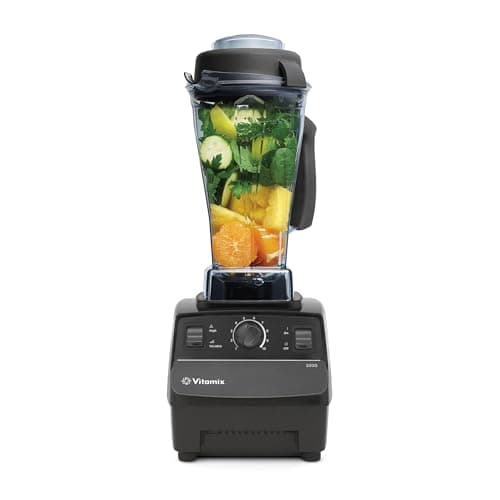
Vitamix 5200
The seven-year warranty is the product. A machine with a fully variable dial, a tall narrow jar and a tamper, backed longer than almost anything else at any price.
Buying once, under a cabinet
Vitamix Ascent X3
Ten years of full warranty, a tamper in the box, and the only full-size machine here that fits under a standard cabinet. The trade is a 48 oz jar instead of 64, at the highest price in the catalog.
First Vitamix
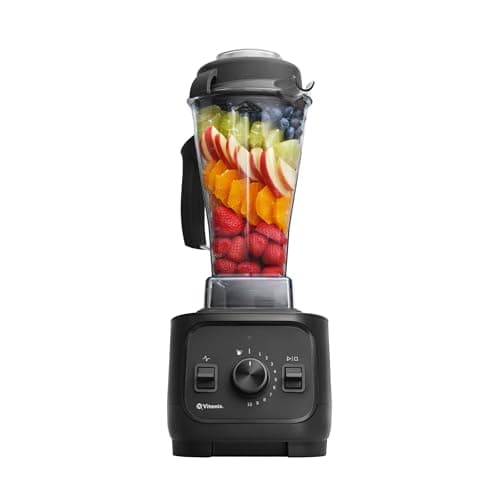
Vitamix VX1
The 5200's 64 oz container and tamper on a base that finally publishes a watt figure, adds pulse and a self-clean program, and costs less. The trade is a five-year limited warranty instead of seven full.
Cabinet clearance
Blendtec Classic 575
A 1,560-watt motor and a blunt, unremovable blade, in a jar short enough to fit under a cabinet. The warranty is two years, not the eight years the internet keeps repeating.
#ad · As an Amazon Associate we earn from qualifying purchases.
Questions
Frequently asked
What does a blender tamper actually do?
It pushes thick material off the walls of the jar back down into the blade while the machine is running, which restarts a vortex that has collapsed. In a stiff, low-liquid mixture the load stops falling back to the centre and the blade spins in an air pocket; the tamper is the tool that feeds it again. It adds no power and does nothing useful in a thin mixture.
Can you use a spoon instead of a tamper?
No. A tamper is shaped and sized to be used through the lid opening with the lid on; a spoon, spatula or chopstick in a running blender can reach the blade and will destroy the utensil, possibly the blade or the jar, and potentially your hand. If you do not have the right tamper, stop the machine and scrape the walls down instead.
Will any tamper fit my blender?
No — tampers are matched to containers rather than to brands. Vitamix ships the 48 oz Vitamix Ascent X3with an S2 low-profile tamper, which is a different part from the one supplied with the 64 oz Classic container on the Vitamix 5200. Order against your container, not against the model name on the base.
Why doesn't Blendtec include a tamper?
Because its jar is designed so you need one less often: wide and short rather than tall and narrow, with a blunt wing blade. A shallow load has less wall to climb and a shorter fall back to the middle, so the vortex is harder to collapse. We badge the Blendtec Classic 575as “no tamper needed” for that reason, and compare the two design philosophies on Blendtec vs Vitamix.
Can you use a tamper for grinding grain or coffee?
No, and it makes things worse. Dry loads have no liquid to circulate, so there is no vortex for a tamper to restore — pushing dry grain into a spinning blade just packs it harder. Dry work is decided by the container the maker sells for it, which is the argument on best blenders for grinding grains and spices.
Is a blender without a tamper worth buying?
Often, yes. The Ninja Professional Plus BN701publishes 1,200 W continuous and 64 oz of usable liquid at a fraction of a Vitamix, and for drinkable smoothies the missing tamper costs you nothing. It costs you a session of stopping and scraping every time you make nut butter, which is why we list that as its own drawback rather than hiding it.
If my blender has no tamper, is the pulse button the substitute?
It is the nearest one. Pulsing collapses the vortex so the load falls back onto the blade, which solves the same cavitation problem a tamper solves by hand — less precisely, and at full power every time. What pulse does on a blender explains the mechanism.
Keep reading
Related
- GuidesThe hub this explainer sits in.
- Best blenders for nut butterThe load a tamper exists for, ranked.
- Blendtec vs VitamixA tool versus jar geometry: two answers to the same problem.
- Best blenders for grinding grains and spicesThe one load where a tamper actively hurts.
- Best blenders for mashed potatoesThe other load where more blade contact is the wrong goal.
- Best blenders for hummus and salsaThick, low-liquid, and decided by the same mechanism.
Receipts
Sources
- Vitamix — Ascent X3 product page and in-box contents: 48 oz BPA-free container, S2 low-profile tamper and tamper holder
- Vitamix — 10-Year Full Warranty terms (Ascent)
- Vitamix — 5200 product page and specification table (64 oz container, tamper included)
- Vitamix — 7-Year Full Warranty terms
- Vitamix — VX1 owner's manual (PDF), specifications, controls and care
- Blendtec — Classic 575 product page (wide, short jar; blunt wing blade; no tamper)
- Blendtec — warranty schedule by model
- SharkNinja — Ninja Professional Plus BN701 specification table
We do not run a testing lab and we do not pretend to. Specifications come from the manufacturer's own published documents and from published standards; prices come from the live Amazon API. Where a figure is not published, the page says “not published” rather than guessing. Read the full method.