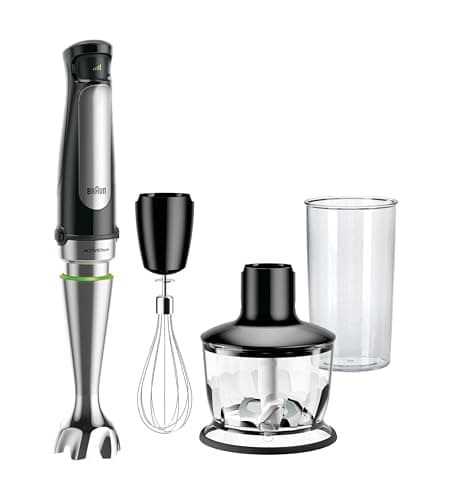
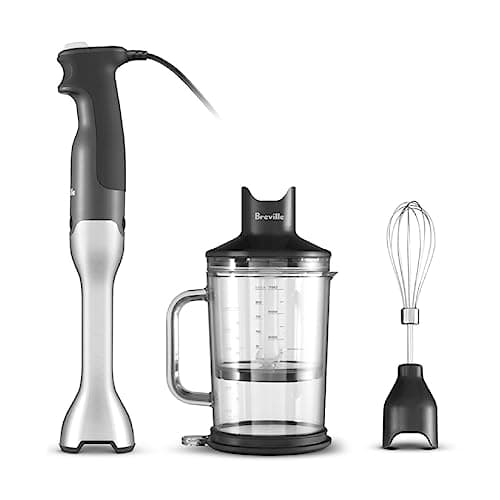
Buy the Breville Control Grip BSB510XL. For emulsions it is for the cook who makes mayonnaise, aioli or hollandaise by hand and wants control rather than power: a published variable-speed trigger and a 42 oz blending jug in the box, which is a vessel tall and narrow enough to actually work in. The budget pick is the Braun MultiQuick 7 MQ7035X— cheaper, more powerful on paper at 500 W against 280 W, and carrying a three-year US warranty where the Breville carries one.
Who each one is for, in one line
- Breville Control Grip— for anyone who makes emulsions regularly: speed control at the trigger and the tallest vessel in the box.
- Braun MultiQuick 7— the budget pick: the most published power of the three, the longest warranty, and a 500 ml chopper for the batch you make once a month.
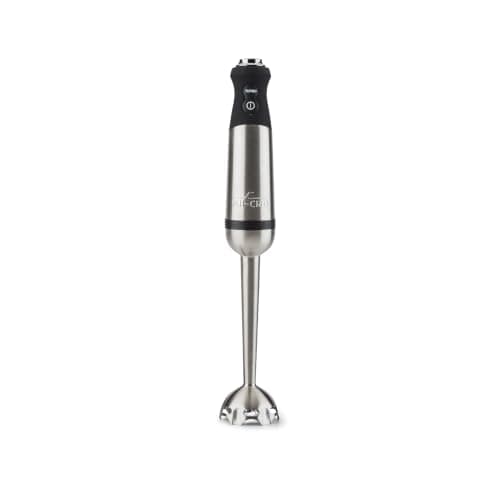
- All-Clad stainless immersion blender— for the cook who wants a metal shaft and 600 W, and does not mind supplying their own jar.
Why this page ranks differently from our soup page
These are the same three machines that appear in the best immersion blenders for soup, and they are deliberately in a different order, because an emulsion is decided by a different set of published features than pot-blending is.
Soup rewards reach, a motor that will chew through fibrous vegetables, and a shaft you can hold in a hot pan. Mayonnaise rewards none of those. It rewards three things:
- Speed control.An emulsion is started slow — you want the blade turning just fast enough to pull oil into the egg in a thin thread — and finished faster once it has taken. A single-speed machine makes that much harder, because the only control you have is how far you lift the shaft. The Breville’s variable trigger is the single most useful feature on this page.
- The blade bell.The guard around the blades is not a safety cage; it is plumbing. It determines whether the vortex pulls liquid down the middle and out the sides — which is what emulsifies — or simply throws it at the walls of the jar. Every machine here has one; it is why a stick blender beats a whisk at this and why a big countertop jar is the wrong tool entirely.
- A tall narrow vessel.This is the one most people get wrong. The shaft has to sit on the bottom with the egg under the bell and the oil sitting above it, so the emulsion forms from the bottom up as you raise the shaft. A wide bowl spreads the oil out and nothing emulsifies. The Breville ships a 42 oz jug; the Braun ships a 500 ml chopper bowl that works for small batches; All-Clad publishes no vessel.
Wattage, which is the thing every listing leads with, is almost irrelevant here. There is nothing hard in a mayonnaise to break down. The full method is on how we pick.
Why a stick blender beats a countertop machine at this
This is one of the few jobs where the cheap tool wins outright, and it is worth understanding why rather than taking it on trust.
A countertop blender’s blade sits in the bottom of a wide jar and needs a minimum volume before it touches anything. A two-egg mayonnaise is roughly 10 to 12 oz finished. In a 64 oz pitcher that is a shallow smear below the blades, and in a 72 oz one it is worse. You cannot add oil slowly through a blender lid while watching the emulsion, and you cannot raise or lower the blade as it thickens.
A stick blender inverts all of that. The blade comes to the food, the vessel can be as narrow as a jam jar, and you control the geometry in real time by moving the shaft. That is why the stick blender is the standard tool for emulsions in professional kitchens as well as home ones, and why our sauces and dressings roundup is led by stick blenders rather than by the most expensive machine in the catalog.
The warranty, which is where the Braun earns its place
Three published terms, three very different promises:
- Braun MultiQuick 7 — three years (US), on immersion blenders. The longest cover on this page and one of the longest in the whole catalog outside Vitamix.
- All-Clad — two years, parts and labor, to the original purchaser, bought through an authorized seller. That last clause is a real condition rather than boilerplate.
- Breville Control Grip — one year limited. The shortest term here, on the machine this page recommends first. That trade is stated rather than hidden: you are buying the variable trigger and the jug, and paying for them in covered years.
Blender warranties compared puts every document side by side, and Braun vs Breville settles the top two on this page one-on-one.
What these cost to run
Nothing, even by the standards of this category. At 18.16¢ per kWhand this site’s standard assumption of 3 minutes a day, 365 days a year, the 600 W All-Clad comes to about $1.99a year, the 500 W Braun about $1.66, and the 280 W Breville about $0.93. A stick blender is also used in bursts of seconds rather than minutes, so the real figures are lower still. The arithmetic, and how to substitute your own rate.
What we are not telling you
We have not made mayonnaise in any of these machines. There is no test, no timing, no tasting panel and no award behind this ranking — it is mechanical reasoning from published features: the speed control each manufacturer documents, the vessel each one puts in the box, the motor rating each one states and the warranty each one writes down. All of it is cited below, and none of these machines publishes a decibel figure, a blade-bell dimension or a vortex measurement, so none of those appear as claims.
How to make mayonnaise with a stick blender, and what to buy for it
1. Buy for the vessel as much as the motor
The jar decides this job. You want something barely wider than the blade bell and tall enough to hold the finished volume — the Breville’s 42 oz jug or the Braun’s 500 ml chopper bowl both qualify. A wide mixing bowl does not, and no amount of power fixes it. If your machine ships no vessel, a tall straight-sided preserving jar works.
2. Prefer variable speed to high speed
A single-speed stick blender will make mayonnaise; a variable one makes it forgiving. Starting slow lets the oil draw in gradually instead of being flung outward, which is the difference between an emulsion and a bowl of oily egg. This is the one place in the whole catalog where a 280 W machine outranks a 600 W one.
3. Put everything in the jar first, oil on top
Egg, acid and seasoning at the bottom, oil poured over. Lower the shaft so the bell sits flat on the bottom, over the egg. Do not stir it first.
4. Start with the bell on the bottom and do not move it
Run it for several seconds without lifting. You will see the emulsion form under the bell and climb. Only when the bottom third has thickened should you start raising the shaft slowly to pull the rest of the oil down. Lifting too early is the single commonest failure, and it looks like “it split” when nothing has split at all — the oil simply never came in.
5. Keep the bell submerged
True of every stick blender job and especially this one. Break the surface while it is running and you will aerate the mix and redecorate the kitchen. The bell is designed to work under liquid.
6. If it does separate, do not throw it out
Start again with one fresh egg yolk in a clean jar and add the split mixture as if it were the oil — slowly, with the bell on the bottom. This is a repair, not a rescue myth, and it works because what failed was the geometry rather than the ingredients.
7. Think about what you are washing
One shaft, rinsed under the tap. That is the other reason this tool wins for emulsions, and the easiest blenders to clean ranks the whole catalog on part count if that is your deciding factor.
How we picked
Blenders we claim to have tested: 0
Every site in this category tells you they blended twenty smoothies. We have not blended any, and we say so. Here is what we do instead: read the manufacturer's manual and spec sheet, record the published motor rating, jar capacity and warranty term, verify the warranty against the manufacturer's own warranty document, work out what the machine costs to run for a year and show the arithmetic, and cite all of it so you can check the work. Prices come live from Amazon's API and disappear rather than go stale.
The scores above are judgments from that documented research — not test results. The full rubric, including what disqualifies a product, is published in full.