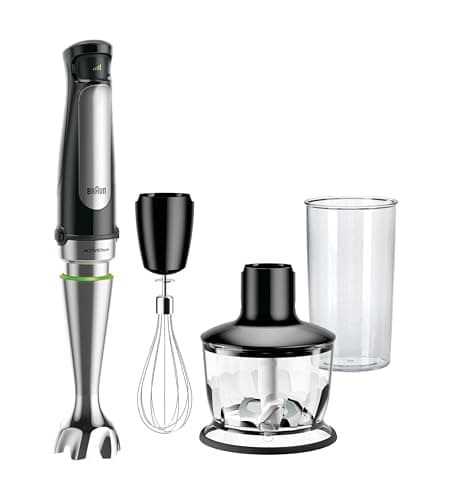
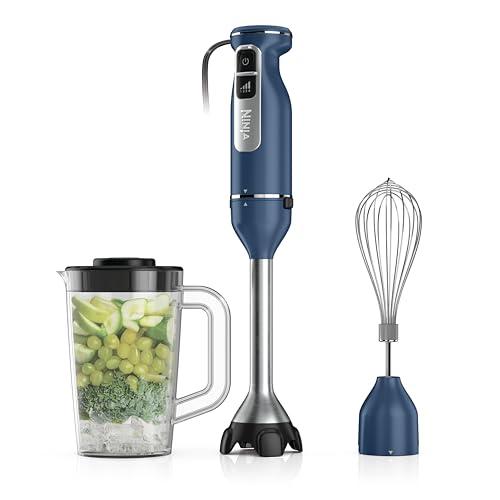
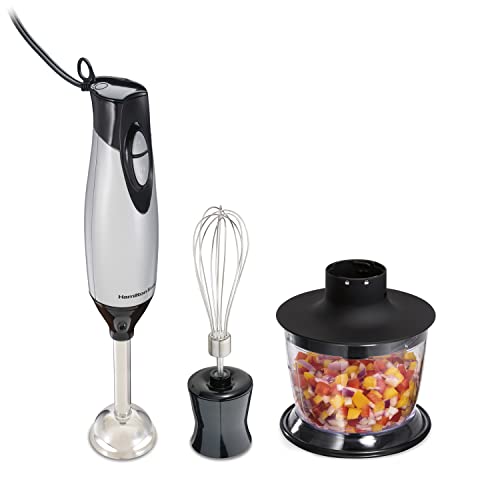
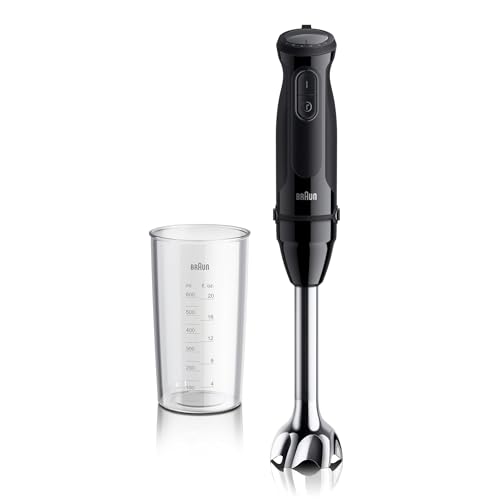
Buy the Braun MultiQuick 5 MQ50001M. In a bracket where most machines publish a wattage and a speed count of two, Braun publishes 21 speeds on a variable one-hand speed wheel, names the shaft as metal in its own specification table, and backs it with the three-year US warrantyit gives all its immersion blenders — triple what the two cheaper machines here carry. If you want the attachments as well as the control, pay a little more for the Braun MultiQuick 7 MQ7035X, which adds a chopper and a whisk. The budget pick is the Hamilton Beach 2 Speed Hand Blender, which costs a fraction of the others and is the only machine on this page whose actual rating plate we were able to read.
What we ranked on, before the picks
A stick blender is a motor, a shaft and a bell. There is very little to it, which is exactly why this bracket is so hard to shop: every listing says “powerful”, the wattages are not comparable with each other, and the photographs all look the same. So this page ignores the marketing copy and ranks on four things the makers actually write down.
- Published speed control.Not “variable” in a bullet point — a number in a specification field. One machine here publishes 21 speeds, one publishes “seamless variable speed from low to high”, one publishes four, and one publishes two. That range decides whether you can start an emulsion slowly or only switch a motor on.
- Warranty length, from the warranty document rather than the box.This is the single biggest spread on the page and the least advertised. Braun writes three years on immersion blenders. Ninja writes one. Hamilton Beach writes one — and gives three years to its countertop blenders, which is a distinction worth knowing before you assume the brand term applies.
- What is in the pack, as the maker lists it.The cheapest machine here ships a stainless wand, a stainless whisk and a 3 cup chopping bowl. The machine we rank first ships a wand and a beaker. Attachment count and price run in the opposite direction to everything else in this bracket.
- Whether the wattage figure means anything. Three of these four manufacturers publish a number you can use and one publishes a peak. We say which is which under every card rather than putting them in a column as though they were the same unit.
What we deliberately did not rank on: blade geometry, noise and build quality. Not one machine in this bracket publishes a decibel figure, a blade dimension or a shaft diameter, so any ranking on those would be invention. The full method is on how we pick.
Why the wattages on this page are not comparable
This is the trap in the whole bracket, and it is worth three paragraphs because it will save you from buying on the biggest number.
Braun publishes input power.Both Brauns here carry a data field literally labeled “Input power w”, and the MQ50001M page says “a 500-watt motor” in prose as well. Input power is what the motor draws from the socket. It is the conservative figure and the one that belongs in a running-cost sum.
Hamilton Beach publishes a nameplate maximum.Its product page says “225 watts of power”, and — unusually for this price — its own use and care guide reproduces the rating plate, which reads 120 V~ 60 Hz 225 W MAX for models 59762, 59765 and 59768. That is a ceiling, not a target. It is the most honest wattage on the page and also the smallest.
Ninja publishes a peak.The CI201 page says “750-peak-watt PowerBase” and gives no continuous figure — which is notable, because SharkNinja does publish a continuous figure on its countertop machines. The Professional Plus BN701 page states 1,200 watts continuous alongside 1,400 watts peak. Ninja knows how to publish the useful number; it has chosen not to for this stick blender. So 750 W is an upper bound and is not the same kind of figure as Braun’s 500. Our blender wattage explained page goes through the four different things brands mean by “watts”.
Who each one is for, in one line
- Braun MultiQuick 5 MQ50001M— the control pick: 21 published speeds and a three-year term, if you can live without the chopper.
- Braun MultiQuick 7 MQ7035X— the same three-year term plus a 500 ml chopper, a whisk and a beaker, for a little more money.
- Ninja Power Duo CI201— the one that whisks: a RapidWhisk head and a 4-cup vessel with a lid, on a one-year warranty.
- Hamilton Beach 2 Speed Hand Blender— the budget pick: three attachments, a readable rating plate and the lowest price in the catalog.
The warranty table, which is the real story of this bracket
Four machines within one price band, and a three-to-one spread in covered years:
- Braun — three years (US), on immersion blenders.Published in Braun’s own knowledge base by product type, and it applies to both Brauns here. Nothing else in this bracket comes close.
- Ninja — “One (1) Year Limited Warranty”, printed on the CI201 product page. The same one-year term Ninja gives its countertop blenders.
- Hamilton Beach — one yearin the US and Canada, under its general product warranty. Worth reading twice, because Hamilton Beach’s separate blender warranty page runs to three years in the US and five in Canada. The hand blenders are covered by the shorter document. If you came to this brand because you had read about a three-year Hamilton Beach warranty, that term belongs to the countertop machines, not to this one.
Blender warranties compared puts every document in this catalog side by side, and our Braun MultiQuick 7 review goes through the one place Braun’s own paperwork contradicts itself on the term.
Two machines you will see recommended that are not on this page
Both are in our catalog and both are reviewed here — they simply do not price under $100 any more, and a price-bracket page that quietly includes machines above its own bracket is not a price-bracket page.
- Breville Control Grip BSB510XL.The best-engineered bell in the category — it is vented specifically to stop the suction lock that makes cheap stick blenders infuriating — on a 280 W motor and a one-year warranty. It prices well above this bracket. Our Breville Control Grip review.
- All-Clad stainless steel immersion blender.600 W, an all-metal body and two years of parts and labor. Also above the bracket, and it leads our soap-making page for a reason that has nothing to do with food.
And two brands you would expect to see that are absent for a different reason entirely. The Cuisinart Smart Stick CSB-179 and the KitchenAid KHBV53both price inside this bracket and both are plausible picks — but cuisinart.com answers every request with a bot challenge and kitchenaid.com returns a 403, so neither machine’s specification could be read from its own maker. The retailer listings we found disagreed with each other: 300 W against 400 W on the Cuisinart, and “3-speed” against “variable” on the KitchenAid. A retailer spec table is not a substitute for the manufacturer’s, so neither is ranked. If those documents become reachable, they get added.
What these cost to run
Almost nothing, which is the one thing you can stop worrying about. At 18.16¢ per kWh and this site’s standard assumption of 3 minutes a day, 365 days a year, the 750 W peak Ninja comes to about $2.49a year as an upper bound, the 500 W Brauns to about $1.66 each, and the 225 W Hamilton Beach to about $0.75. A stick blender is also used in bursts of seconds rather than minutes, so every real figure is lower than this. The arithmetic, and how to substitute your own rate.
What we are not telling you
We have not used any of these four machines. There is no test, no timing, no decibel reading and no award behind this order — it is a ranking built from published documents: the speed count each maker commits to in a specification field, the warranty each one writes in its own terms, the attachments each one lists in the pack, and the wattage each one publishes together with what kind of wattage it is. Every one of those documents is linked below. Where a maker publishes nothing — noise on all four, shaft material on the Ninja, weight on the Hamilton Beach — this page says so instead of filling the gap.
For small-batch purees specifically, where low-speed control matters more than watts, best immersion blenders for baby food re-ranks these machines on that criterion.
How to buy a stick blender for under $100
1. Decide whether you are buying speeds or attachments
This bracket forces the choice, and it is the only decision that really matters. Under $100 you can have fine speed control (the MQ50001M’s 21-position wheel) or a box full of tools (the Hamilton Beach’s wand, whisk and chopping bowl), and only the Braun MultiQuick 7 gives you a reasonable amount of both — at the top of the bracket. Work out which one you will actually use. If you make soup, two speeds is genuinely enough. If you make mayonnaise, it is not.
2. Read the warranty for the product type, not the brand
The Hamilton Beach case on this page is the clearest illustration in the whole catalog: the same brand publishes a three-year blender warranty and a one-year general warranty, and the hand blender falls under the shorter one. Brands write warranties by product category. Find the document that names your category before you assume a term.
3. Treat wattage as a unit question, not a size question
750 peak watts and 500 input watts are not 50% apart; they are different measurements. Within this page the only safe comparisons are Braun against Braun. Across brands, use the published speed count and the warranty instead — those are stated in the same units by everybody.
4. Check that the shaft detaches, and how
Both Brauns publish an “Easy Click Plus” fitment system, the Ninja’s 9 in arm comes off its PowerBase, and the Hamilton Beach’s attachments detach. This is not a luxury: a stick blender whose shaft does not come off is a stick blender you cannot put in a dishwasher and cannot safely rinse, because the motor housing must not go near water. Immersion blender attachments explained sets out which fittings are interchangeable.
5. Expect to supply your own vessel, unless you buy the one that includes it
Braun publishes a beaker in the pack for both machines and publishes no capacity for it, which has been true of this brand for years. Ninja is the exception here: a 4-cup blending vessel with a lid, stated as such. If you want a container you can measure in, that is the one machine on this page that commits to a figure.
6. If you are blending in the pot, buy for the pot
A stick blender in a pan of hot soup is the safest way to blend something hot, and it is why this category exists — but it has rules, and the big one is that the bell stays under the surface while the motor is running. Ninja sells that problem as a feature with PanProtect and SplatterShield, described as “designed for scratch-free blending* and to prevent splatters” with the asterisk reading “(*When used as directed.)”. Read blending hot liquids safely before the first batch, whichever machine you buy.
7. Know what a stick blender will not do
No machine in this bracket will crush ice, make nut butter or blend a jar of frozen fruit, whatever the wattage suggests. If that is the job, you want a pitcher machine — the best blenders under $100 ranks the countertop machines in the same price band, and blender vs immersion blender settles which tool suits which job.